Best Lunch Spot 2 Minutes from Yabacho Station | Nagoya's Rare Wagyu Experience During Asian Games
 gotowp
Here is a number that surprised even longtime wagyu enthusiasts when they first heard it: out of roughly 500,000 wagyu cattle raised across Japan each year, only 300 belong to the Horai Wagyu breed. That is 0.06% of the entire national herd — a figure so small that most people in Japan have never encountered this beef at all, let alone visitors arriving from overseas. And yet, on a quiet second floor just two minutes from Yabacho Station in Nagoya's Osu district, those 300 heads become the story of a lifetime for travelers who know where to look.
With the Asian Games 2026 now in full swing here in Nagoya, September 14th marks one of the busiest Mondays this city has seen in years. Spectators and visitors are moving between venues, exploring neighborhoods in between events, and — crucially — searching for that one meal they will still be talking about when they get home. This article is not about where to find a quick bite near the stadium. It is about something rarer: how to turn a lunch into the kind of story your followers will ask about for years.
Who This Is For
- ✅ Travelers who want their Japan trip photos to stand out from the crowd of sushi and matcha latte posts
- ✅ Asian Games 2026 visitors looking for a memorable Nagoya lunch experience between events
- ✅ Wagyu enthusiasts curious about rare Japanese beef beyond Kobe and Matsusaka
- ✅ Anyone staying in Nagoya before or after a trip to Shirakawa-go, Takayama, or Gifu
- ✅ Foodies who believe the best travel content comes from genuine discovery, not tourist checklists
The Photograph People Can't Stop Asking About
There is a particular kind of travel photo that does something different on your feed. It is not a landmark shot. It is not a group selfie. It is something your followers look at and immediately ask: 「What is that?」
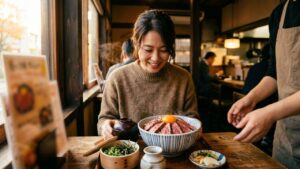
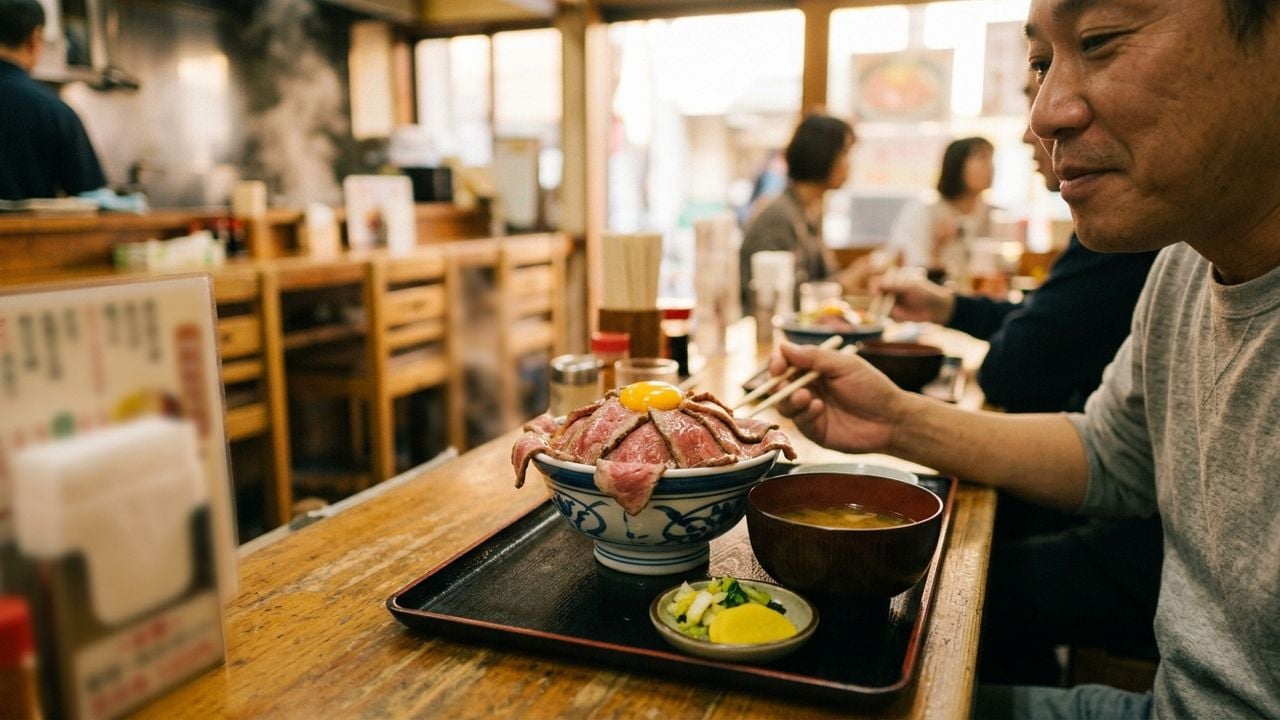
The Rare Wagyu Gyudon at Itadaki is that dish. Arranged in a traditional Japanese ceramic bowl, the thinly sliced Horai Wagyu is laid across warm rice in a way that looks almost too beautiful to disturb. A golden Nagoya Cochin egg yolk sits at the center. Scattered across the beef are shiso leaves from Toyohashi, a few strands of dried nori, and a touch of Itadaki's original 8-spice blend. The colors — deep crimson marbling against white rice, broken by the green of shiso and the amber of the yolk — are entirely natural. No staging required.
But what turns the photograph into a story is what you tell people when they ask. And Itadaki gives you more to say than almost any other dish in Nagoya.
You now know what makes Horai Wagyu so rare — but knowing whether Itadaki is open on the specific day you are visiting Nagoya is a different question entirely. Our business calendar is posted monthly on Instagram, including any irregular closures during Asian Games week. Takes about 30 seconds to check.
The Backstory That Makes Every Post Unforgettable
Masayuki Goto, who founded Itadaki in April 2022 after more than 18 years in the food and beverage industry, had a specific frustration. Premium versions of katsudon, oyakodon, and kaisendon existed. Gyudon — the humble beef bowl — had never been elevated into a fine dining experience. He asked a simple question: why not?
The answer became Itadaki's entire identity. Goto partnered directly with the three farms in Aichi Prefecture that raise Horai Wagyu — cattle fed on sake lees from 『Horaisen Sora,』 one of Aichi's most celebrated breweries. This feeding method gives the beef a flavor profile that is genuinely unlike standard wagyu: lighter marbling than Kobe, a lean sweetness that is distinctly its own. Only 300 heads are produced nationally each year. Itadaki is one of the few restaurants in Nagoya with a direct-supply relationship with these farms.
To serve this beef at the texture that defines the dish — the silky, just-cooked sensation that regulars describe as 「rare-style」 — Goto developed a proprietary two-stage cooking technique. The process brings the beef's core temperature above 70°C, meeting Japan's Ministry of Health, Labour and Welfare safety standards in full, while preserving the mouthfeel that makes the first bite genuinely startling. This technique took years to refine and is not something any other gyudon restaurant currently replicates.
When someone asks you about your photo and you say: 「This is Horai Wagyu — 300 cattle raised in Aichi Prefecture per year, fed on premium sake lees, prepared using a cooking method that was invented specifically for this dish」 — that is not a caption. That is a dinner-table story that lasts for years.
✓ Key Takeaways
- Horai Wagyu is one of Japan's rarest wagyu breeds — 300 heads per year across only 3 farms, all in Aichi Prefecture
- Itadaki's two-stage cooking technique delivers a rare-style texture while fully meeting Japanese food safety standards
- The dish is visually striking by design — every element, from the Nagoya Cochin egg yolk to the Toyohashi shiso leaves, is chosen for both flavor and presentation
With only 10 bowls of Horai Wagyu available each day and Asian Games visitors already filling the Osu area, the gap between 『I want to try this』 and 『I actually got to eat it』 comes down to one step. Reservation is handled through Tabelog — the same platform used by most of Nagoya's serious lunch spots. No account required if you book as a guest.
The Details You Won't Find on the Menu
What guests experience at the table is the result of decisions most people never notice — and that is exactly how Goto prefers it.
Take the rice. Itadaki uses 『Aichi no Kaori,』 a premium Aichi-grown variety, cooked in high-tech rice cookers that are recalibrated every year to match that year's harvest quality. The sweetness of new-crop rice behaves differently from aged rice, and the cooker settings are adjusted accordingly. The miso soup combines Hatcho miso and soybean miso from Okazaki City — a double-miso approach that creates depth without heaviness. The pickles on the side are Atsumi Ichō-zuke, a traditional variety from the Atsumi Peninsula, chosen because their mild tang cuts through the richness of the wagyu in exactly the right way.
The 『magic sauce』 — used both to briefly prepare the beef and to simmer the onions — is built on white soy sauce from Hekinan City, blended with wine. It is lighter and more aromatic than standard soy sauce, which is precisely why Goto chose it. The goal was a sauce that complements the wagyu without masking it.
Every condiment on the table is from Aichi: pickled ginger from Kimura Farm in Inazawa City, dried seaweed harvested from Himakajima in Mikawa Bay, chirimen jako from Minamichita. There is not a single ingredient on the table that was sourced outside the prefecture. For guests who care about provenance — and increasingly, that is most international travelers — this level of consistency is something you can actually feel in the meal.
「Perfect lunch during our Nagoya stay before our Shirakawa-go trip the following day.」
Guest review — Itadaki visitor
That review says something important. Itadaki is not a detour from a Nagoya itinerary. It fits naturally into the kind of trip where Nagoya is a base for deeper exploration — and the full guide to Nagoya lunch planning during Asian Games 2026 walks through exactly how to build that kind of day.
Two Minutes from Yabacho, Ten Minutes from Nagoya Station
The practical side of getting here during Asian Games week is straightforward. Itadaki is on the second floor of the building at 4-1-20 Osu, Naka-ku — a four-minute walk from Yabacho Station Exit 4 on the Meijo Subway Line, which is just two minutes from where most guests are standing when they arrive at the Osu area.
From Nagoya Station, take the Higashiyama Line to Sakae, transfer to the Meijo Line, and get off at Yabacho. Total transit time: approximately 10 minutes. During Asian Games 2026, the subway is almost always the faster option — and Yabacho connects directly to several venues without requiring a transfer.
Itadaki is open Monday, Tuesday, Saturday, and Sunday from 11:00 to 15:00, with last order at 14:30. On public holidays, the kitchen opens at 9:00. September 14th is a Monday, which means Itadaki is open today — and during a week when many restaurants in the city center are operating at full capacity, that matters.
One thing worth knowing before you arrive: the Horai Wagyu is limited to 10 bowls per day. During Asian Games week, those bowls are filling up earlier than usual. If you are weighing whether to book in advance or take your chances on a walk-in during this period, reservation via Tabelog is the safer call. The Mikawa Beef Rare Wagyu Gyudon is always available and equally worth your time — but if Horai Wagyu is the story you want to tell, securing a reservation is the honest advice.
Menus are available in English, Simplified Chinese, and Korean. A photographic five-step guide explains exactly how to enjoy the dish in sequence — from separating the egg to the final wasabi note. You do not need Japanese to navigate the experience.
For guests who like to plan the full picture of an Osu afternoon, this guide to exploring Osu's subculture district around a rare wagyu lunch covers the neighborhood in detail.
A Story Worth Telling Before You Leave
Travel content that lasts is built on two things: a moment that genuinely surprised you, and the knowledge to explain why it matters. Itadaki was designed to deliver both.
Goto named the restaurant after 『itadakimasu』 — the Japanese expression of gratitude spoken before every meal. The philosophy behind that word is that food is a gift: from the farmers who raised it, the land that produced it, and the craft that transformed it. Every element of this bowl reflects that belief, from the sake-lees-fed cattle in Okumikawa to the ginger picked at Kimura Farm in Inazawa.
The Asian Games bring the world to Nagoya this September. And somewhere between the opening ceremony and the next event on your schedule, there is a two-minute walk from Yabacho Station that leads to a bowl of something genuinely rare — a dish with a story your followers have never heard, and a flavor they have never tasted.
For our complete menu, access details, and store information, visit our official page at https://itadaki8.com/english/
The story behind this bowl — 300 heads per year, sake lees from Aichi's finest brewery, a cooking technique invented specifically for this dish — is already worth sharing. The seat that makes it yours is one reservation away. Tabelog online booking takes under two minutes.