Hidden Gem Wagyu: Discovering Nagoya's Best-Kept Secret
 gotowp
Here's the bottom line: you do not need to speak a word of Japanese to fully enjoy one of Nagoya's most remarkable culinary experiences. That's the honest answer to one of the questions we hear most often at Itadaki — and it's worth saying clearly before anything else.
Language anxiety is real. Across our four years in Osu, we've heard the same concern from visitors time and again: "I'd love to try authentic local restaurants, but I'm nervous about not understanding the menu or being able to communicate with the staff." It's a worry that keeps many travelers inside familiar international chains — and away from the kinds of experiences that become the true highlight of a Japan trip.
What follows is a look at how our guests actually experience Itadaki — told through their own words — and what we've put in place to make sure every visitor, regardless of language background, can walk in, order with confidence, and leave with a story worth telling.
Who This Is For
- ✅ Foreign visitors to Nagoya who feel nervous about dining at Japanese-only restaurants
- ✅ First-time visitors to Japan who want an authentic local experience without the stress of a language barrier
- ✅ Travelers who have already tried well-known wagyu brands and are curious about Aichi's hidden gems
- ✅ Solo diners, couples, and families who want to understand exactly what they're eating — and how to enjoy it properly
- ✅ Anyone who has wondered: "Will I actually be able to order here?"
The Voice That Started This Conversation
One piece of feedback from a recent guest has stayed with us more than most:
"The five-step eating guide made the dish even more enjoyable and memorable."
That single sentence says something important. The guest didn't write about the wagyu alone, or the rarity of Horai Wagyu — though both are extraordinary. What made the experience more enjoyable and memorable was understanding how to eat it. The guide transformed a beautiful bowl of food into a purposeful journey.
That's exactly what we set out to create. When founder Masayuki Goto developed the concept for Itadaki in 2022, the question wasn't only "how do we serve rare wagyu gyudon safely?" — it was also "how do we make sure every guest, from anywhere in the world, can experience this the way it's meant to be experienced?"
You now know the menu is in English and the five-step guide is printed right on it — but the one thing no article can tell you is whether Horai Wagyu will still be available on the day you visit. Our Instagram carries the monthly business calendar and real-time updates on availability. A quick check takes under a minute.
What's Actually in the Multilingual Menu — and Why It Matters
Every table at Itadaki receives a fully printed menu in English, Simplified Chinese, and Korean. Not a QR code that links to a machine-translated webpage. A physical, designed, photographed menu you can hold in your hands and point to.
The menu includes:
- Clear photos of every dish, so you know precisely what you're ordering before it arrives
- Prices listed in Japanese yen with no hidden charges
- Ingredient explanations for each dish — particularly useful for guests with food concerns
- A dedicated allergen section (soy, wheat, egg, sesame are all noted clearly)
- The five-step visual guide: "How to Enjoy Rare Gyudon"
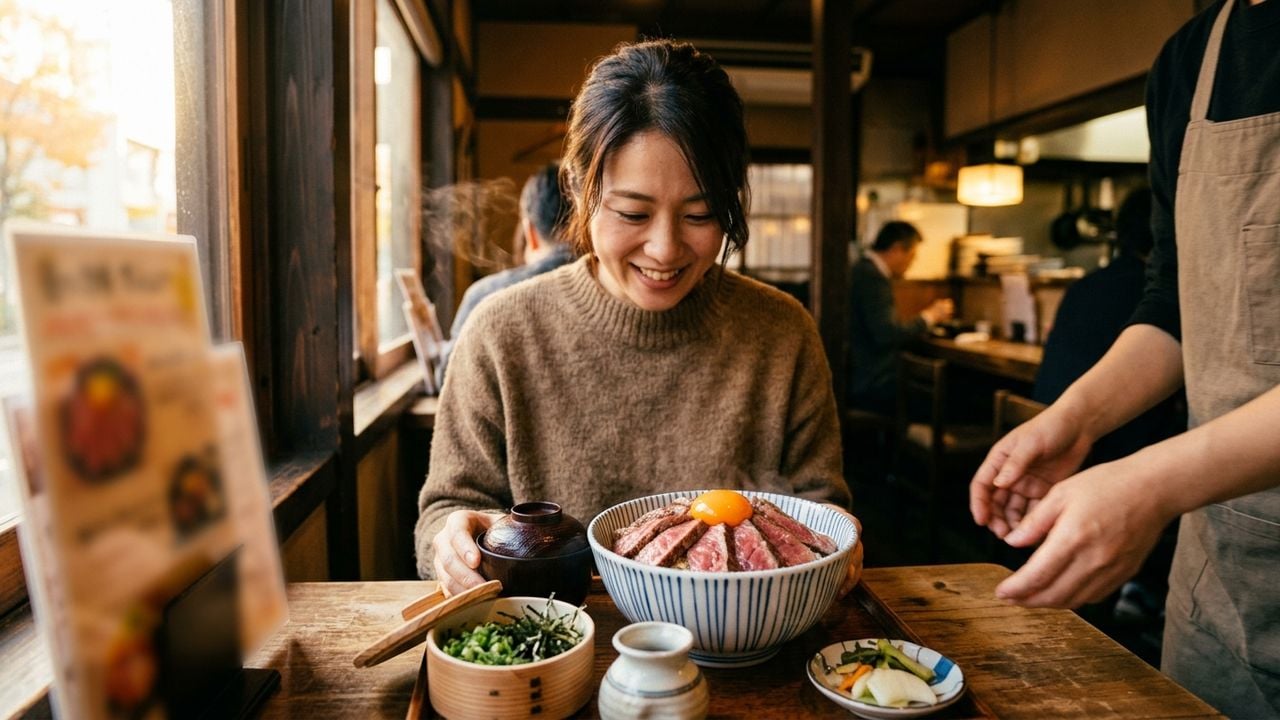
That last item is the one most guests mention. The five-step guide walks you through the entire ritual of eating a Rare Wagyu Gyudon — from separating the raw Nagoya Cochin egg (white into the miso soup, yolk atop the beef), to enjoying the wagyu in its purest form first, to mixing the golden yolk through, to layering in the complimentary condiments (pickled ginger, dried nori seaweed, chirimen jako, and Itadaki's original 8-spice blend), and finally finishing with a touch of wasabi for a clean, refreshing close.
Without that guide, a first-time guest might simply mix everything together immediately. The guide is what turns the bowl into a sequence — and sequences, it turns out, are what guests remember long after the flavors have faded.
If you're curious about what the full experience looks like from a traveler's perspective, this piece on finding an English-friendly wagyu restaurant near Nagoya Station gives a useful overview of what to expect before you arrive.
✓ Key Takeaways
- Itadaki's multilingual printed menu in English, Simplified Chinese, and Korean removes the language barrier entirely — no Japanese needed to order or understand what you're eating.
- The five-step visual guide included in the menu is what guests consistently cite as transforming the meal from a dish into a full experience.
- Allergen information (soy, wheat, egg, sesame) is clearly noted — guests with dietary concerns can review the menu at the table before ordering.
The English menu removes the language barrier, but the 10-bowl daily limit on Horai Wagyu is a different kind of obstacle — one that no menu can solve after the fact. Securing your spot in advance via Tabelog means you arrive knowing the bowl is waiting for you. The reservation form is available in a few taps.
"The English Menu Made It Stress-Free" — More From Our Guests
The five-step guide comment isn't an isolated one. Here's another piece of feedback that reflects what we hear regularly:
"The English menu with clear serving instructions made the experience stress-free."
"Stress-free" is the exact opposite of what many visitors fear when they consider stepping into an authentic local specialty restaurant in Japan. The mental image is: a hand-written menu in kanji, a staff member waiting for an order while you fumble through Google Translate, the quiet dread of ordering the wrong thing.
At Itadaki, the printed menu is designed specifically to prevent that scenario. You can take your time. You can point at a photo. You can read the ingredient list in your own language. And if you'd like to use a translation app for additional questions, the relaxed pace of our lunch service makes that completely comfortable.
Our staff are genuinely welcoming to international visitors — not just politely tolerant, but actively pleased to see guests who've made the effort to find us in Osu. We're a small restaurant (18 seats, open only on Saturdays, Sundays, Mondays, and Tuesdays for lunch), so the atmosphere is never rushed. You are not moving through a conveyor belt. You are a guest.
Practical Notes for Your Visit: What to Know Before You Walk In
A few honest, practical details that help international visitors plan with confidence:
Getting here: Itadaki is a 4-minute walk from Yabacho Station Exit 4 on the Meijo Subway Line. From Nagoya Station, it's roughly 10 minutes total — take the Higashiyama Line to Sakae, transfer to the Meijo Line, and get off at Yabacho. Sakae Station, Kamimaezu Station, and Osu Kannon Station are also within walking distance.
Horai Wagyu availability: Our signature Horai Wagyu — produced by only 3 farms in Japan, with just 300 heads raised annually — is strictly limited to 10 bowls per day. It can sell out during peak hours. Reservation via Tabelog is strongly recommended if you specifically want to experience Horai Wagyu. If Horai Wagyu is unavailable on the day, Mikawa Beef Rare Wagyu Gyudon (starting at ¥1,800) is always available.
Hours: Lunch only — 11:00 to 15:00 on Saturdays, Sundays, Mondays, and Tuesdays (last order 30 minutes before closing). On public holidays, we open at 9:00. Irregular closures can happen — our official Instagram carries the monthly business calendar.
Dining alone: Five counter seats make Itadaki one of the more comfortable solo dining options in the Osu area. Plenty of guests visit alone, including business travelers who've discovered us while working in Nagoya. If you'd like to read more on that experience, this article on what makes Itadaki a standout option for solo visitors near Sakae covers it in more detail.
Accessibility: Itadaki is located on the 2nd floor, accessed by staircase. Strollers can be brought into the restaurant, and staff may assist with carrying where possible — though this cannot be guaranteed depending on conditions at the time.
Payment: Credit cards, Apple Pay, and Google Pay are accepted.
The Detail That Changes Everything: Every Ingredient Tells a Story
One more thing that the English menu communicates — and that guests consistently respond to — is the story behind each ingredient. Because everything at Itadaki comes from Aichi Prefecture, the menu isn't just a list of items. It's a map of a region.
The Nagoya Cochin egg you separate at the start of the five-step ritual comes from Yamada Poultry Farm. The pickled radish — Atsumi Ichō-zuke — comes from the Atsumi Peninsula. The shiso leaves (Aikei No.1 variety) are grown in Toyohashi. The miso soup base uses Hatcho miso from Okazaki City, with Atsumi aosa seaweed and black nori floating at the surface.
When that context is explained in your own language, the bowl becomes something different from a meal. It becomes an introduction to a prefecture most international travelers have never explored in depth. Guests who've made Nagoya a stop on their way to or from the Hida region — Shirakawa-go, Takayama — often tell us that Itadaki reframed how they thought about Aichi entirely. If that sounds like your itinerary, the story of how Hida region travelers discover Aichi's rare wagyu at Itadaki might resonate before you visit.
Goto's philosophy when he founded Itadaki — naming it after "itadakimasu," Japan's expression of gratitude before eating — was always about respect: for the farmers, for the ingredients, and for the guest's experience of both. The multilingual menu isn't a translation convenience. It's an invitation, written in your language, to understand where every bite comes from.
For our complete menu, access details, and store information, visit our official page at https://itadaki8.com/english/
You came here wondering whether you'd be able to order and enjoy the meal without Japanese — and the answer is yes, clearly and confidently. The next step is making sure Horai Wagyu is on the table when you arrive, not sold out by the time you walk up the stairs. Reserve your bowl now via Tabelog before the 10 daily slots fill.