Asian Games 2026 Nagoya Food Guide: Local Aichi Beef You Can Only Try Here
 gotowp
You've been planning this Japan trip for months. You've sorted your match tickets, mapped out your days around venues, and packed more than you probably need. And somewhere between scheduling athlete dinners and lining up your Nagoya sightseeing, a question surfaces that no travel app quite answers: Where do I eat something I will actually remember for the rest of my life?
Not another wagyu steak. Not a conveyor belt sushi lunch squeezed between events. Something that exists only here — in this city, at this moment — and nowhere else on earth. That's the meal worth finding.
If that sounds like what you're after, this guide is for you.
Who This Is For
- ✅ Asian Games 2026 visitors who want at least one meal that becomes a story — not just a dining stop
- ✅ Wagyu enthusiasts who have tried Kobe and Matsusaka beef and are ready to discover what Aichi has been quietly raising
- ✅ Repeat visitors to Japan who know the tourist trail well and are actively looking beyond it
- ✅ Travelers curious about Aichi's food culture — ingredients, producers, and techniques you simply cannot find outside this prefecture
- ✅ Anyone wondering whether a beef bowl could ever be worth writing home about
Aichi Doesn't Just Host the Games — It Raises Some of Japan's Rarest Beef
Most international visitors associate wagyu with two names: Kobe and Matsusaka. Both are exceptional. Both are also well-documented, photographed from every angle, and available in restaurants from Tokyo to Singapore. If you've already had them, you know what to expect.
Aichi Prefecture operates quietly on a different level. The Okumikawa mountain region — tucked into the inland highlands of the prefecture — is home to a wagyu breed called Horai Wagyu. It's raised across just three farms in Japan. Annual production sits at roughly 300 heads. To put that in perspective: Japan raises approximately 500,000 wagyu cattle each year. Horai Wagyu represents a fraction so small it barely registers on any national chart.
What makes it distinct isn't scarcity alone. The cattle are fed on sake lees from Horaisen Sora, a renowned local premium sake brewed in the same mountain region. This gives the beef a flavor profile that combines delicate marbling with pronounced lean-meat character — a combination that's genuinely uncommon even within the wagyu world.
You cannot order Horai Wagyu through a distributor. You cannot find it in most Nagoya restaurants. Access comes through direct relationships with the farms themselves — and in the Osu district of Nagoya, one restaurant has built exactly that relationship since 2022.
The Asian Games schedule is unpredictable — match days shift, plans change, and a restaurant with just 10 bowls of Horai Wagyu per day fills up faster than you'd expect during the Games period. Itadaki publishes its monthly business calendar on Instagram so you can confirm exactly which days are open before you build your lunch plan around it. Take a look before your schedule locks in.
The Restaurant That Invented a New Category of Japanese Cuisine
Itadaki — The Original Rare Wagyu Gyudon — opened in Osu in April 2022, founded by Masayuki Goto, who had spent the previous decade running MAX'S BAR and watching Aichi's small food producers struggle through the pandemic with unsold harvests. His response was to build a restaurant concept around direct farm sourcing, designed to support those producers long-term.
The concept he landed on surprised even people familiar with Japanese cuisine. Gyudon — the humble beef bowl — is one of Japan's most universally recognized comfort foods. It's available at chain restaurants across the country for a few hundred yen. Goto looked at it differently: why does every other donburi have a premium version — kaisendon, oyakodon, katsudon — but gyudon has never crossed into that territory?
The answer became Itadaki's signature: Rare Wagyu Gyudon. Using Horai Wagyu, a proprietary two-stage cooking technique that heats the beef to over 70°C at the core to fully meet Japan's food safety standards, and every single ingredient sourced from Aichi Prefecture, Goto created a category of Japanese cuisine that simply did not exist before. NHK and seven other major Japanese television networks have since covered it as exactly that — the originator of something new.
The name Itadaki comes from itadakimasu, the expression spoken before meals in Japan — a word of gratitude to the farmers, the land, and everyone who made the food possible. That philosophy runs through every bowl served here.
✓ Key Takeaways
- Horai Wagyu is produced by only 3 farms in Japan, with just 300 heads raised annually — its availability in Nagoya is genuinely rare
- Itadaki invented the "Rare Wagyu Gyudon" concept, combining Japanese food safety compliance with a rare-style eating experience found nowhere else
- Every ingredient on the table — beef, rice, egg, pickles, sauce, even the ginger — comes from Aichi Prefecture
You now know why Horai Wagyu is genuinely rare — 300 heads a year across three farms — and why 10 bowls a day disappears faster than most visitors expect on Asian Games weekends. The Tabelog reservation page lets you secure your bowl before you arrive in Nagoya, so the scarcity doesn't become a disappointment on the day.
What the Experience Actually Looks Like
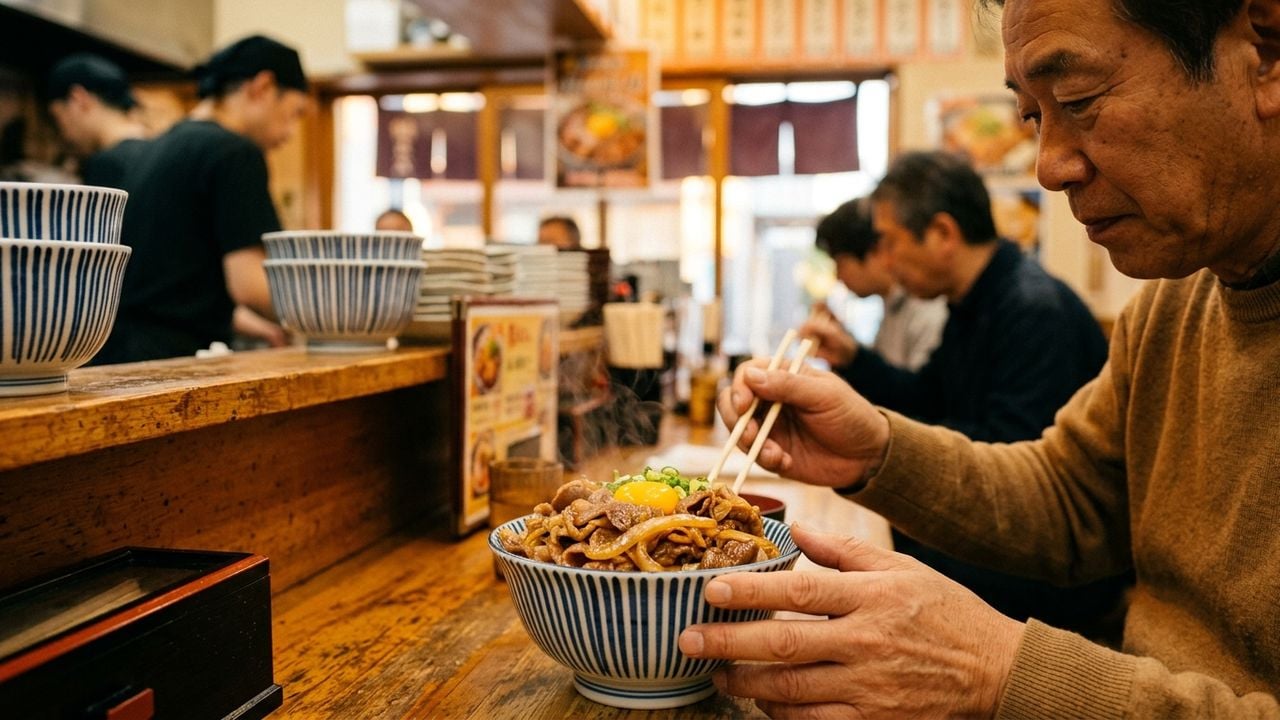
The bowl arrives as a deliberate composition. Aichi no Kaori rice at the base, the Horai Wagyu arranged across it in a rare-style preparation, a raw Nagoya Cochin egg — sourced from Yamada Poultry Farm — placed on the side. The miso soup alongside is made with Hatcho miso from Okazaki City, with Atsumi aosa seaweed floating on the surface. A set of condiments sits at the table: pickled ginger from Kimura Farm in Inazawa, chopped seaweed from Himakajima island in Mikawa Bay, chirimen jako from Minamichita, and Itadaki's original eight-spice blend.
The restaurant provides a five-step guide — printed and available in English — that walks you through the intended sequence: first, separate the egg, placing the white into your miso soup and the yolk atop the beef. Eat the wagyu in its purest form first. Mix in the yolk. Then begin layering the condiments. Finish with wasabi. Each step changes the flavor profile of the bowl, making it less a single dish and more a tasting journey within a single serving.
The Shinkoccho — the standard size featuring Horai Wagyu, with 100g of beef and 200g of Aichi no Kaori rice — is priced at ¥2,700. It is limited to 10 bowls per day. On event days and weekends during the Asian Games period, selling out before noon is likely.
For guests who want to experience the Horai Wagyu in a different form, the Teppen side plate (50g, ¥800) offers the same beef prepared with a distinct cutting and searing technique, giving it a noticeably different character from the gyudon itself.
If Horai Wagyu is unavailable, Mikawa Beef — raised in Aichi's Mikawa region on okara feed with lactic acid bacteria gut management — is always on the menu, starting from ¥1,800 for the Fumoto size. It is a different wagyu entirely, with its own distinct story.
"The staff were welcoming and made us feel at home even without perfect Japanese."
— Guest review, Itadaki
The language barrier is one of the things visitors to Japan worry about most. At Itadaki, printed menus are available in English, Simplified Chinese, and Korean, and the five-step eating guide is visual enough that it communicates across any language. Goto's years of welcoming international guests — a passion shaped by his own love of discovering food cultures abroad — shows in how the restaurant is set up. You will not feel like an outsider here.
Getting Here During the Asian Games: Practical Details
Itadaki is located on the second floor of a building in Osu, a four-minute walk from Yabacho Station Exit 4 on the Meijo Subway Line. If you're staying near Sakae or traveling from Nagoya Station, the journey takes roughly 10 minutes by subway. The Osu district itself is well worth the detour: Osu Kannon Temple, the 1,200-shop Osu Shopping Street, and the free-admission Hisaya-odori Garden Flarie (three minutes from Yabacho Station) are all within easy walking distance. If you're looking for lunch options during Asian Games 2026 in the city center rather than near the venues, this comparison of venue lunch vs. city center dining in Nagoya may help you plan your day more effectively.
During the Asian Games and Para Games period, Itadaki operates on its regular schedule: Monday, Tuesday, Saturday, and Sunday, 11:00–15:00. Public holidays open at 09:00 and close at 15:00. Last order is 30 minutes before closing. The restaurant is closed Wednesday, Thursday, and Friday — no exceptions. Irregular closures do occur; the monthly business calendar is published on the official Instagram account.
Seating is 18 in total, with comfortable sofa-style tables throughout. Counter seats are available for solo diners. No private rooms. No dinner service.
Reservation is available via Tabelog online. For Horai Wagyu specifically — limited to 10 bowls per day — reserving in advance is strongly recommended during the Games period. Walk-ins are welcome when seats are available, but availability for Horai Wagyu cannot be guaranteed for walk-in guests on busy days.
For groups considering a full restaurant buyout during the Asian Games — corporate lunches, team gatherings, or celebration meals — Itadaki can accommodate up to 18 guests. Please inquire via Instagram DM in advance. If you're looking for broader guidance on dining around the Asian Games period in Nagoya, the complete guide to Nagoya lunch during Asian Games 2026 covers a range of options and planning tips worth reading before you finalize your schedule.
The Story You'll Carry Home
The most lasting travel memories are rarely the biggest or most expensive moments. They're the ones where something unexpected happened — where you discovered a story you hadn't gone looking for.
300 heads of wagyu per year, fed on sake lees from a mountain brewery, prepared using a technique developed by one restaurant to safely deliver an experience that didn't exist before 2022 — that's not a story you'll find packaged on a tour itinerary. It's the kind of thing you tell people when you get home, and they ask: wait, how did you even find that?
Itadaki is in Osu. It serves lunch. It's limited. And it's exactly the kind of meal that makes a trip to Japan feel like more than a checklist.
For our complete menu, access details, and store information, visit our official page at https://itadaki8.com/english/
You came to Nagoya for the Asian Games, but the meal that stays with you longest might have nothing to do with the scoreboard. Horai Wagyu — the rarest Aichi beef, in the only restaurant that invented this way of serving it — is waiting, 10 bowls at a time. Secure yours through Tabelog before the Games crowd gets there first.