Venue Lunch vs City Center Nagoya During Asian Games 2026
 gotowp
A few weeks ago, a visitor from Hong Kong stopped by after her morning session at the games. She sat down, ordered, and at the end of the meal said something that has stayed with me: "I almost just grabbed something at the venue food court. I'm so glad I didn't."
She had made the short trip into the city center — into Osu — specifically because a local she'd met on the subway had pointed her this way. She wasn't looking for convenience. She was looking for the kind of lunch that becomes a story. That's a very different thing.
With the 2026 Asian Games in Nagoya now underway, I've been having this conversation a lot. Spectators and visitors face a genuinely real choice between eating at or near the venue and making a short detour into Nagoya's city center. So I want to lay out both options honestly — because the right answer depends entirely on what kind of experience you're after.
Who This Is For
- ✅ Asian Games spectators deciding whether to eat near the venue or venture into Nagoya's city center
- ✅ Repeat visitors to Japan who want to find a lunch spot locals actually go to — not just something convenient
- ✅ Travelers from Hong Kong, Taiwan, or elsewhere who value personal discovery over guidebook defaults
- ✅ Anyone who wants their Nagoya lunch to be a story worth telling — not just fuel between sessions
- ✅ Visitors with 60–90 minutes between events who are wondering if a city center detour is worth it
What Venue Dining Actually Looks Like During Asian Games 2026
Let's be fair about this. Eating at or near the competition venues has real advantages — and I don't want to pretend otherwise.
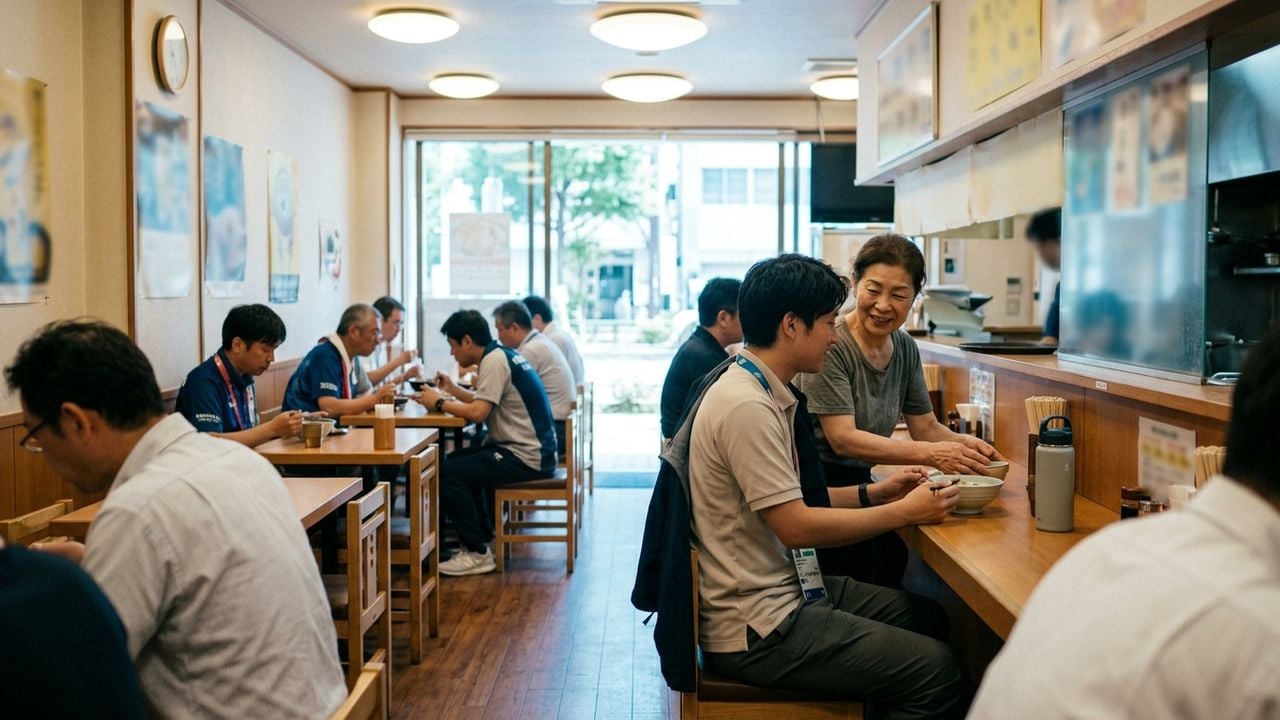
If your schedule is tight, if you're with a large group that needs to stay together, or if you simply don't want the cognitive load of navigating a new area between sessions, staying close to the venue is completely reasonable. Food courts and nearby convenience options exist for exactly this reason, and they do the job.
But here's what I hear consistently from visitors who take that route: it's forgettable. Not bad — just forgettable. The kind of meal where three days later you can't quite remember what you ate, because it wasn't designed to be remembered. It was designed to be fast.
For first-time visitors to Japan — especially those on a packed schedule seeing multiple cities in a week — that trade-off makes sense. But if you've been to Japan before, if you've already done the convenience meals, if you're the kind of person who is now actively looking for what the guidebooks haven't found yet — venue dining is probably not going to give you what you came for.
You're weighing a genuine choice — venue convenience vs. the kind of city-center lunch that becomes a story — and you need to know whether Itadaki is actually open on the day you're planning to go. Our monthly business calendar on Instagram shows exact open days for August and September, including any irregular closures during the Asian Games period. Takes under a minute to check.
What the City Center Actually Offers — Specifically Osu
Nagoya's city center is not a single place. It's a collection of very different neighborhoods, each with its own character. And for the Asian Games visitor who wants to maximize both the sports and the food, the neighborhood that makes the most practical sense is Osu.
Osu is not the neighborhood you'll find in most international guidebooks. That's precisely the point. It's a dense, layered district — Buddhist temples next to vintage electronics shops, traditional craft stores next to cafés that have been here for decades. The 1,200-shop Osu Shopping Street runs through the middle of it, and Osu Kannon Temple anchors its northern edge. It's a neighborhood that Nagoya residents actually use — not a set-piece designed for tourism.
From the main Asian Games venues, the Osu area is accessible by Nagoya's subway network in a manageable window. The Meijo Line connects directly, and Yabacho Station puts you right at the edge of the district. A 60–90 minute lunch window, which falls naturally between morning and afternoon sessions, is realistic.
The question is: what do you do with that time?
The answer that repeat visitors keep coming back to is: find the specialty restaurant. Not a general dining hall, not a place that serves everything. A place that has committed entirely to doing one thing — and does it better than anyone else.
✓ Key Takeaways
- Venue dining works well for visitors with tight schedules or first-time visitors to Japan — but it rarely creates a memorable story.
- Osu, Nagoya's most characterful city-center district, is accessible by subway and offers the kind of specialty dining that repeat Japan visitors specifically seek out.
- The real question isn't "venue or city" — it's "what kind of lunch experience do I actually want from this trip?"
The Horai Wagyu bowls are limited to 10 per day, and with Asian Games sessions ending at similar times for many spectators, those 10 bowls don't last long into the afternoon. If your plan is to make the city-center detour during the games, securing a reservation via Tabelog is the one step that turns the plan into a certainty.
The Kind of Place Locals Mean When They Say "This Is Where I Really Eat"
When the Hong Kong visitor I mentioned earlier described what she was looking for, she used a phrase I hear often: "A place where locals really eat." It's a specific feeling — the sense that you've stepped off the tourist path and into something genuine.
That's what drew her to Itadaki, our specialty restaurant in Osu. We do one thing: Rare Wagyu Gyudon — Japan's traditional beef bowl, reimagined using premium wagyu from Aichi Prefecture's own farms, prepared with a proprietary two-stage cooking technique that delivers a rare-style texture while fully meeting Japan's food safety standards.
We're not featured in mainstream English guidebooks. We're a lunch-only restaurant, open four days a week (Saturday, Sunday, Monday, and Tuesday), with 18 seats and a deliberate focus on quality over volume. The beef we serve — Horai Wagyu from the Okumikawa region of Aichi — is produced by just three farms, with only 300 heads raised annually across all of Japan. Out of roughly 500,000 wagyu cattle in this country, 300 are Horai Wagyu. We source directly from those farms.
That's not a marketing story. That's just the reality of what we serve.
The Horai Wagyu option is limited to 10 bowls per day, and we do recommend reserving via Tabelog if you're planning to visit during Asian Games — sessions end at similar times for many spectators, and peak hours can see these bowls sell out. But the Mikawa Beef Rare Wagyu Gyudon (always available) is also a genuine Aichi experience, starting from ¥1,800, and many visitors who initially came for the Horai Wagyu have told us the Mikawa bowl surprised them just as much.
"The lunch was the highlight of my Nagoya trip — I'm telling all my friends about it."
— A guest who visited Itadaki during their Nagoya stay
That's the kind of lunch the city center can offer that the venue food court simply cannot.
If you're curious about how other Asian Games visitors have planned their Nagoya lunches around the event schedule, our complete guide to Nagoya lunch during Asian Games 2026 breaks down timing, access, and how to plan around your sessions. And for a more personal look at what this experience has meant to visitors, this story of one guest's rare wagyu lunch during the games gives a good sense of what to expect.
How to Make the City Center Detour Actually Work
The practical concern I hear most often is timing. "I only have about 90 minutes between my morning session ending and needing to be back." That's a real constraint, and I want to be honest with you about what's achievable.
From the Yabacho Station area (where Itadaki is a 4-minute walk from Exit 4 of the Meijo Line), the journey back to most of the Nagoya venues used for Asian Games events is well within a 20–30 minute window by subway. That leaves a comfortable 60 minutes for lunch — enough time to sit, eat, and experience the meal properly without rushing.
What I'd suggest, based on what our guests have found works well: plan the detour for the mid-Games window, not the first day. Your first day, when you're still figuring out venue logistics, is not the moment to experiment with a new neighborhood. Once you have a session or two under your belt and know your rhythms — that's when the city center lunch becomes not just possible, but genuinely enjoyable.
A few practical notes if you're planning a visit to Itadaki during this period:
- We are open Saturday, Sunday, Monday, and Tuesday only — 11:00 to 15:00 (last order 14:30). Check our monthly calendar on Instagram before you plan, as irregular closures can occur.
- Reservations for Horai Wagyu are strongly recommended via Tabelog, given the 10-bowl daily limit.
- English menus are available, and our team is used to welcoming international visitors. No Japanese required.
- All seating is sofa-style, which makes a relaxed, unhurried lunch easy — even if you're arriving straight from a session.
You can also read about where to eat lunch during Asian Games 2026 in Nagoya for a broader look at options across the city, if you're still mapping out your week.
Which Option Is Actually Right for You
Here's the honest version of the comparison:
Choose venue or nearby dining if: You're visiting Japan for the first time, your schedule between sessions is genuinely under 60 minutes, or you're traveling with a large group that doesn't want to navigate transit together.
Choose the city center — and specifically Osu — if: You've been to Japan before, you know what a good meal can feel like in this country, and you want to come home with a story that's yours. Not a photo of a popular destination everyone else has taken. A discovery — the kind where you find yourself, like the visitor from Hong Kong, telling your friends exactly where to go the next time they're in Nagoya.
The Asian Games will give you world-class sport. What you choose to eat in between is one of the few parts of the trip that's entirely your own.
For our complete menu, access details, and store information, visit our official page at https://itadaki8.com/english/
You've read what the city center lunch can actually offer that the venue food court cannot — now it comes down to one decision. The 10 daily Horai Wagyu bowls will not wait, and neither will the best window in your Asian Games schedule. Reserve your bowl now via Tabelog and make this the lunch you'll still be talking about when you get home.