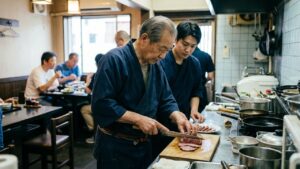
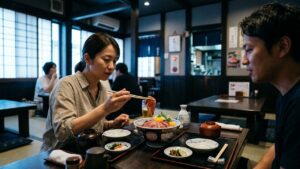
Warlord City Lunch: Where History Fans Discover Nagoya's Rare Wagyu
 gotowp
You've spent the morning walking the stone paths of Nagoya Castle, standing in the shadow of the keep where Oda Nobunaga once strategized. You've felt the weight of the Sengoku era under the summer heat of Aichi, and now you're hungry — genuinely hungry — and you want a lunch that feels like it belongs to this city. You pull out your phone, search for something worth crossing the district for, and a place called Itadaki keeps appearing. Rare wagyu gyudon. Aichi ingredients. Limited to 10 bowls a day. It sounds exactly right.
Then you look at the map. Osu district. A tangle of covered arcades, side streets, and passages that seem to loop back on themselves. The restaurant is on a second floor. You wonder: Will I even find it?
That question stops more visitors than the price tag ever does. This article is written specifically for you — the traveler whose day is already full of Nagoya history and doesn't want to spend the precious lunch window wandering in circles.
Who This Is For
- ✅ Samurai history enthusiasts who have visited or are planning to visit Nagoya Castle, Atsuta Shrine, or Inuyama Castle
- ✅ First-time visitors to Osu district who find the maze of covered arcades confusing to navigate
- ✅ Travelers who want a lunch destination worth the small detour — not just the nearest convenience
- ✅ Visitors heading onward to Shirakawa-go or Takayama who want to make the most of their Nagoya day
- ✅ Anyone who has heard about rare wagyu in Nagoya and wants clear directions, not just a pin on a map
Why History Travelers Keep Ending Up in Osu
Nagoya's identity as Japan's "Warlord City" — birthplace of Nobunaga, Hideyoshi, and Ieyasu — draws a particular kind of traveler. People who go to Nagoya Castle don't just take a selfie with the golden shachihoko and leave. They read the exhibit panels. They stand in the reconstructed Honmaru Palace and try to understand the scale of what was built here. By the time they're done, it's past noon, and they want something that feels connected to the place.
Osu is a natural next stop. Located between Nagoya Castle and Kanayama on the Meijo Line, it's the kind of neighborhood that rewards curiosity — Osu Kannon Temple with 400 years of history, the long covered arcade of Osu Shopping Street, vintage shops tucked between maid cafés. History and modern Nagoya layered on top of each other.
That's also where Itadaki sits: in Osu, on the second floor of a building a 4-minute walk from Yabacho Station, serving a gyudon that uses only ingredients from Aichi Prefecture — the same land that fed samurai armies and shaped Japan's culinary identity. If that sounds like a stretch, consider that Hatcho miso, which forms the base of Itadaki's miso soup, has been produced in Okazaki — Tokugawa Ieyasu's birthplace — for over 600 years. Everything in the bowl has roots here.
For those curious how Itadaki fits into a broader day of Nagoya sightseeing, this account of combining samurai history and rare wagyu in a single Nagoya day maps out one natural itinerary that works well.
Itadaki is open only on scheduled business days, and irregular closures do happen — which makes a quick check essential before you build your Nagoya day around a lunch here. The monthly business calendar is posted there so you can confirm your date before you plan. Takes about 30 seconds.
The Part Nobody Tells You: How to Actually Get There
Getting to Itadaki is genuinely simple — once you know the two key pieces of information that most visitors are missing.
The station: Yabacho, Meijo Subway Line, Exit 4. From there, Itadaki is a 4-minute walk. That's it. If you're coming from Nagoya Station, take the Higashiyama Line toward Fujigaoka, get off at Sakae (two stops, about 4 minutes), transfer to the Meijo Line, and ride two more stops to Yabacho. Total travel time: approximately 10 minutes. No taxis, no rental bikes, no guesswork.
Yabacho Station is also within easy reach if you're coming from Osu Kannon Station or Kamimaezu Station on foot — the Osu Shopping Street connects these areas in a long covered corridor, so you can walk through the arcade and arrive at the restaurant as a natural end point of your Osu stroll.
The landmark: look for the sign that reads「元祖レア牛丼 頂」at street level. Pronounced "Ganso Rea Gyudon Itadaki," this is the Japanese signage for The Original Rare Wagyu Gyudon — Itadaki. When you see it, take the stairs to the 2nd floor. The entrance is not behind a large storefront; it's above street level, which is why many visitors walk past it without realizing. Once you know to look for the staircase, it's unmistakable.
A Google Maps link is available on our website for direct navigation from wherever you're starting your day. If you're arriving from Nagoya Castle by subway, the Meijo Line runs directly from the castle area — making the route logical rather than backtracking.
One practical note about Osu itself: Google Maps can occasionally be imprecise in this district because the covered arcades aren't always rendered accurately. Trust the exit number (Yabacho Exit 4) and the 4-minute walk, not the blue line on your screen.
✓ Key Takeaways
- Yabacho Station Exit 4 (Meijo Line) → 4-minute walk to Itadaki. From Nagoya Station, the total journey is approximately 10 minutes by subway.
- Look for the street-level sign「元祖レア牛丼 頂」and take the stairs to the 2nd floor — the restaurant is not visible from the street as a ground-floor shopfront.
- Google Maps can be unreliable in Osu's covered arcade area; the station exit and landmark signs are your most reliable guides.
You now know the exit number, the landmark sign to look for, and the 4-minute walk — but the Horai Wagyu is limited to 10 bowls a day, and history travelers tend to arrive around the same time. Securing your bowl in advance means you can focus the morning on Nagoya Castle and Osu without the uncertainty of whether lunch will still be there when you arrive. Reservation is made via Tabelog online.
Planning Your Day Around Lunch at Itadaki
Here's a scenario that comes up often, and that Itadaki's lunch-only hours actually suit very well: you're spending a full day in Nagoya before continuing on to Shirakawa-go or Takayama the following morning. You want to use the day well. History in the morning — Nagoya Castle, perhaps a visit to Atsuta Shrine — and then a lunch that closes the loop before you settle into your hotel.
A guest who did exactly this put it plainly:
"Perfect lunch during our Nagoya stay before our Shirakawa-go trip the following day."
That's the structure that works. Nagoya history in the morning, Osu and Itadaki for lunch, and the afternoon free for Osu Kannon Temple, the shopping arcade, or Hisaya-odori Garden Flarie (a 3-minute walk from Yabacho Station, with free admission and six themed garden spaces). It compresses well without feeling rushed.
If you're building this kind of day from scratch, this guide to historic Nagoya spots that pair naturally with a rare wagyu lunch may help you sequence the morning before arriving in Osu.
One important planning detail: Itadaki is open Tuesday, Monday, Saturday, and Sunday from 11:00 to 15:00. On public holidays, hours begin at 9:00. There is no dinner service, and last order is 30 minutes before closing. Irregular closures do occur — the monthly business calendar is posted on Itadaki's official Instagram, so it's worth checking before you commit to the day.
The Horai Wagyu — a Japanese black wagyu raised in Okumikawa, Aichi, by just three farms with only 300 heads produced annually — is limited to 10 bowls per day. If that's specifically what you're coming for, a reservation via Tabelog is the safest approach. Peak hours, particularly on weekends, can see those 10 bowls gone well before 1:00 pm.
When You Arrive: What to Expect Inside
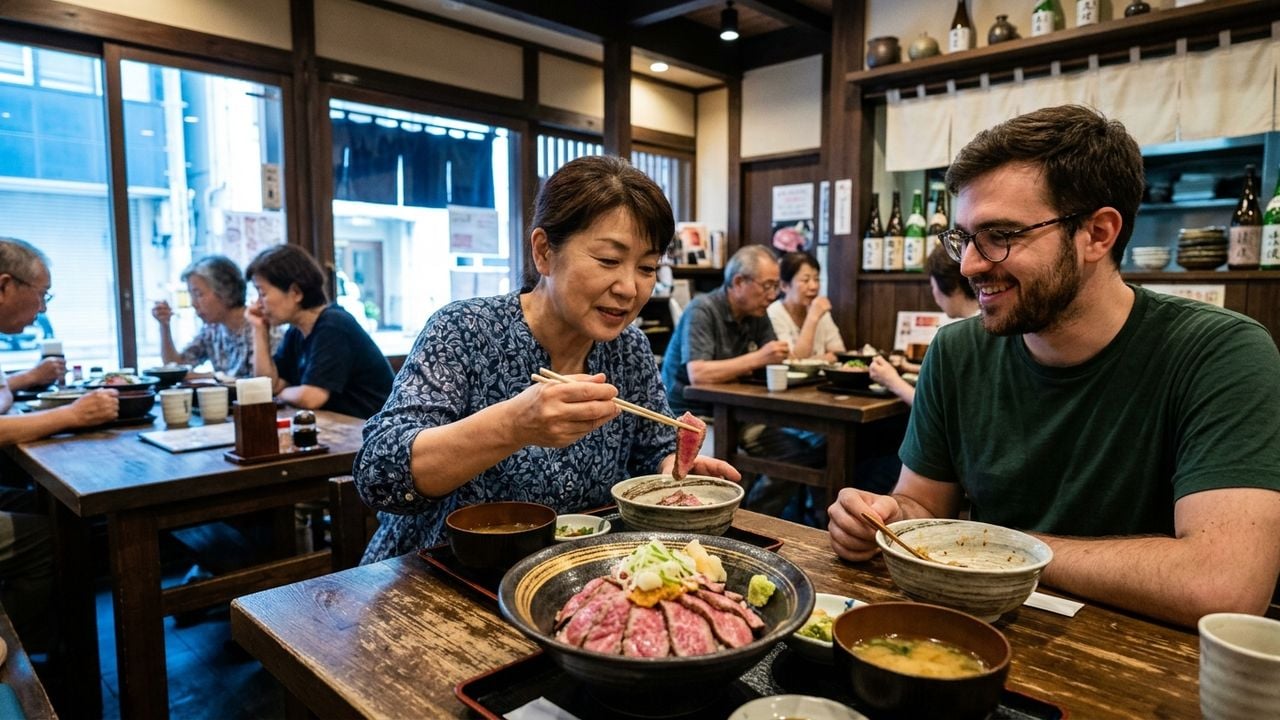
The restaurant seats 18 in total — counter seats near the window, a larger sofa table that suits groups of up to five, and smaller tables for pairs. The sofa seating is one of those quiet details that makes a meal feel less hurried than a typical lunch stop. You settle in, not perch.
Menus are printed in English (as well as Simplified Chinese and Korean), and a five-step visual guide explains how the dish is meant to be eaten — starting with separating the Nagoya Cochin egg, placing the yolk over the beef and stirring the white into the miso soup, then working through the condiments and finishing with wasabi. It's a sequence, not a performance. It changes the meal from a bowl of food into something you actively participate in.
Every ingredient comes from Aichi Prefecture: the white soy sauce in the "magic sauce" from Hekinan City, the miso from Okazaki, the pickled radish from the Atsumi Peninsula, the shiso leaves from Toyohashi, the egg from Yamada Poultry Farm. For travelers who have just spent a morning learning how deeply Aichi shaped Japanese history, there's something satisfying about a meal that takes that geography seriously.
If you're a first-time visitor to Nagoya piecing together a larger Japan itinerary, this piece on discovering Nagoya's rare wagyu as part of a deeper Japan journey may give you the broader context for why this city — and this bowl — is worth the stop.
One Last Thing Before You Go
Osu is not a district you navigate on autopilot. It rewards the traveler who is paying attention — who notices the old temple gate between two modern storefronts, who hears the taiko practice drifting from somewhere down a side street. Itadaki fits into that spirit. It's not at street level. It doesn't have a large sign visible from a hundred meters away. You find it because you looked for it.
When you do, you'll find a restaurant that opened in 2022 with a clear purpose: to build something that supports Aichi's small farms while creating a meal that can't be replicated anywhere else. The story behind the bowl is worth knowing. The bowl itself is worth finding.
For our complete menu, access details, and store information, visit our official page at https://itadaki8.com/english/
You've mapped the route, planned the day, and know exactly what to look for when you reach Yabacho Exit 4 — the only step left is making sure one of those 10 Horai Wagyu bowls has your name on it. Reservations are available now via Tabelog, and it takes only a minute to secure your spot.