Is There Authentic Samurai-Era Food in Nagoya Today?
 gotowp
Here's a number that surprises most visitors: Nagoya was the birthplace of three of Japan's most powerful warlords — Oda Nobunaga, Toyotomi Hideyoshi, and Tokugawa Ieyasu — yet fewer than 10% of foreign travelers to Japan include Nagoya in their itinerary. The food culture those samurai left behind? Even fewer people know it exists.
But it does exist. And in some cases, it has been quietly evolving for centuries — until someone decided to do something genuinely new with it.
Who This Is For
- ✅ Travelers who want their Japan trip content to stand out beyond the standard Tokyo sushi and Osaka street food posts
- ✅ History enthusiasts curious whether samurai-era food culture is still alive in Nagoya in any real, tangible form
- ✅ Foodies seeking dishes with a story deep enough to share — not just a photo, but a genuine narrative
- ✅ Visitors to Nagoya Castle, Atsuta Shrine, or the Osu district who want to extend their samurai city experience into a meal
- ✅ Anyone planning a Nagoya stop who wants to come home with a story their friends will actually find fascinating
What Does "Samurai-Era Food" Actually Mean in Nagoya?
When people imagine samurai food, they often picture austere warrior meals — simple rice, pickles, miso soup. That image isn't entirely wrong, but it misses something important: Nagoya's ruling class developed a remarkably distinct regional food culture, and traces of it survive in ways that are still deeply embedded in daily life here.
Hatcho miso — the dark, dense, intensely savory fermented soybean paste produced in Okazaki City — was a staple provisioned to Tokugawa armies precisely because it could survive long campaigns without spoiling. Today it's the base of Nagoya's iconic miso katsu, miso nikomi udon, and miso oden. The same Okazaki craftspeople who supplied Edo-period soldiers still produce Hatcho miso using centuries-old wooden barrels pressed with river stones.
White soy sauce — a lighter, sweeter alternative to standard soy sauce — was developed in the Mikawa region (present-day Hekinan City in Aichi Prefecture) during the Edo period specifically to complement the flavors of delicate rice-based dishes. It became a quiet pillar of the regional pantry, rarely known outside Aichi.
What makes Nagoya's food heritage particularly compelling for visitors is that these aren't museum pieces — they're living ingredients, still grown and fermented by small Aichi producers, and still shaping the flavor of the city's best kitchens.
You're starting to see that the story behind Nagoya's samurai food heritage is richer than most travel guides suggest — but knowing which days Itadaki is actually open is the piece that turns curiosity into a real plan. The monthly business calendar, including any irregular closures, is published directly on our official Instagram. Takes less than a minute to check.
How Did Those Ingredients Survive Four Centuries?
The honest answer: geography and stubbornness. Aichi Prefecture's agricultural diversity — the warm Mikawa Bay coastline, the fertile Nōbi Plain, the river valleys of Okumikawa — meant that regional producers could sustain specialty crops and livestock even as national food culture standardized around more convenient alternatives.
Ingredients like Nagoya Cochin chicken (a heritage breed dating to the late Edo period), Atsumi Ichō-zuke pickled radish from the Atsumi Peninsula, and shiso leaves from Toyohashi's specialty farms never disappeared — they simply became local knowledge, the kind of thing Aichi residents grew up with but rarely thought to explain to outsiders.
That gap between local knowledge and international awareness is exactly what makes Nagoya's food scene so rich for discovery right now. As travelers looking for authentic food in Nagoya beyond Tokyo and Kyoto are discovering, the city has a depth of ingredient culture that rewards curiosity.
✓ Key Takeaways
- Nagoya's samurai-era food culture is alive through specific ingredients: Hatcho miso, white soy sauce, Nagoya Cochin, and regional pickles — all still produced by small Aichi farms today.
- These ingredients stayed alive through geographic isolation and artisan persistence, not tourism or marketing — which is precisely what makes discovering them feel genuine.
- The gap between local knowledge and international awareness creates an opportunity: visitors who find these ingredients are finding something their followers at home genuinely haven't seen.
Horai Wagyu — only 300 heads produced annually across three farms in Japan — is limited to 10 bowls per day at Itadaki, and it does sell out during peak hours. If your Nagoya day is built around this experience, a reservation through Tabelog is the one step that makes the difference between having the bowl and missing it.
Is There a Single Dish That Captures the Full Aichi Food Story?
This is where the story gets interesting — and shareable.
In 2022, Masayuki Goto opened Itadaki in the Osu district of Nagoya with a question that sounds simple but had never been answered: why does every classic Japanese rice bowl have a premium, story-driven version — katsudon, oyakodon, kaisendon — except gyudon? Why had the beef bowl never been elevated beyond chain restaurant territory?
His answer was to build a gyudon entirely from Aichi Prefecture ingredients, including some that trace directly back to the region's samurai-era pantry. The Hatcho miso from Okazaki. The white soy sauce from Hekinan. The Nagoya Cochin egg. The Atsumi Ichō-zuke pickles. Every element chosen not for novelty, but because it was the right ingredient for the right role — and because the story behind it was worth telling.
The beef itself is Horai Wagyu, a Japanese black wagyu raised in Okumikawa, deep in Aichi's forested inland mountains — fewer than 300 heads produced annually across just three farms in Japan. These cattle are fed on sake lees from Horaisen Sora, one of the region's most respected sake breweries, giving the meat a flavor profile that is genuinely unlike any wagyu you'll find in the more publicized brand names. Out of roughly 500,000 wagyu in Japan, only 300 of them are Horai Wagyu.
For guests who want to go deeper into how Nagoya's samurai legacy shapes a full day of sightseeing and food, this complete guide to samurai Nagoya with a lunch stop at Itadaki walks through the experience from castle to bowl.
"Instagram-worthy presentation and unforgettable taste. My followers keep asking about it."
— Guest review
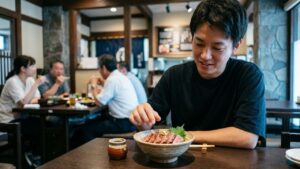
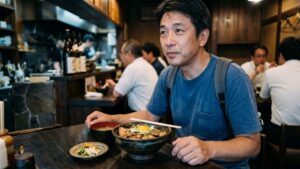
That reaction makes sense when you see the dish. The rare-style wagyu is arranged in the bowl with a Nagoya Cochin egg yolk resting at the center, shiso leaves from Toyohashi fanned alongside, and a small collection of condiments — pickled ginger, dried Mikawa Bay seaweed, chirimen jako whitebait, and Itadaki's own eight-spice blend — placed at the edge of the table. It's visually striking in the way that traditional Japanese ceramic craftsmanship always is: precise, considered, with every element doing something.
But the visual is only the beginning of the story. When your followers ask "What is that?" you'll have an answer that takes a few minutes to tell — and they'll want to hear it.
What Makes This a Story Worth Sharing, Not Just a Photo?
Most Instagram-worthy food delivers the visual. The experiences that generate lasting conversation deliver the context — a reason that the image matters beyond its composition.
Itadaki's Rare Wagyu Gyudon has several layers of that context. The rarity of the beef (300 heads out of 500,000 nationwide). The agricultural lineage of each ingredient — Edo-period fermentation methods, Meiji-era heritage chicken breeds, a pickle tradition tied to the geography of a specific peninsula. The fact that Goto built this restaurant during the COVID-19 pandemic specifically to support small Aichi farms that were struggling with unsold harvests — and named the restaurant "Itadaki" after itadakimasu, the Japanese expression of gratitude spoken before every meal.
That last detail tends to land with visitors in a way that menu descriptions don't. It reframes the meal as an act of connection — between the diner, the farmer, and a food culture that has been maintained with genuine care across generations.
The dish is also structured to be experienced in five deliberate steps: separating the egg yolk from the white (the white goes into the miso soup), tasting the wagyu in its purest form first, then mixing the yolk through, then introducing the condiments one by one, then finishing with wasabi. Each step produces a slightly different taste and texture. It's a meal with a beginning, middle, and end — the kind of experience that's worth describing, not just photographing.
The rare-style texture, it's worth noting, is achieved through Itadaki's proprietary two-stage cooking technique, which heats the beef to above 70°C at the core — fully meeting Japanese Ministry of Health, Labour and Welfare food safety standards. The mouthfeel is distinctive, but the preparation is completely safe.
Where Is Itadaki, and When Can I Visit?
Itadaki is located on the second floor at 4-1-20 Osu, Naka-ku, Nagoya — a four-minute walk from Yabacho Station Exit 4 on the Meijo Subway Line, and also within walking distance of Sakae, Kamimaezu, and Osu Kannon stations. From Nagoya Station, the total journey is roughly ten minutes by subway.
The restaurant is open for lunch only: 11:00–15:00 on Saturdays, Sundays, Mondays, and Tuesdays (last order 30 minutes before closing), and 9:00–15:00 on public holidays. Wednesdays, Thursdays, and Fridays are closed. Irregular closures do apply — the monthly schedule is published on the official Instagram account.
Horai Wagyu is limited to 10 bowls per day and can sell out during peak hours. Reservation via Tabelog is strongly recommended if you're planning your day around it. Mikawa Beef — the other Aichi-raised wagyu on the menu — is available without the same daily limit, starting from ¥1,800 for the standard size.
The restaurant seats 18 in a relaxed sofa-style setting, with a five-seat counter ideal for solo diners and larger tables that work well for groups. Printed menus are available in English, Simplified Chinese, and Korean, and the photographic five-step serving guide is designed so the experience is fully accessible without Japanese language skills.
For travelers building a samurai city day — Nagoya Castle in the morning, Atsuta Shrine in the late morning, Osu Kannon and the shopping street before lunch — Itadaki sits naturally at the end of that arc. It's the kind of meal that gives the history a flavor to remember. Those exploring how Nagoya's samurai food culture compares to Kyoto's approach may find that this bowl answers the question more directly than any museum exhibit could.
Putting It Together: Is the Story Worth Telling?
Nagoya's samurai-era food culture didn't vanish — it transformed, slowly and quietly, through four centuries of agricultural persistence and culinary ingenuity. The Hatcho miso is still aged in Okazaki. The white soy sauce is still pressed in Hekinan. The Nagoya Cochin still lays the eggs. And in the Osu district, someone is using all of it to make a gyudon that people fly to Nagoya specifically to eat.
The story exists. The dish that holds it exists. The question is just whether you'll be there on one of the days the kitchen is open — and whether you'll have planned ahead enough to secure one of the ten Horai Wagyu bowls.
For our complete menu, access details, and store information, visit our official page at https://itadaki8.com/english/
The story is here, the ingredients are here, and the ten Horai Wagyu bowls will be here — on the days the kitchen is open. Securing your spot through Tabelog takes only a moment, and it's the reason guests arrive knowing their bowl is waiting.