Guest Story: A Wagyu Enthusiast's First Rare Gyudon Experience
 gotowp
Late August in Nagoya has its own particular energy. The summer heat is still in full force, but there's a subtle shift in the air — a reminder that the best part of any Japan trip isn't always the famous landmark you planned months in advance. Sometimes, it's the meal you almost didn't book.
That's exactly what happened to a guest who came to Itadaki for the first time recently — a self-described wagyu enthusiast who had already tried Kobe beef in Kobe and Matsusaka beef in Mie, and arrived at our door wondering if there was anything left to surprise him. He left saying: "The lunch was the highlight of my Nagoya trip — I'm telling all my friends about it."
That moment — the one where a meal becomes a story worth telling — is precisely what we built Itadaki around. And in this piece, I want to walk you through exactly what that experience looks like, and why it tends to hit differently for guests who arrive as wagyu connoisseurs.
Who This Is For
- ✅ Wagyu enthusiasts who have already tasted Kobe or Matsusaka beef and are looking for something genuinely new
- ✅ Travelers on a Japan trip who want at least one meal that becomes a story — not just a dinner
- ✅ Repeat visitors to Japan exploring beyond Tokyo, Kyoto, and Osaka for hidden culinary discoveries
- ✅ Anyone curious about what "rare wagyu gyudon" actually means — and whether it's safe to eat
- ✅ Visitors in Nagoya who want to understand the story behind the dish before they arrive
When "Good Wagyu" Is No Longer Enough
There's a particular kind of traveler who plans their Japan itinerary around beef. They've done the research. They know the difference between A4 and A5 grading. They've had the teppanyaki in Kobe, the shabu-shabu in Kyoto, the yakiniku in Tokyo. And yet, somewhere along the way, the experience starts to feel familiar — exquisite, yes, but predictable in its form.
When our founder Masayuki Goto first conceived of Itadaki in 2022, he was asking a version of that same question from the chef's side. Katsudon has its premium incarnations. Kaisendon can be elevated to fine dining. But gyudon — Japan's iconic beef bowl, known almost universally as fast food — had never been reimagined at the highest level. Nobody had asked: what would gyudon look like if it used the rarest wagyu in Japan, prepared with the precision of a specialty restaurant?
That question became the foundation of what we now call the Rare Wagyu Gyudon — a culinary concept that didn't exist before Itadaki opened its doors in Osu, Nagoya. Not a variation on something else. A genuinely new category.
For wagyu enthusiasts specifically, this distinction matters. You're not coming to Itadaki to eat the same experience in a different city. You're coming to eat something that was invented here, using an ingredient that you cannot source anywhere else in the world.
You've just read that Horai Wagyu is limited to 10 bowls per day — and now you're wondering whether you can actually count on it being available when you visit. Our monthly business calendar tells you exactly which days we're open and helps you time your visit. A quick check before you plan takes less than a minute.
The Ingredient That Changes Everything: Horai Wagyu
Of the roughly 500,000 wagyu cattle raised in Japan at any given time, only 300 belong to the Horai Wagyu lineage — raised across just three farms in Aichi Prefecture's Okumikawa region. That's not a marketing figure. It's a production reality shaped by the unique feeding method these farms use: sake lees from Horaisen Sora, a premium local sake brewed in the same mountains where the cattle are raised.
The result is a beef with a flavor profile that surprises even experienced wagyu eaters. The marbling is present, but it's lighter than what you'd expect from the most heavily marbled cuts. The lean meat carries its own depth. It tastes, as one guest put it, like the land it came from — specific, unhurried, honest.
Goto sources Horai Wagyu directly from those farms — a partnership built during the COVID-19 pandemic, when small Aichi producers were struggling with unsold inventory and needed support. That direct relationship is why we can serve it at all. And it's why we limit it to 10 bowls per day. Not as a performance of exclusivity, but because that's genuinely how much we can prepare with the care this ingredient deserves.
If you'd like to go deeper on the wagyu itself — what makes Horai different from other Japanese brands and how it compares to the cuts you may have tried elsewhere — our complete guide to rare wagyu gyudon for beef connoisseurs covers the full picture.
✓ Key Takeaways
- Itadaki invented the Rare Wagyu Gyudon concept — this dish exists nowhere else in the world in this form
- Horai Wagyu is produced by only 3 farms in Japan, with just 300 heads raised annually — its scarcity is real, not manufactured
- The experience is designed to be a complete culinary narrative, not just a single impressive bite
The five-step experience we described above — starting with that golden Nagoya Cochin yolk and ending with wasabi — begins with securing your bowl before it sells out. Horai Wagyu is limited to 10 portions daily, and reservations via Tabelog are the most reliable way to guarantee yours. The process is straightforward and takes only a few minutes.
What "Rare-Style" Actually Means — And Why It's Safe
This is the question I hear most often from guests who arrive having done their homework. Is it actually raw? Is it safe?
Here's the honest answer. The beef you receive at Itadaki is not raw. It's cooked to an internal temperature of over 70°C — fully in compliance with Japan's Ministry of Health, Labour and Welfare food safety standards. What our proprietary two-stage cooking technique achieves is the texture and visual appearance of rare beef, while meeting every required safety benchmark. Goto developed this method specifically so that guests could experience something genuinely new without any compromise on safety.
Goto is a Certified Food Sanitation Supervisor under Japan's national food safety framework, and Itadaki operates under a licensed restaurant permit from the Aichi Prefecture Public Health Center. The technique has been featured on eight major Japanese television programs — including NHK, Japan's national public broadcaster — precisely because it represents a genuine innovation in how wagyu can be prepared.
For guests who want to understand the full science and process behind this technique before visiting, we've written in detail about the two-stage cooking method behind rare wagyu safety.
The Five Steps That Turn a Bowl Into a Memory
When the bowl arrives at your table, you'll find a printed guide — available in English, Simplified Chinese, and Korean — that walks you through five deliberate steps. This isn't ceremony for its own sake. Each step genuinely changes the flavor and texture of what you're eating.
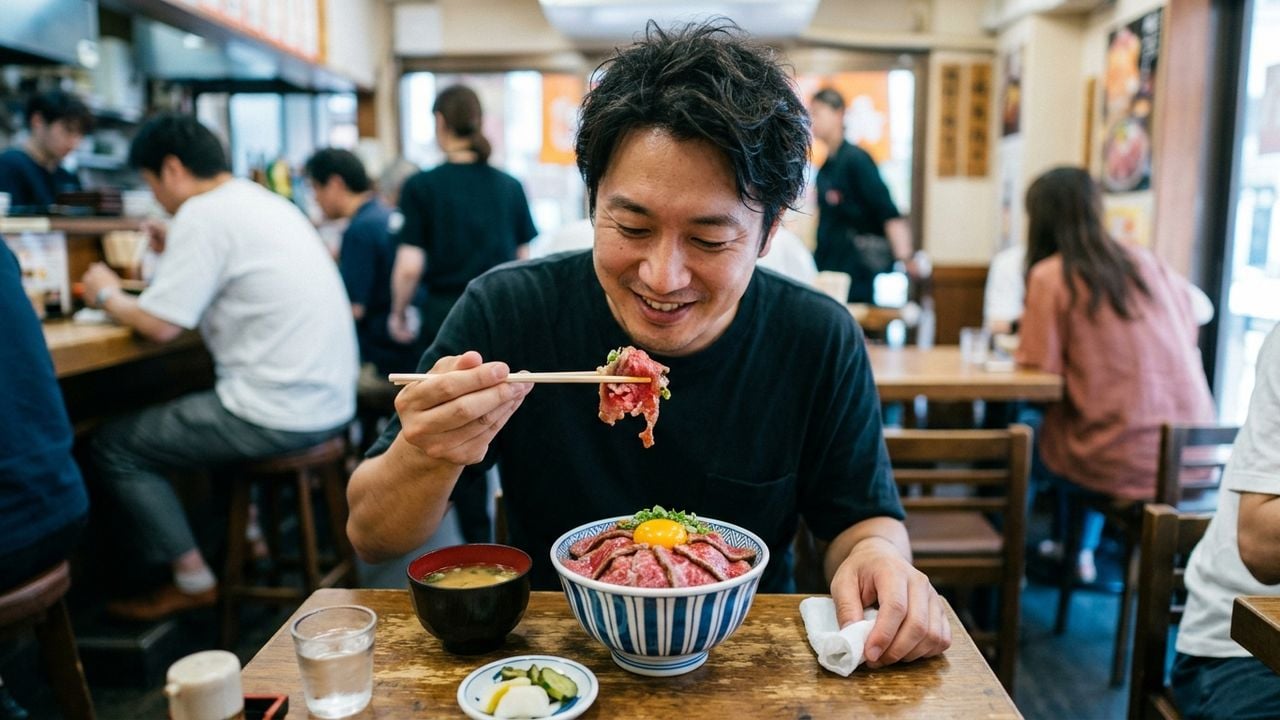
You begin by separating the Nagoya Cochin egg: the white goes into the miso soup, the golden yolk rests on top of the beef. You taste the wagyu first, undisturbed — just the rare-style beef, the rice, and the magic sauce made from white soy sauce brewed in Hekinan City, blended with wine. Then you break the yolk into the beef, letting it coat each slice with a silky richness. From there, the condiments on the table — pickled ginger from Kimura Farm in Inazawa, dried nori from Mikawa Bay, chirimen jako from Minamichita, and Itadaki's original 8-spice blend — let you explore the bowl in entirely different directions. The final note is wasabi, which cuts through the richness and closes the experience cleanly.
What strikes most guests — and what struck the wagyu enthusiast who inspired this piece — is that the bowl keeps revealing itself. It doesn't give you everything in the first bite. There's a progression. A culinary journey, not just a meal.
"The lunch was the highlight of my Nagoya trip — I'm telling all my friends about it."
Guest at Itadaki, Osu, Nagoya
That impulse to share is something we see often. Not because the dish is visually striking — though it is, and it photographs beautifully — but because the story behind it is one that travels well. When you go home and explain what Horai Wagyu is, where it comes from, how it's raised, how the bowl is prepared and served in five steps at a specialty restaurant in an Osu side street... that story is yours to keep.
Planning Your Visit: What You Need to Know
Itadaki is open for lunch only — Tuesday, Saturday, Sunday, and Monday from 11:00 to 15:00, and on public holidays from 9:00. We're closed Wednesday through Friday. Because Horai Wagyu is strictly limited to 10 bowls per day and can sell out during peak hours, a reservation via Tabelog is strongly recommended if you're set on the Horai Wagyu experience.
We're located at 4-1-20 Osu, 2nd floor, Naka-ku, Nagoya — a four-minute walk from Yabacho Station Exit 4 on the Meijo Subway Line, and also within comfortable walking distance from Sakae Station, Kamimaezu Station, and Osu Kannon Station. From Nagoya Station, the journey takes approximately 10 minutes by subway.
The menu is fully available in English, and the five-step guide we mentioned above is printed in English as well. You don't need Japanese to navigate the experience — and our team is accustomed to welcoming international guests from all over the world.
If you're curious what a first visit looks like from the perspective of another international traveler discovering Nagoya's wagyu scene for the first time, this guest story from a Toyota visitor who found Itadaki during a business trip gives a vivid account of the experience from arrival to the last bite.
For our complete menu, access details, and store information, visit our official page at https://itadaki8.com/english/
A Japan trip is a rare opportunity. The meals you carry home aren't the ones you expected — they're the ones that surprised you. We'd be glad if Itadaki becomes one of those for you.
The guest whose story opened this article didn't plan for Itadaki to be the highlight of his Nagoya trip — but it was, and now he's telling everyone about it. If you want that bowl waiting for you when you arrive, the only way to be certain is to reserve ahead. Tabelog reservations are available online, and securing your spot takes just a few clicks.