How I Combined Samurai History and Rare Wagyu in One Nagoya Day
 gotowp
Late August in Nagoya is the kind of heat that makes you slow down and pay attention. The stone walls of Nagoya Castle hold the warmth of the afternoon long after the crowds thin out. Walking through the castle grounds in summer, something about the scale of the place — the sheer ambition of it — reminds me of why I started Itadaki in the first place.
Masayuki Goto, founder of Itadaki, has lived and worked in Nagoya long enough to stop seeing it as a stopover city. To him, it is a city that rewards people who look closely. And on the days he walks the same routes his guests walk — from Nagoya Castle's tenshu keep down to Osu — he understands exactly what kind of lunch should be waiting at the end.
But one question follows that walk almost every time a foreign visitor arrives at the door: "Is the wagyu actually safe? I'm a little worried about the rare preparation."
This article follows Goto through a typical service day at Itadaki, with that question sitting squarely at the center.
Who This Is For
- ✅ Travelers who want to spend a full day exploring Nagoya's samurai history before lunch
- ✅ Anyone who has hesitated to order rare-style wagyu because of food safety concerns
- ✅ Visitors curious about how Japan's food safety standards actually work in a working kitchen
- ✅ Foodies who have already tried Kobe and Matsusaka beef and are ready to discover something genuinely rare
- ✅ Repeat Japan visitors building an itinerary that goes deeper than the Golden Route
The Morning Ritual: Before the First Guest Arrives
Goto arrives at Itadaki's second-floor space on Osu's 4-chome well before 11:00. The neighborhood is already alive — the shutters of the shopping street lifting one by one, the smell of incense drifting faintly from the direction of Osu Kannon Temple five minutes away.
Inside, the first thing he checks is not the front-of-house setup. It is the beef.
Horai Wagyu, sourced directly from farms in Okumikawa, Aichi Prefecture, arrives with a traceability that matters deeply to Goto. Only three farms in Japan raise this breed, producing just 300 heads annually. The cattle are fed on sake lees from Horaisen Sora — a method that shapes the fat distribution and the flavor in ways that no industrial operation could replicate. When only ten portions of this beef will be served today, there is no margin for anything short of precise.
"People ask me if rare wagyu is safe," Goto says, checking the temperature readings on the cooking equipment. "My answer is always the same: come watch the process. Then decide."
The two-stage cooking technique he developed for Itadaki is the answer to that question in practical form. The beef is brought to over 70°C at its core — the threshold specified by Japan's Ministry of Health, Labour and Welfare for beef safety. What makes the technique unusual is that it achieves full internal temperature compliance while preserving the texture that makes the dish worth traveling for. It is not a shortcut. It took real development time to get right.
Goto holds a Certified Food Sanitation Supervisor qualification from the Japanese Ministry of Health, Labour and Welfare. The two-stage method is not a workaround — it is a system built from within the regulatory framework, not in spite of it.
If the food safety question is still turning over in the back of your mind, you are not alone — it is the single most common concern guests bring to Itadaki's door before visiting. The monthly business calendar on Instagram also shows exactly which days Itadaki is open, so you can plan your Nagoya day without guesswork. No account needed to view the schedule.
Why the Safety Question Matters (And Why It Shouldn't Stop You)
If you grew up in the United States, the UK, or Australia, you learned early that pink beef carries risk. Public health guidance in those countries has historically advised against undercooked beef for valid reasons — E. coli and other bacterial contamination are genuine concerns in certain production environments.
Japan operates under a different — and in the context of high-quality wagyu — notably rigorous framework. But what Goto observes is that most visitors don't know the specifics. They arrive at the door genuinely uncertain, and without a clear explanation, that uncertainty becomes a reason to walk away from something they would otherwise love.
Here is what actually happens at Itadaki during service:
- The Horai Wagyu and Mikawa Beef used at Itadaki come exclusively from Aichi Prefecture farms operating under strict quality controls
- Each portion is cooked using the proprietary two-stage method, reaching over 70°C at the core — fully compliant with Japanese Ministry of Health standards
- The result is a texture that reads as rare to the palate, because the fat marbling and the lean muscle respond differently to precise temperature — not because the beef is undercooked
- This technique is difficult to replicate outside of Itadaki's specific setup, which is exactly why it took time to develop and is specific to this restaurant
If you are curious about the science behind what makes Horai Wagyu different from other Japanese wagyu breeds, that is a good place to start before your visit.
✓ Key Takeaways
- Itadaki's two-stage cooking method brings the beef to over 70°C at the core — fully compliant with Japan's Ministry of Health, Labour and Welfare food safety standards
- Horai Wagyu is sourced directly from three farms in Aichi Prefecture, with just 300 heads raised annually — production quality and traceability are built into the supply chain
- The "rare" texture is a result of precise temperature control, not of serving undercooked beef
You now know how the two-stage cooking method works and why the Horai Wagyu is limited to ten bowls per day — which means the practical next question is whether a bowl will still be available when you arrive. Reserving your seat through Tabelog is the only way to hold one of those ten Horai Wagyu portions before your Nagoya day begins. The reservation process takes only a few minutes.
Service Begins: The Five-Step Experience Explained from the Kitchen
By 11:00, the first guests are seated. The sofa-style chairs fill quietly — a couple at one of the two-person tables, a solo traveler at the counter, a small group settling into the five-person sofa table near the window.
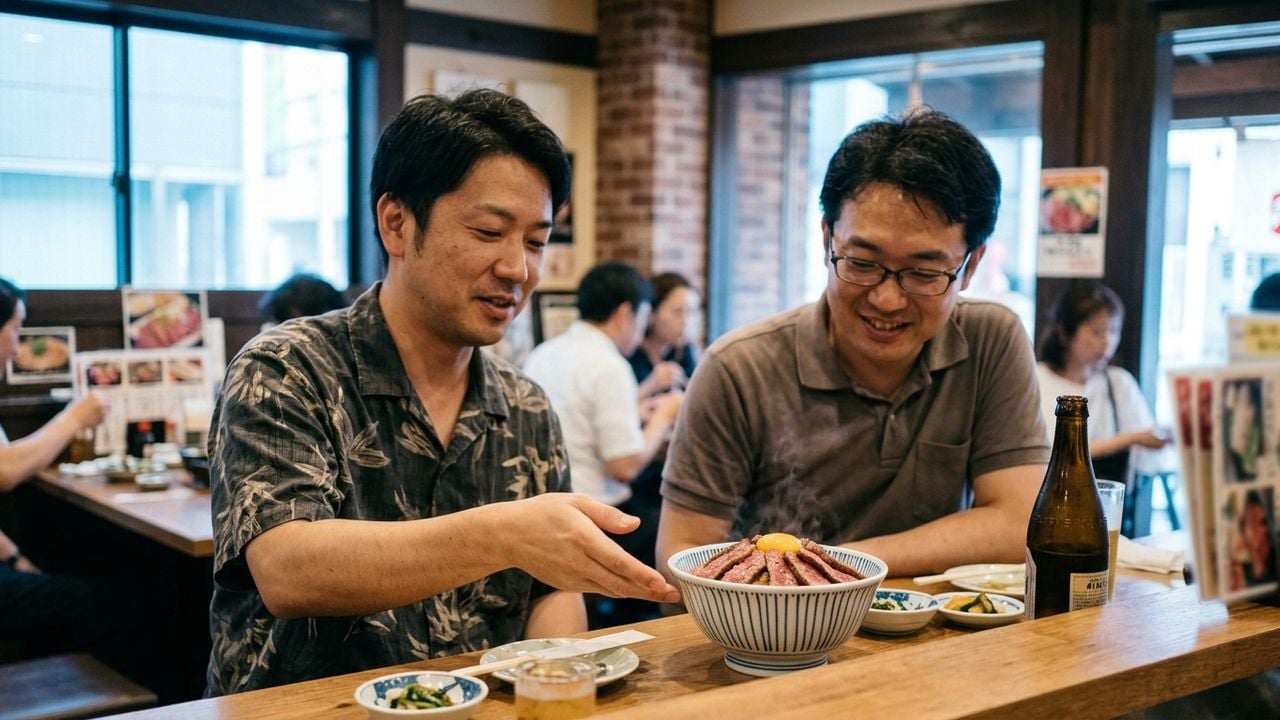
The dish that arrives in front of each guest carries a story Goto has told many times and still finds genuinely worth telling. The Nagoya Cochin egg from Yamada Poultry Farm sits whole on the bowl. The shiso leaves — Aikei No.1 variety, grown in Toyohashi — frame the beef. The miso soup beside it is made with Hatcho miso from Okazaki City.
Every element is from Aichi Prefecture. Not as a marketing line, but as a discipline that started when Goto watched local farmers struggle during the pandemic and decided the only honest response was to build something that needed them.
For guests who have never encountered rare-style wagyu before, the five-step guide on the printed English menu does real work. Separate the egg — white into the soup, yolk onto the beef. Eat the wagyu first in its purest form. Then mix. Then add condiments from the tabletop. Then finish with wasabi. Each step opens a different dimension of the same bowl.
One of the most direct pieces of feedback Goto has received from a guest captures something he can't always put into words himself: "I traveled to Nagoya specifically to eat here — it was 100% worth it." That kind of commitment — building an entire trip around a lunch — is something he takes seriously every service day.
"I traveled to Nagoya specifically to eat here — it was 100% worth it."
Guest review, Itadaki
For travelers who have already explored Kobe and Matsusaka beef and are wondering where the next discovery is, the comparison between those well-known wagyu brands and Horai Wagyu is a question Goto has answered in detail elsewhere — and the short version is that Horai Wagyu occupies a genuinely different category.
The Nagoya Day That Makes Sense
Goto is a basketball fan and a committed explorer of restaurants outside his own city. He travels internationally with the specific intent of eating things he has never encountered. That instinct — the willingness to trust a place you don't fully understand yet — is something he hopes visitors bring to Nagoya.
A morning at Nagoya Castle, where you can walk the original stone ramparts and stand in the same grounds where Tokugawa Ieyasu consolidated power, followed by a walk south through Sakae and into Osu, is a day that earns its lunch. Hisaya-odori Garden Flarie, three minutes from Yabacho Station, offers a quieter detour — six themed gardens, including a greenhouse, that appear in major English travel guides and cost nothing to enter.
By the time guests reach Itadaki's second-floor space — four minutes from Yabacho Station Exit 4 on the Meijo Subway Line — the city has done its part. The question of whether to order the Horai Wagyu bowl, limited to ten portions per day, is the only decision left.
For guests who want to explore the intersection of samurai history and contemporary wagyu culture more broadly, the full guide to combining Nagoya's historical sites with a rare wagyu lunch covers the routing in detail.
End of Service: What Goto Takes Away from Each Day
By 14:30, service is winding down. Last orders are taken thirty minutes before closing. The ten Horai Wagyu portions — on most busy days — are long gone. Goto checks in on the kitchen, walks through the dining room, and does the same quiet inventory he started the morning with.
The thing he thinks about most, on days when a guest has specifically addressed the food safety question, is how much a clear answer changes the experience. Not the dish itself — the dish is consistent. But the guest's ability to actually taste it, without the background noise of unresolved doubt, is what makes the difference between a good meal and a memorable one.
The two-stage technique exists to make that possible. The sourcing from Aichi farms exists to make it honest. And the five-step guide exists to make sure no one eats the bowl in a way that leaves flavor on the table.
Itadaki is open for lunch service on Saturdays, Sundays, Mondays, and Tuesdays, from 11:00 to 15:00 (last order 14:30). On public holidays, the restaurant opens at 9:00. Irregular closures do occur — the monthly business calendar is published on the official Instagram account. Because Horai Wagyu is limited to ten bowls per day, a reservation through Tabelog is recommended, particularly during peak travel periods.
For the complete menu, access directions, and full store information, visit the official English page at https://itadaki8.com/english/.
You have spent a morning with Nagoya's samurai history and now you understand exactly what is waiting at the end of that walk — a bowl built on 300-head-a-year wagyu, a food-safe rare preparation, and ingredients from Aichi farms that needed a restaurant like this to exist. The ten daily Horai Wagyu portions go early on busy days, and August is a peak travel month. Secure your seat before the day fills.