The Samurai City Rare Wagyu Discovery: Itadaki in Historic Osu
 gotowp
A guest messaged me on Instagram last week. She was flying into Nagoya for two nights — a stopover before heading to Shirakawa-go — and her one non-negotiable was Horai Wagyu. "I've read about it everywhere," she wrote. "But I'm terrified I'll show up and it'll be gone."
That message stayed with me through our entire prep that morning. Because she's not alone. Honestly, the question I receive most often from international visitors isn't about the cooking method or the price. It's this: Will it sell out before I get there?
The answer is: sometimes, yes. And I want to be straight with you about that — because I'd rather you plan well and experience Horai Wagyu than arrive disappointed. So let me walk you through what a real service day looks like at Itadaki, and exactly what you can do to make sure your bowl is waiting for you.
Who This Is For
- ✅ Visitors planning a short stay in Nagoya who can't afford to miss out on Horai Wagyu
- ✅ Travelers unfamiliar with Japanese reservation platforms like Tabelog and worried about language barriers
- ✅ Anyone wondering what actually happens inside Itadaki from the moment doors open to the final bowl
- ✅ Wagyu enthusiasts exploring Osu and wanting to understand why the 10-bowl limit exists in the first place
- ✅ First-time visitors to Nagoya who want to plan their lunch stop with confidence
Why 10 Bowls — and Why That Number Never Changes
Before we talk reservations and timing, it helps to understand where that limit comes from. Horai Wagyu is raised in Okumikawa, deep in the mountains of Aichi Prefecture. Across all of Japan, only 3 farms produce it — and they raise just 300 heads annually. To put that in context: there are roughly 500,000 wagyu cattle in Japan at any given time. Horai Wagyu represents a fraction of a fraction.
What makes it further distinct is the feeding method. The cattle are raised on sake lees from Horaisen Sora, a premium local sake brewed in the same mountain region. That creates a beef with a flavor profile you won't find anywhere else — light, nuanced marbling alongside genuine lean meat character. Not the heavy fat of a typical high-marbled wagyu. Something quieter, and more interesting.
When I source this beef, I receive a specific, fixed allocation tied to what the farms can sustainably provide. I don't limit the bowls to create artificial scarcity. The limit exists because the supply itself is genuinely limited. Every morning I come in, I know exactly how many portions of Horai Wagyu are available. On a typical service day, that's 10 bowls. That number is the reality, not a marketing decision.
You now know why Horai Wagyu disappears before noon on busy days — but knowing the reason doesn't tell you whether we're open the day you're planning to visit. Our business calendar changes monthly, and irregular closures do happen. Our official Instagram posts the exact schedule each month so you can confirm your date before you book anything.
What the Morning Looks Like Before the Doors Open
We open Tuesday, Monday, Saturday, and Sunday — lunch only, from 11:00 to 15:00. On public holidays we open from 09:00. Wednesday through Friday, we're closed.
My mornings at Itadaki start well before 11:00. The Horai Wagyu has to be handled with precision — our two-stage cooking technique heats the beef to over 70°C at the core, which fully meets Japan's Ministry of Health food safety standards while preserving that signature rare-style texture. That process can't be rushed, and it can't be improvised. Each portion is prepared according to the same precise method, every single day.
While the beef is being readied, the rice — Aichi no Kaori, grown right here in Aichi Prefecture — is cooked in temperature-calibrated rice cookers that we adjust each year based on that season's harvest quality. The miso soup is prepared with Hatcho miso and soybean miso from Okazaki City, finished with Atsumi aosa seaweed and black nori. The Atsumi Ichō-zuke pickles are set out. The Aikei No.1 shiso leaves from Toyohashi are arranged. The Nagoya Cochin eggs from Yamada Poultry Farm are checked.
By the time 11:00 arrives, everything is in place. The doors open. And on a busy Saturday, the first guests are sometimes already waiting outside.
The Real Risk: What Happens If You Arrive at Noon Without a Reservation
Here's the honest picture. On weekends and public holidays, Horai Wagyu bowls can be gone before noon. Walk-in guests who arrive at 11:30 or 12:00 sometimes find that the 10 bowls have already been claimed — either through reservations or by early walk-in guests who arrived right at opening.
This is what worries visitors like the guest who messaged me. She had a tight itinerary. One shot at lunch in Nagoya. She couldn't risk the walk of disappointment.
The solution is straightforward, but it requires knowing one thing most international visitors don't: that you can reserve a Horai Wagyu bowl in advance through Tabelog, Japan's leading restaurant reservation platform. And yes — you can do it entirely in English.
Here's the step that matters most. When making your reservation through Tabelog, go to the notes or special requests field and paste this phrase exactly:
鳳来牛希望
That tells us you'd like Horai Wagyu reserved for your visit. Without that note, your reservation holds your seat — but not your specific bowl. With it, we know to set one aside before service begins.
If you're a walk-in guest and Horai Wagyu has sold out, please don't leave. Our Mikawa Beef Rare Gyudon is always available — prepared using the exact same two-stage cooking technique, with the same care and the same all-Aichi ingredients. Mikawa Beef from the Aichi Mikawa region is outstanding in its own right, and many guests who came for Horai Wagyu end up equally moved by the Mikawa bowl. The experience of exploring Aichi's wagyu landscape beyond famous brands often begins right here.
And if you want to try for Horai Wagyu without a reservation, your best move is simple: arrive at 11:00 sharp when we open.
✓ Key Takeaways
- Horai Wagyu is limited to 10 bowls per day — not for effect, but because only 300 heads are raised annually across 3 farms in Japan
- Reserve via Tabelog and add 鳳来牛希望 in the notes field to secure your bowl in advance. Tabelog reservations can be made in English.
- Walk-in guests who miss out on Horai Wagyu can always enjoy Mikawa Beef Rare Gyudon — same technique, same Aichi ingredients, always available
You've read the step that matters most — pasting 鳳来牛希望 into the Tabelog notes field to hold your Horai Wagyu bowl. That note only works once you've actually made the reservation. Tabelog's booking form is available in English, and securing your seat takes just a few minutes.
What Service Feels Like From Inside the Room
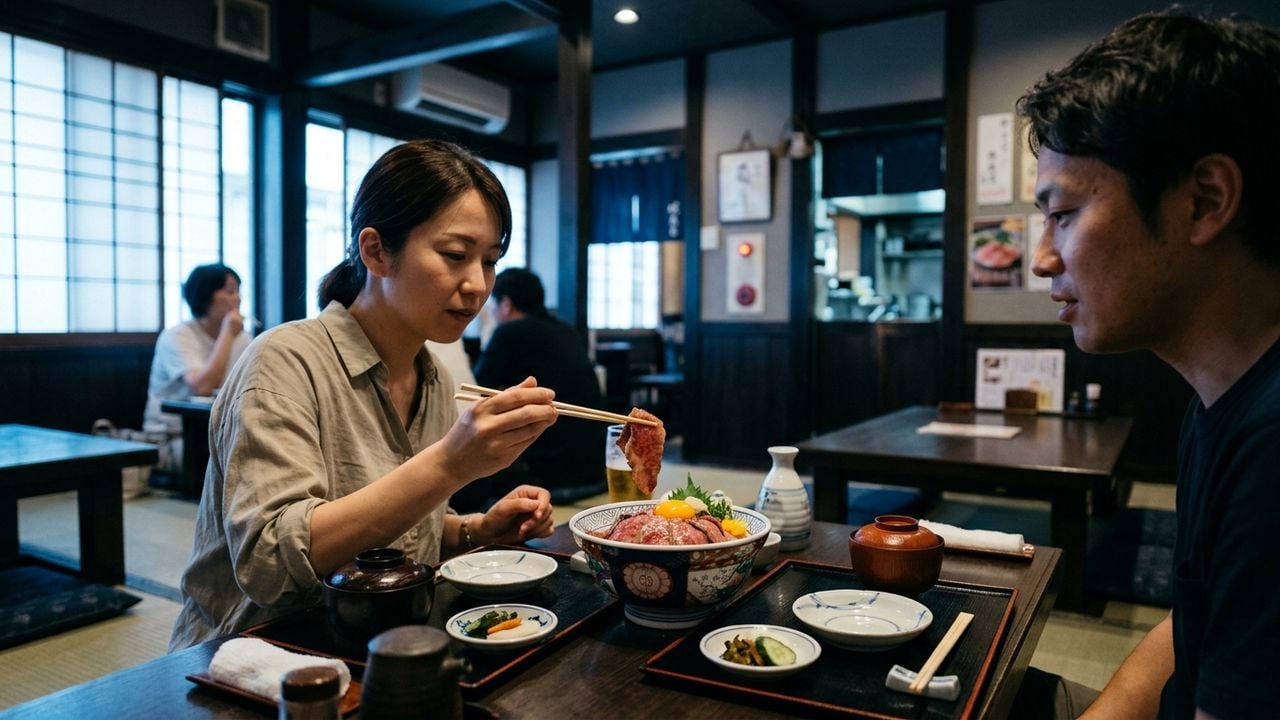
Once guests are seated at our 18-seat restaurant — counter seats, sofa tables for couples, families, and groups — I watch something happen that never gets old. The bowl arrives. There's a pause. Then the five-step eating guide gets read, carefully, and the Nagoya Cochin egg gets separated just as instructed.
One guest last season put it in a way that I think captures it better than I could: "The English menu with clear serving instructions made the experience stress-free." That comment meant a great deal to me, because that was exactly the intention. Our printed menus are available in English, Simplified Chinese, and Korean — and the five-step guide is visual enough that even without reading a word, guests understand the sequence intuitively.
"The English menu with clear serving instructions made the experience stress-free."
— Guest review
The stress-free part matters. Nagoya can feel like a detour for international travelers who've built their Japan trip around Tokyo, Kyoto, and Osaka. Many visitors arrive a little uncertain — is this the right neighborhood? Did I find the right building? We're on the second floor of a building on a side street off the main Osu shopping street, a four-minute walk from Yabacho Station Exit 4 on the Meijo Subway Line. Once guests find us, I want everything else to feel effortless.
The five steps unfold slowly over the meal — first the wagyu pure, then the golden yolk mixed in, then the condiments one by one: pickled ginger from Kimura Farm in Inazawa, dried seaweed from Himakajima in Mikawa Bay, chirimen jako from Minamichita, the original 8-spice blend, and finally wasabi. By the time guests reach that last note, the bowl has taken them through half a dozen distinct flavor moments. That's the journey I designed Itadaki around. And it all starts with securing your seat — and your bowl — before you arrive.
If you're curious about how the two-stage cooking technique makes rare-style wagyu safe, we've written about that in detail separately. The short version: the core temperature exceeds 70°C, meeting Japan's strictest food safety standards. The rare texture is real. The safety is also real.
Making the Most of Your Osu Lunch Stop
Osu is one of Nagoya's most layered neighborhoods. Within a few minutes of Itadaki, you have Osu Kannon Temple, the 1,200-shop shopping street, the preserved atmosphere of a district that has been a center of Nagoya life for over 400 years. Visitors who combine Osu exploration with their rare wagyu lunch tend to find that the neighborhood earns far more time than they'd planned for.
Hisaya-odori Garden Flarie — a free-admission urban garden just three minutes from Yabacho Station — is worth seeing before or after your meal, particularly if you're visiting in late summer when the gardens are lush. The Asian Games are coming to Nagoya in 2026, and the city feels like it's building toward something — IG Arena, designed by Kengo Kuma, opened just last year, and the energy across the city has shifted in a way you can feel on the streets of Osu.
The samurai history is never far either. Nagoya was the birthplace of three of Japan's greatest warlords — Oda Nobunaga, Toyotomi Hideyoshi, Tokugawa Ieyasu — and the castle that once defined this city still stands. Coming from Nagoya Castle to a lunch at Itadaki in Osu isn't as unlikely a pairing as it sounds. Both are about what this city has always done: take something ordinary and make it extraordinary.
That's what Itadaki is, at its core. A gyudon. The most ordinary dish in Japan. Reimagined with wagyu so rare that most people in Japan have never tasted it, prepared with a cooking technique we developed from scratch, surrounded by ingredients that tell the full story of Aichi Prefecture's food culture. One bowl, all of it.
For our complete menu, access details, and store information, visit our official page at https://itadaki8.com/english/
Your Nagoya lunch window is short, and Horai Wagyu — 300 heads a year, 10 bowls a day — doesn't wait. The reservation that protects your bowl is one Tabelog booking away, and you can complete it right now in English with that single Japanese phrase in the notes field.