Step-by-Step Guide to Solo Dining at Itadaki for Business Visitors
 gotowp
You've wrapped up a long day of meetings near Toyota or at a Nagoya MICE venue. You have exactly one free hour for lunch, you're on your own, and you want something genuinely memorable — not a convenience store onigiri, not the hotel buffet. You've heard about wagyu beef being a bucket-list experience in Japan, but you're also a little cautious: Is it actually safe to eat beef that rare-looking? What if I can't read the menu? Will a solo traveler even feel comfortable at a specialty restaurant?
These are completely reasonable questions — and they're exactly what this guide is here to answer. If you're a business visitor in Nagoya with a free lunch window, here's your step-by-step walkthrough for a solo dining experience at Itadaki, the originator of Rare Wagyu Gyudon in Osu, Nagoya.
Who This Is For
- ✅ Business travelers visiting Nagoya for Toyota-related work, MICE events, or technical visits
- ✅ Solo diners who want a memorable lunch without navigating a group reservation
- ✅ Visitors who are curious about wagyu but have food safety concerns about rare-style preparation
- ✅ Anyone with limited time who wants a clear, no-confusion game plan before walking in
- ✅ Repeat Japan visitors ready to explore beyond the well-known wagyu brands
Step 1: Settle the Safety Question First
Let's address this directly, because it's the question that holds most Western visitors back: Is it safe to eat rare-style wagyu?
In the US and many European countries, health authorities advise against consuming undercooked beef due to risks like E. coli and salmonella. That guidance makes complete sense in those contexts. But Itadaki's preparation is something quite different from simply serving undercooked beef.
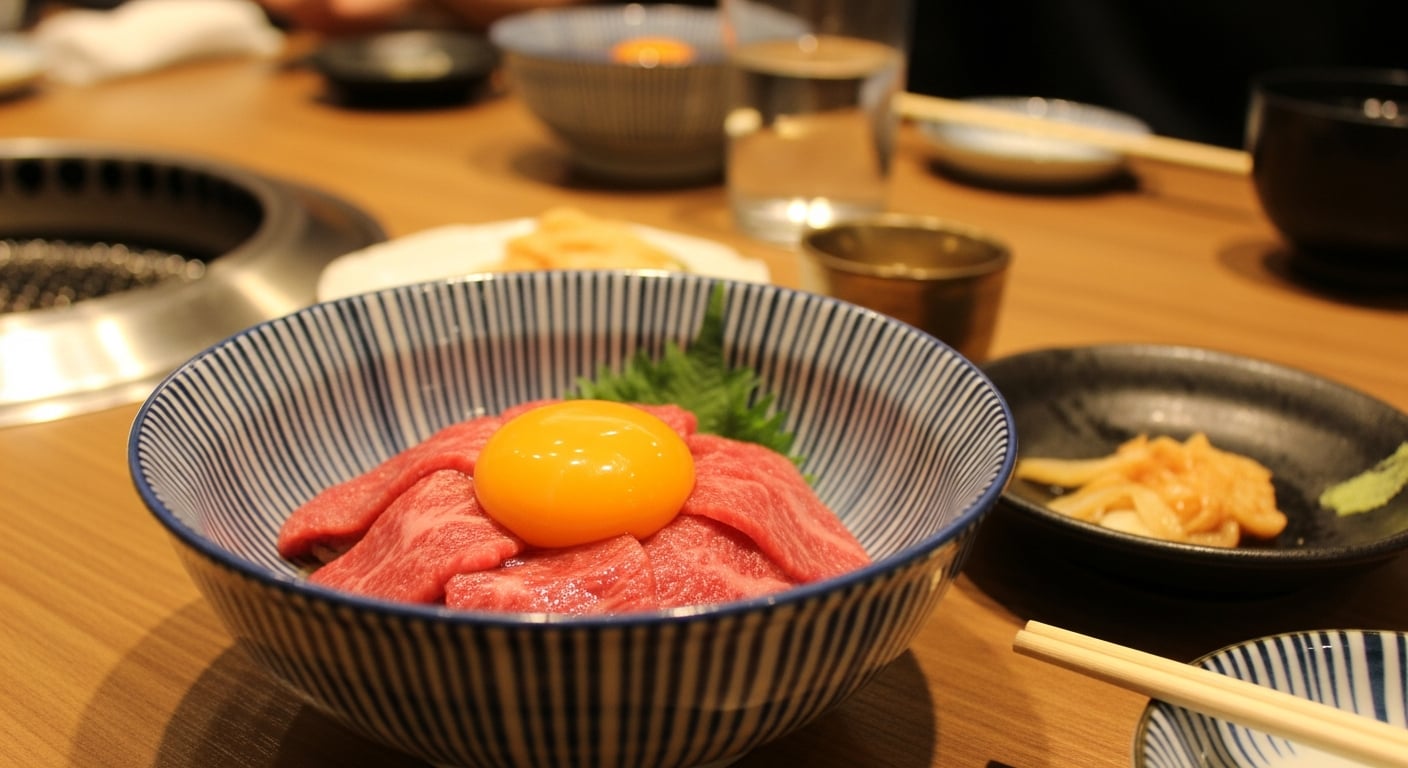
The beef at Itadaki is prepared using a proprietary two-stage cooking technique developed by founder Masayuki Goto, who holds certification as a Food Sanitation Supervisor under Japan's Ministry of Health, Labour and Welfare. This technique heats the beef to over 70°C at the core — fully satisfying Japan's strict national food safety standards — while preserving the silky, tender texture that makes a rare-style presentation so distinctive.
In other words: the "rare" appearance is a carefully engineered culinary result, not a shortcut. The beef is not raw. It meets every regulatory requirement set by Japan's food safety authorities. Itadaki has served this dish since 2022, has been featured on 8 major Japanese TV programs including NHK, and has welcomed guests from around the world without incident.
Only two beef sources are used: Horai Wagyu and Mikawa Beef, both raised in Aichi Prefecture under rigorous quality controls by trusted local farms with whom Goto maintains direct-supply partnerships. The supply chain is short, transparent, and intentional.
If food safety was the one thing keeping you from booking a table — you can now set that concern aside.
Step 2: Plan Your Arrival
Itadaki is open for lunch only, Tuesday, Monday, Saturday, and Sunday (11:00–15:00), with last order at 14:30. On public holidays, doors open at 09:00. The restaurant is closed Wednesday, Thursday, and Friday — so check the monthly schedule before you plan.
From central Nagoya, the easiest route is straightforward: take the Higashiyama Line from Nagoya Station to Sakae, transfer to the Meijo Line, and get off at Yabacho. Use Exit 4. Itadaki is a 4-minute walk from there. Total transit time from Nagoya Station: approximately 10 minutes.
The restaurant is on the 2nd floor. At street level, look for the Japanese sign reading 元祖レア牛丼 頂 — take the stairs up. It's easy to spot once you know what you're looking for.
For the ultra-rare Horai Wagyu — produced by only 3 farms in Japan, with just 300 heads raised annually — availability is limited to 10 bowls per day. If securing this specific bowl matters to you, a reservation via Tabelog Online is strongly recommended. When adding notes during the reservation process, paste this phrase to request Horai Wagyu: 鳳来牛希望. Tabelog's reservation interface is available in English. If you're going walk-in, arriving right at 11:00 opening maximizes your chances.
✓ Key Takeaways
- Itadaki's rare-style wagyu is prepared to over 70°C at the core — fully meeting Japan's Ministry of Health, Labour and Welfare food safety standards. It is not raw beef.
- Horai Wagyu is limited to 10 bowls per day. Reserve via Tabelog and paste 鳳来牛希望 in the notes to secure your bowl.
Step 3: Arrive, Sit, and Order Without Stress
Solo dining at Itadaki is genuinely comfortable. The restaurant has 18 seats in total, including 5 counter seats specifically designed for solo diners and couples. All seating features sofa-style cushioning — not the rigid bar stools you might expect at a counter. For a business traveler who's been on their feet all morning, that matters.
The printed menu is fully available in English (as well as Simplified Chinese and Korean), with photos, prices, and clear ingredient explanations for every dish. There is no language barrier to navigate. If you have any questions, pointing at the menu works perfectly, and translation apps are welcome.
For a first-time solo visit, a practical approach is to order the Shinkoccho — the standard size of the Horai Wagyu Rare Gyudon at ¥2,700 — or if Horai Wagyu has sold out, the Fumoto (Mikawa Beef, 100g, ¥1,800) is always available and prepared with the same two-stage technique. Both are full, satisfying lunch portions. Average spending per guest is around ¥3,000, so factor in a side dish or a Kinshachi craft beer from Nagoya if you have time.
Step 4: Follow the Five-Step Eating Guide
This is where the experience shifts from "a good bowl of beef" to something genuinely worth remembering.
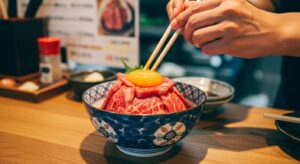
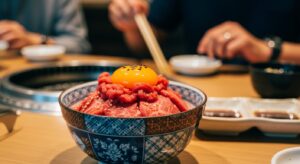
Itadaki's menu includes a visual five-step guide — printed in English — that walks you through exactly how to enjoy the dish. It begins with the Nagoya Cochin egg: separate the white into the miso soup, and place the golden yolk on top of the beef. Then taste the wagyu on its own first, appreciating the rare texture and the flavor that comes from cattle raised on sake lees from Horaisen Sora, one of Aichi's finest breweries. From there, the guide takes you through mixing the yolk, adding the complimentary tabletop condiments (pickled ginger, dried seaweed from Mikawa Bay, chirimen jako, Itadaki's original 8-spice blend), and finishing with wasabi.
Each step changes the taste profile noticeably. It's not just instructions — it's a sequence that unfolds the dish's layers deliberately, the way Goto designed it to be experienced.
"The five-step eating guide made the dish even more enjoyable and memorable."
— Guest review
For a solo diner, that printed guide is particularly valuable. You don't need a companion to narrate the experience. The dish guides itself.
Step 5: Fit It Into Your Nagoya Schedule
A solo lunch at Itadaki takes roughly 45 to 60 minutes from walk-in to exit — well within a business traveler's midday window. The lunch-only, daytime format means there's no pressure to rush through dinner plans.
If your schedule allows a few extra minutes before or after, Itadaki sits inside the Osu district, one of Nagoya's most distinctive neighborhoods. Osu Kannon Temple is a 5-minute walk. Hisaya-odori Garden Flarie — a free-admission urban garden featured in major English travel guides — is a 3-minute walk from Yabacho Station. Both make for a clean 90-minute Nagoya lunch break that feels anything but ordinary.
If you're visiting Nagoya for a day of Toyota facilities or MICE commitments and want one meal that stands completely apart from the rest of your itinerary, this is a reliable candidate. It's a short subway ride from Nagoya Station, requires no Japanese language skills, and delivers an experience that simply doesn't exist anywhere else — a culinary concept invented at this specific restaurant, using ingredients produced within Aichi Prefecture.
"The lunch was the highlight of my Nagoya trip — I'm telling all my friends about it."
— Guest review
Ready to Reserve Your Spot?
Itadaki operates on a limited daily schedule, and Horai Wagyu moves quickly during peak hours. If your Nagoya itinerary is taking shape, the simplest next step is to lock in your reservation now — it takes two minutes via Tabelog Online, and the interface is fully available in English.
Paste 鳳来牛希望 into the notes field to request Horai Wagyu. That's all it takes.
We'd love to welcome you to the table — wherever your business trip takes you in Nagoya, one rare lunch is waiting in Osu.
👉 Reserve Your Rare Wagyu Experience
Since our schedule varies monthly (we're open Saturday, Sunday, Monday, and Tuesday only), make sure to verify our calendar before you travel:
👉 Check Our Monthly Schedule on Instagram
For our complete menu, access details, and store information, visit our official page at https://itadaki8.com/english/