Discover Osu's Rare Wagyu Bowl Between Your Mountain Journeys
 gotowp
You've mapped out your mountain journey — Shirakawa-go, Takayama, maybe a detour through the Gifu highlands — and Nagoya is your natural stopover. You have one lunch window. You've read about Itadaki's Horai Wagyu Rare Gyudon, and you're wondering: Will it actually be available when I arrive? Do I need to book in advance? And how do I even reserve if I don't read Japanese?
That uncertainty is real — and it's worth addressing head-on before you build your itinerary around it.
Who This Is For
- ✅ Travelers using Nagoya as a base before or after Shirakawa-go, Takayama, or Gifu
- ✅ Anyone planning a short Nagoya stop (one or two days) who can't afford to miss a target dish
- ✅ First-time users of Japanese reservation platforms like Tabelog who want a clear step-by-step guide
- ✅ Walk-in visitors who want to know their best backup options if Horai Wagyu is already gone
- ✅ Wagyu enthusiasts who want to understand exactly why this bowl is limited to 10 servings a day
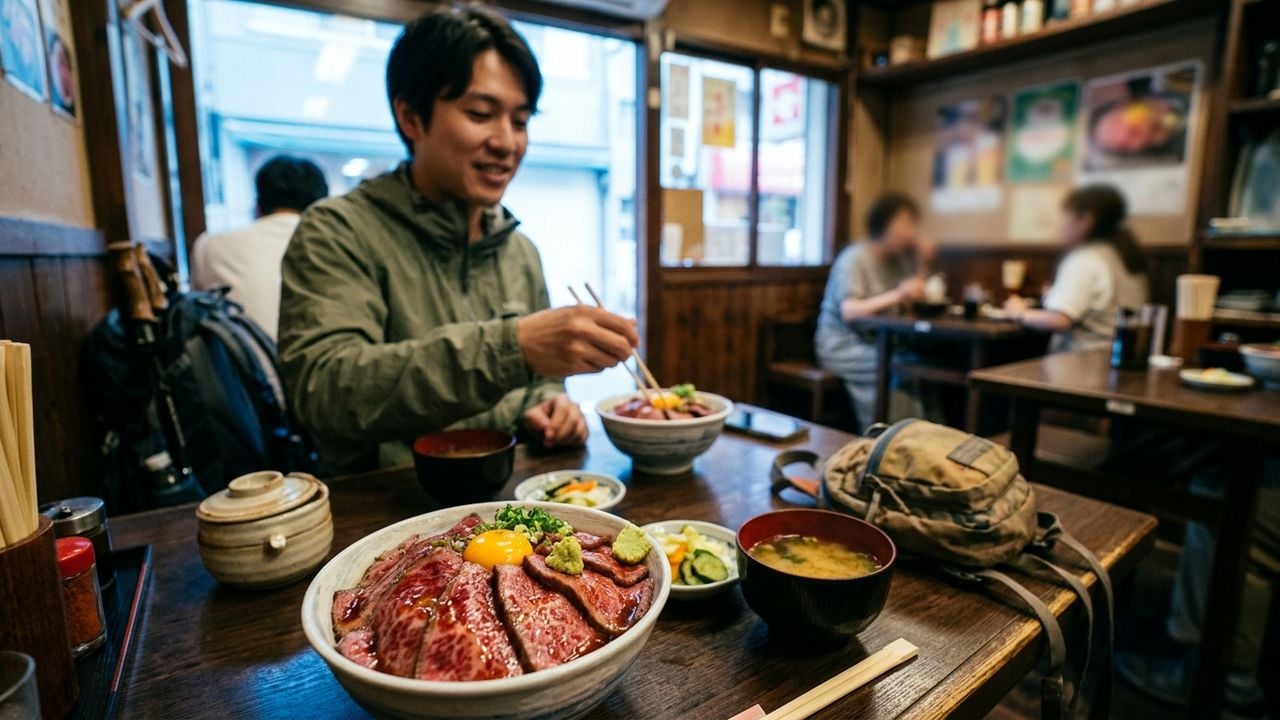
Why 10 Bowls a Day — The Numbers Behind the Scarcity
Horai Wagyu isn't a marketing limitation. It's a biological one.
Of Japan's estimated 500,000 wagyu cattle, Horai Wagyu accounts for roughly 300 heads raised annually — across just 3 farms in Okumikawa, deep in Aichi Prefecture's mountain interior. These animals are raised on a specific diet that incorporates sake lees from Horaisen Sora, a premium local sake, which shapes the beef's distinctive character: lighter marbling than typical wagyu, with a lean-meat depth that stands apart from the familiar richness of Kobe or Matsusaka.
That's 300 animals per year, nationwide. Not per prefecture — nationwide.
Masayuki Goto, who founded Itadaki in Osu in April 2022, built a direct-supply partnership with these farms from the beginning — partly as a practical sourcing strategy, and partly as a commitment born during the pandemic, when small producers of premium Aichi ingredients were struggling with unsold harvests. The 10-bowl daily limit at Itadaki isn't about creating artificial scarcity. It's about how much of this beef can actually be delivered fresh, and used with integrity.
That context matters when you're planning your visit. If you're traveling through Nagoya on a tight schedule — say, arriving from Tokyo in the morning and departing for Takayama on an afternoon Limited Express — you genuinely cannot afford to walk in at 12:30 and discover the Horai Wagyu sold out an hour earlier.
You've just learned that Horai Wagyu is limited to 10 bowls a day — and that irregular closures can affect any given date. Itadaki's monthly business calendar is posted on Instagram, and it's the only reliable way to confirm your target date is actually open. A quick check before you finalize your mountain journey itinerary takes under a minute.
The Reservation Playbook: Step by Step for International Visitors
Tabelog is Japan's most widely used restaurant reservation platform, but it's not commonly known outside Japan. Here's exactly how to use it to secure your Horai Wagyu bowl.
Step 1: Go to Itadaki's Tabelog reservation page. The interface is available in English — you don't need to navigate Japanese menus.
Step 2: Select your preferred date and time. Itadaki is open for lunch only (11:00–15:00), and operates on Saturdays, Sundays, Mondays, and Tuesdays. Last order is 30 minutes before closing. Note that August 25, 2026 (Tuesday) is a regular business day, so if you're traveling in late August around the time this article is published, midweek lunch slots are worth checking.
Step 3 — the most important step: In the notes or special requests field, copy and paste the following Japanese phrase exactly as written:
鳳来牛希望
This translates to "Horai Wagyu requested." Staff at Itadaki will see this note and hold your Horai Wagyu bowl allocation. Without this phrase, a standard reservation does not automatically guarantee the Horai Wagyu — it only reserves your seat.
The reservation itself can be completed entirely in English. The Japanese phrase is needed only in the notes field so the kitchen can prepare accordingly.
One practical note: Itadaki's business calendar occasionally changes. Irregular closures do happen. Before your trip, cross-check your selected date against the monthly schedule posted on Itadaki's official Instagram — it's updated monthly and is the most reliable source for confirmed open days.
✓ Key Takeaways
- Horai Wagyu is limited to 10 bowls per day due to genuine supply scarcity — 300 heads raised annually across 3 farms in Japan.
- Reserve via Tabelog Online in English, and include the note 鳳来牛希望 to specifically request Horai Wagyu.
- Always confirm your visit date against Itadaki's monthly Instagram calendar before finalizing travel plans.
You now have the note to paste — 鳳来牛希望 — and you know the reservation process runs entirely in English on Tabelog. The one remaining step is actually locking in the date before your travel window closes. Reservations are made through Tabelog Online, and securing your seat takes only a few minutes.
If You're Walking In: What the Numbers Tell You
Not every itinerary allows time for advance planning. If you're arriving without a reservation — perhaps you're passing through Nagoya unexpectedly, or your schedule only solidified the night before — here's how to read your odds.
Opening time is 11:00. Arriving at or before 11:00 gives you the strongest chance of securing Horai Wagyu as a walk-in guest. Peak lunch traffic in the Osu district typically builds between 12:00 and 13:30, and at 10 bowls per day, the Horai Wagyu allocation can be gone well before 13:00 on busy days.
The walk from Yabacho Station Exit 4 (Meijo Subway Line) to Itadaki's second-floor entrance at 4-1-20 Osu takes about 4 minutes. From Nagoya Station, the total journey via the Higashiyama Line to Sakae, then the Meijo Line to Yabacho, is approximately 10 minutes. If you're building a morning Nagoya itinerary — say, Osu Kannon Temple followed by a stroll through the Osu Shopping Street — timing your arrival at Itadaki right at opening is entirely manageable.
If Horai Wagyu is already gone when you arrive, Mikawa Beef Rare Gyudon is always available. This is Itadaki's second signature offering, prepared using the same proprietary two-stage cooking technique that brings the beef to over 70°C at its core while preserving a rare-style texture. Mikawa Beef comes from Aichi's Mikawa region, raised on okara feed with careful gut management — a completely different animal profile from Horai Wagyu, and worth experiencing on its own terms. The Fumoto size (100g beef, 200g rice) starts at ¥1,800.
For a deeper look at how the two wagyu compare in character and flavor, this guide on Horai Wagyu versus other rare wagyu walks through the differences in detail.
"The rare wagyu was unlike anything I've ever tasted — a life-changing culinary experience."
— Guest review
That kind of response is what we hear consistently from guests who make the extra effort to plan ahead. And the planning, as you've now seen, is simpler than it might initially appear.
The Mountain Journey Context: Why This Particular Lunch Matters
Travelers routing through Nagoya on their way to or from Shirakawa-go and Takayama often find themselves with a compressed Nagoya window — one morning, one afternoon, one meal to make count. The Osu district puts a remarkable amount within walking distance: Osu Kannon Temple, the 1,200-shop Osu Shopping Street, and Hisaya-odori Garden Flarie just three minutes from Yabacho Station — a free-admission urban garden featured in major English travel guides, and genuinely worth the detour before or after lunch.
Itadaki sits on the second floor at 4-1-20 Osu, in the heart of this neighborhood. 18 seats, sofa-style table seating throughout, no dinner service — just a focused lunch experience built around one idea: that the gyudon, Japan's most humble comfort food, deserved a version worthy of the finest Japanese ingredients. Everything on the table at Itadaki comes from Aichi Prefecture — the rice, the sauce, the miso, the pickles, the egg, the condiments. For travelers who have spent days moving through Japan's mountain regions, there's something grounding about sitting down to a bowl that tells the full story of a single prefecture.
Itadaki has been featured on 8 major Japanese television programs, including NHK, since opening in 2022. It was recognized as the originator of the "Rare Wagyu Gyudon" culinary concept — a category that didn't exist before Goto asked a simple question: why was gyudon the only Japanese rice bowl without a premium version?
If you're curious about how to enjoy the rare wagyu bowl step by step, we've put together a detailed guide covering the five-stage eating method — including what to do with the Nagoya Cochin egg, when to add wasabi, and how to work through the complimentary condiments at the table.
The Practical Summary: Your Pre-Departure Checklist
Before you finalize your Nagoya lunch plan, run through these numbers one more time:
- 10 — bowls of Horai Wagyu available per day, no exceptions
- 300 — heads of Horai Wagyu raised annually across all of Japan
- 3 — farms in Okumikawa producing Horai Wagyu
- 4 years — since Itadaki opened in April 2022, refining this concept daily
- 11:00 — opening time; arriving at opening maximizes walk-in availability
- 鳳来牛希望 — the phrase to paste into your Tabelog reservation notes
The Horai Wagyu bowl at the Shinkoccho (standard) size — 100g beef, 200g rice — is ¥2,700 tax included. Larger sizes are available. There are no set menus; everything is ordered à la carte, so you can tailor the experience to your appetite and interest.
Whether your mountain journey took you through Shirakawa-go's thatched-roof farmhouses or Takayama's preserved merchant streets, Nagoya's Osu district offers a very different kind of discovery — one that's specifically about the ingredients and craft of Aichi Prefecture. Itadaki is where that discovery happens over a single, carefully composed bowl.
For our complete menu, access details, and store information, visit our official page at https://itadaki8.com/english/.
Your Nagoya lunch window is short, and those 10 Horai Wagyu bowls don't wait. Now that you know exactly how to reserve — in English, with one Japanese phrase in the notes field — the next move is straightforward. Confirm your date, paste 鳳来牛希望, and arrive knowing your bowl is ready.