Is Rare Wagyu Safe to Eat in Japan?
 gotowp
Late August in Nagoya — the summer heat hasn't let up, and the Osu district is buzzing with visitors from every corner of the world. If you've made it this far into your Japan trip, there's a good chance you've already tasted quite a bit: ramen at a counter where you ordered from a vending machine, sushi at a conveyor belt restaurant, maybe tempura at a place that handed you a picture menu. And somewhere along the way, you probably heard about wagyu.
But then came the hesitation. Rare wagyu? That sounds like something you'd need to speak fluent Japanese to navigate — and to understand whether it's actually safe. We hear this concern from guests almost every week at Itadaki, and it's one worth answering properly.
Yes, the rare wagyu gyudon at Itadaki is safe to eat in Japan. It's prepared using our proprietary two-stage cooking technique, which heats the beef to over 70°C at the core — fully meeting Japan's Ministry of Health, Labour and Welfare food safety standards — while preserving a rare-style mouthfeel. And yes, you can order and enjoy the entire experience in English, without speaking a single word of Japanese.
Who This Is For
- ✅ Visitors who feel nervous about dining at local Japanese restaurants due to language barriers
- ✅ Travelers who've heard about rare wagyu gyudon but aren't sure how to order or what to expect
- ✅ Anyone curious about food safety around rare-style beef in Japan
- ✅ First-time visitors to Nagoya looking for an authentic experience that's still accessible
- ✅ Wagyu enthusiasts who have already tried Kobe or Matsusaka beef and want to discover something new
Is rare wagyu actually safe to eat in Japan?
This is the question that stops a lot of visitors before they even look up the address. The word "rare" attached to beef can trigger understandable concern — especially if you're used to food safety guidelines back home that advise against undercooked meat.
Here's the honest answer: at Itadaki, the wagyu is not raw. Our two-stage cooking technique was developed specifically to deliver the silky, melt-in-your-mouth texture of rare-style beef while ensuring the core temperature reaches over 70°C — the threshold required by Japan's national food safety standards. This isn't a workaround or a loophole. It's a genuine technical achievement that took real development to get right, and it's the reason we can serve this dish with confidence.
Masayuki Goto, our founder, holds a Certified Food Sanitation Supervisor qualification issued by Japan's Ministry of Health, Labour and Welfare. He didn't build this concept on a hunch — he built it on a foundation of food safety expertise applied to a culinary vision. Every bowl served at Itadaki follows the precise recipe and standards he developed.
So if you've been hesitating because of food safety concerns: that concern is valid, and it's been taken seriously from day one here.
You now know the rare wagyu is safely prepared and the menu is in English — but whether the Horai Wagyu will still be available on the day you visit is a different question entirely. Our monthly business calendar tells you exactly which days we're open and helps you plan around our limited 10-bowl-per-day supply. It takes a few seconds to check.
Will I be able to order without speaking Japanese?
Completely and comfortably, yes. This is something we've put genuine thought into, because we know how easily language anxiety can turn a promising restaurant experience into an awkward one — and how that anxiety often pushes visitors toward familiar international chains instead of the places that make Japan worth traveling to.
At Itadaki, every table is provided with a fully printed menu in English, Simplified Chinese, and Korean. Each item comes with a photo, a clear price, and an explanation of the ingredients. There's no guesswork, no pointing at characters and hoping for the best.
Beyond the menu itself, we also include a visual step-by-step guide called "How to Enjoy Rare Gyudon" — five illustrated steps that walk you through the entire experience: how to separate the egg yolk from the white, when to mix, when to add the condiments, and how to finish with wasabi. You don't need a staff member to explain it. The guide does that for you, and it makes the dish more enjoyable precisely because you understand what's happening at each stage.
If you have specific questions — about allergens, portion sizes, or anything else — our staff welcomes communication, and translation apps work perfectly well in our space. We've served guests from dozens of countries, and the experience is designed to feel welcoming to everyone who walks through the door.
✓ Key Takeaways
- The rare-style wagyu at Itadaki is cooked to Japan's required food safety standards using a proprietary two-stage technique — the texture is rare, the safety is not compromised
- A fully printed multilingual menu (English, Chinese, Korean) with photos and a 5-step visual guide means you can order and enjoy the meal entirely without Japanese
The five-step guide and multilingual menu remove the language barrier — but the 10 daily bowls of Horai Wagyu don't wait for walk-ins. If Horai Wagyu is the reason you're making the trip to Osu, securing your bowl in advance is the one step the menu can't do for you. Reservations are made through Tabelog Online.
What happens if I don't know what the dish is supposed to taste like?
That's exactly what the five-step guide is for — and honestly, it's part of what makes the meal memorable rather than just a bowl of beef and rice.
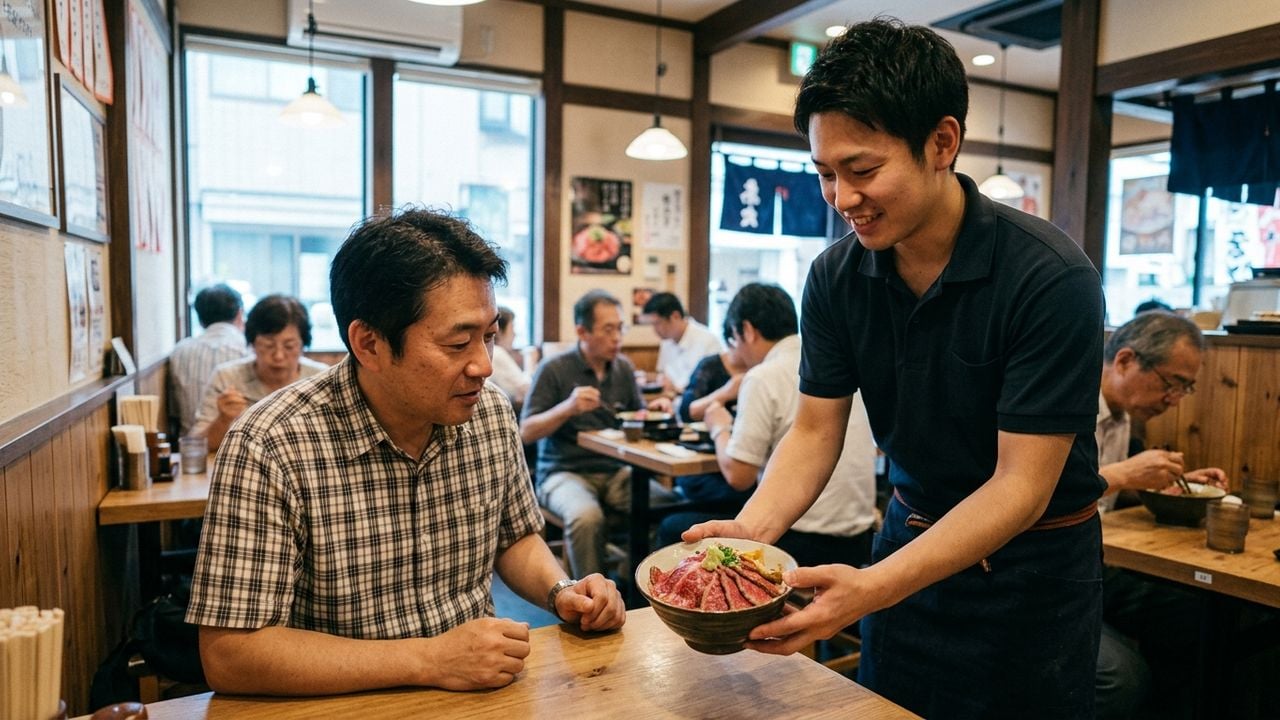
The dish arrives beautifully presented: thin slices of wagyu fanned over steaming Aichi-grown rice, a raw Nagoya Cochin egg sitting on top, and a row of complimentary condiments along the side — pickled ginger, dried nori seaweed, chirimen jako (tiny dried whitebait), and our original 8-spice blend. It's visually striking in a way that earns its Instagram reputation, and the guide tells you what to do next.
Step one: separate the egg. The white goes into your miso soup (yes, that's intentional, and yes, it's excellent). The yolk stays on the beef. Step two: taste the wagyu first, before mixing anything, so you can appreciate the Horai Wagyu on its own terms. Steps three through five build the flavor progressively — the yolk, the condiments, then the wasabi as a clean finish.
We've had guests tell us they initially weren't sure what to make of the dish when it arrived, then couldn't stop thinking about it for the rest of their trip. One guest who had already tried Kobe beef and Matsusaka beef put it simply:
"I've had Kobe beef and Matsusaka beef, but Horai Wagyu at Itadaki was on another level."
That reaction isn't about price or prestige. It's about eating something genuinely uncommon — Horai Wagyu from Okumikawa, raised by just three farms in Japan with only 300 heads produced annually, fed on sake lees from Horaisen Sora — and understanding the story behind it as you eat.
For guests who've made it this far in their Japan travels and want to understand how Itadaki fits into a broader Nagoya food itinerary, our piece on finding an authentic rare wagyu bowl near Sakae covers some helpful context for navigating the area.
Are there any dietary concerns I should know about before visiting?
Honest communication matters here, so let us be straightforward. Itadaki is a wagyu specialty restaurant — we do not offer vegetarian, vegan, or Halal-certified options, and our beef is not Halal-certified. If you have strict dietary requirements along those lines, we'd rather tell you now than have you arrive and be disappointed.
For common allergens: soy is present in our soy sauce, miso, and pickled radish. Wheat is in the soy sauce. A Nagoya Cochin egg comes with every gyudon by default (it can be removed at a small reduction in price). The chirimen jako topping on the condiment tray contains sesame — if you have a sesame allergy, simply avoid that condiment; our original 8-spice blend does not contain sesame.
If you have a severe allergy, please let us know at the time of reservation. Our kitchen is a small, focused operation, and while we take every care, we cannot fully guarantee against cross-contamination.
If you're traveling with children and wondering about the rare-style preparation specifically, we've addressed that in detail separately — you can read our full guide on whether children can eat rare wagyu at Itadaki safely.
Do I need to make a reservation, or can I walk in?
Walk-ins are welcome, but if you have your heart set on the Horai Wagyu — the ultra-rare variety — a reservation is strongly recommended. We limit Horai Wagyu to 10 bowls per day. During peak hours in summer, those bowls can be gone well before our 2:30 PM last order. Reservations are made through Tabelog Online.
Our Mikawa Beef Rare Gyudon is always available and does not require a reservation, starting from ¥1,800 for the standard size. But if Horai Wagyu is the reason you're making the trip, don't leave it to chance.
We're open for lunch only — Tuesday, Monday, Saturday, and Sunday from 11:00 to 15:00 (last order at 14:30). We're closed Wednesday through Friday. On public holidays, we open at 9:00. Our monthly business calendar is posted on Instagram, so it's worth checking before you plan your visit.
Getting here is straightforward: we're a 4-minute walk from Yabacho Station Exit 4 on the Meijo Subway Line, and also within comfortable walking distance from Sakae, Kamimaezu, and Osu Kannon stations. From Nagoya Station, the whole journey takes around 10 minutes by subway.
If you're working Nagoya into a broader Central Japan itinerary — perhaps combining it with a mountain journey through Gifu Prefecture — our guide for finding a rare wagyu bowl between mountain trips might help you time your visit well.
What if I still have questions when I arrive?
Bring your questions. Bring your translation app. Bring your curiosity. The printed multilingual menu covers the vast majority of what you need to know before your bowl arrives, and the five-step guide covers the rest. Our staff is genuinely pleased to welcome international visitors, and the restaurant's 18 seats are designed for a relaxed, unhurried lunch — not a rushed conveyor-belt experience.
The name "Itadaki" comes from "itadakimasu" — the expression of gratitude Japanese people say before eating. It reflects something real about how we think about every ingredient, every farmer, and every guest who sits down here. You don't need to speak Japanese to feel that. You just need to show up.
For our complete menu, access details, and store information, visit our official page at https://itadaki8.com/english/.
You've read through how the dish is prepared, how to order it in English, and what to watch out for with allergens — the picture is clear. What's left is claiming your seat before those 10 daily Horai Wagyu bowls are gone. Reservation takes just a moment through Tabelog Online.