Inside Look: The Nagoya Lunch Scene Guidebooks Don't Show
 gotowp
A guest stopped me after finishing her bowl last month and said something I didn't expect: "I almost didn't come. I read 'rare wagyu' on your menu and got nervous. My husband said we should skip it."
She ended up ordering anyway — after her hotel concierge reassured her that Itadaki had appeared on NHK. And when she finished, she turned to me and said those words I'll always remember: "The lunch was the highlight of my Nagoya trip — I'm telling all my friends about it."
That moment stuck with me. Because she was so close to missing it entirely — not because the dish wasn't right for her, but because nobody had explained what "rare wagyu" actually means in the Japanese context. The guidebooks that list Nagoya's sights rarely go there. Food blogs gloss over it. And so visitors arrive in this city carrying a very reasonable concern, with nowhere to get a real answer.
That's what this article is for.
Who This Is For
- ✅ Travelers who've seen "rare wagyu" on Itadaki's menu and aren't sure if it's safe to eat
- ✅ Visitors from the US, Europe, or Australia where undercooked beef carries well-known health warnings
- ✅ Foodies exploring Nagoya's lunch scene beyond what the standard travel guides recommend
- ✅ Anyone who wants to understand the actual cooking method before making a reservation
- ✅ Repeat Japan visitors curious about what Osu district offers that isn't in the typical itinerary

Why "Rare Wagyu" Sounds Alarming If You Grew Up in the West
If you're from the United States, the UK, Australia, or most of Western Europe, you've been told — correctly, in your local context — that undercooked ground beef is dangerous. Regulatory bodies like the USDA and the UK Food Standards Agency recommend cooking beef to safe internal temperatures precisely because bacterial contamination risks are real in those supply chains.
So when a restaurant in Japan advertises a "rare wagyu beef bowl," the immediate instinct for many Western visitors is caution. That's not irrational. It's a lifetime of good food safety habits applied to an unfamiliar situation.
The gap isn't in your judgment — it's in the information available to you. Because what's happening at Itadaki is genuinely different from what you're imagining.
If the two-stage cooking technique has answered your safety question but you're still unsure which days Itadaki is actually open during your Nagoya stay, that's the next piece you need. Our monthly business calendar — including any irregular closures — is posted on Instagram so you can plan around your itinerary with confidence. No account required to view the schedule.
What "Rare" Actually Means at Itadaki — The Two-Stage Cooking Technique
Here's the part the guidebooks skip.
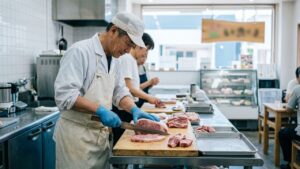
At Itadaki, our "rare" preparation is not raw beef. It is not a seared exterior with a cold, uncooked center. What we serve is the result of a proprietary two-stage cooking technique — developed specifically to meet Japan's Ministry of Health, Labour and Welfare food safety standards — that heats the beef to over 70°C at the core.
Let that number land for a moment. 70°C at the core. That's not surface temperature. That's the internal temperature throughout the beef, verified and repeatable. Japan's food safety regulations for restaurants are among the strictest in the world, and our method was built around those standards from day one.
So why does it still feel rare?
That's the craft. The technique controls temperature and timing across two distinct stages to preserve the texture that makes wagyu extraordinary — that soft, yielding quality that melts rather than chews — while eliminating the bacterial risk entirely. It took real development to get there, and it's one of the reasons Itadaki was featured on NHK and seven other major Japanese television programs. Not because we claimed something dramatic, but because what we achieved is genuinely unusual.
I hold a Certified Food Sanitation Supervisor qualification from Japan's Ministry of Health, Labour and Welfare. Itadaki is a fully licensed restaurant operator under Aichi Prefecture's Public Health Center. The safety infrastructure behind every bowl is not an afterthought — it is the foundation the entire restaurant was built on.
✓ Key Takeaways
- Itadaki's "rare" wagyu is cooked to over 70°C at the core — fully meeting Japan's official food safety standards
- The proprietary two-stage cooking technique was purpose-built to deliver rare texture without bacterial risk
- The restaurant operates under full licensing from Aichi Prefecture's Public Health Center
You now know that the "rare" in our wagyu gyudon means over 70°C at the core — not raw, not a gamble. The one remaining variable is whether Horai Wagyu will still be available when you arrive, since only 10 bowls are made each day. Securing your seat in advance via Tabelog removes that uncertainty entirely. The reservation form is in Japanese, but the process takes only a few minutes.
The Beef Itself: Why Source Quality Matters for Safety
Food safety isn't only about cooking temperature. It begins long before the beef reaches the kitchen.
Every bowl at Itadaki uses either Horai Wagyu or Mikawa Beef — both raised in Aichi Prefecture under rigorous quality control by farms we source from directly. Horai Wagyu, in particular, is produced by only three farms in Japan, with just 300 heads raised annually. These are not industrial-scale operations. They are small, traceable, relationship-based farms where quality control is personal and documented.
The Horai Wagyu cattle are fed on sake lees from Horaisen Sora — a premium local sake from Okumikawa — which contributes to their distinctive flavor profile. But the feeding method also reflects the kind of careful, considered husbandry that defines how this beef is raised. We know where this beef comes from, who raised it, and how. That traceability is part of what makes our preparation possible at all.
This is the Nagoya lunch scene that doesn't appear in most guidebooks: not the famous chain restaurants, not the widely translated tourist spots, but a small, focused restaurant in Osu that has spent years building direct relationships with Aichi's farmers because it believed that the best bowl had to start with the best source.
If you're curious about how Osu district itself fits into Nagoya's broader character — the history behind those streets, the temples, the subculture — this look at why the Osu Kannon area preserves old Nagoya goes deeper into the neighborhood Itadaki calls home.
"The lunch was the highlight of my Nagoya trip — I'm telling all my friends about it."
— Guest from overseas, visiting Nagoya as part of a Japan itinerary
What to Expect When You Sit Down: The Five-Step Experience
Understanding the safety of the dish is one thing. Knowing how to eat it is another — and this is where Itadaki differs from almost any other lunch experience in Nagoya.
Our English menu includes a five-step eating guide, and the staff are glad to walk you through it. Here's the short version:
- Separate the Nagoya Cochin egg — place the white into your miso soup, set the yolk on top of the beef.
- Taste the wagyu first, on its own. Before mixing anything, appreciate what Horai Wagyu actually tastes like — the texture, the depth of flavor from that sake-lees feed.
- Mix the yolk with the beef for a richer, silkier bite.
- Add the condiments at your own pace — pickled ginger from Kimura Farm in Inazawa, chopped seaweed from Mikawa Bay, chirimen jako, and our original eight-spice blend.
- Finish with wasabi for a clean, refreshing final note.
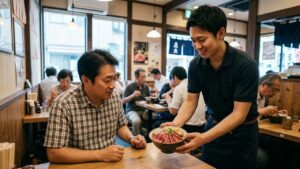
The dish is visually striking — served in traditional Japanese ceramic ware with vibrant colors from the egg yolk, deep red beef, and green shiso. Every element on the table, from the rice (Aichi no Kaori, grown in Aichi Prefecture) to the Atsumi Ichō-zuke pickles from the Atsumi Peninsula, comes from somewhere in Aichi. It's the kind of lunch that gives you a story to bring home, and the kind of presentation that photographs beautifully if you want to share it.
For visitors who want the full picture of how Itadaki fits into a Nagoya stay — the access, the neighborhood, the practical logistics — this complete Nagoya lunch guide for second-time Japan visitors covers the bigger context well.
Practical Notes Before You Visit
Itadaki is open for lunch only — 11:00 to 15:00 — on Saturdays, Sundays, Mondays, and Tuesdays (with last order 30 minutes before closing). On public holidays, we open from 09:00. We are closed Wednesdays through Fridays, and occasional irregular closures do happen. Our monthly business calendar is posted on Instagram, so it's worth checking before you make the trip.
Horai Wagyu is limited to 10 bowls per day. On busy mornings, these do sell out. If the Horai Wagyu bowl — the Shinkoccho at ¥2,700 — is the reason you're visiting, booking ahead via Tabelog is the practical move. Mikawa Beef gyudon is always available and starts from ¥1,800.
We're on the 2nd floor at 4-1-20 Osu, Naka-ku — a four-minute walk from Yabacho Station Exit 4 on the Meijo Subway Line. Menus are available in English, Simplified Chinese, and Korean. The 18-seat dining room has sofa-style table seating throughout, which makes for a relaxed, unhurried lunch — the kind you'd want for a dish worth paying attention to.
For our complete menu, access details, and store information, visit our official page at https://itadaki8.com/english/
The Lunch That Doesn't Make the Guidebooks — and Why That's the Point
Most Nagoya lunch recommendations in travel guides are built around familiarity: miso katsu, hitsumabushi, tebasaki. These are genuinely worth trying. But the lunch that stays with you — the one you're still talking about on the flight home — usually comes from somewhere the guidebook didn't send you.
The guest I mentioned at the start almost missed it. She came anyway, asked a real question ("Is this actually safe?"), got a real answer, and finished her bowl with a decision already made: she was going to tell her friends.
That's the Nagoya lunch scene this article is about. Not hidden in the sense of obscure or difficult — we're four minutes from a subway exit — but hidden in the sense that you have to be curious enough to look past the first page of results. If you're reading this, you already are.
You've read about the technique, the traceability, and what to expect when the bowl arrives. The last step is making sure you actually get a seat — and a bowl of Horai Wagyu — on the day you plan to visit. With only 10 available each day, a Tabelog reservation is the straightforward way to make this lunch happen.