The Complete Business Traveler's Guide to Nagoya Lunch
 gotowp
A few weeks ago, a guest stopped me on his way out and said something that's stayed with me. He was a business traveler — in Nagoya for meetings related to the automotive industry — and he'd almost skipped lunch entirely because, as he put it, "I wasn't sure I'd be able to figure out the menu without Japanese." He'd defaulted to the hotel restaurant the day before. On his last afternoon in Nagoya, a colleague pointed him toward Itadaki. He ordered, ate, and then stood at the door for a moment before turning around to say: "I should have come here on day one."
I think about that guest a lot. Not because it was a compliment — but because the anxiety he described is so common, and so unnecessary. If you're in Nagoya on business and wondering whether you can actually enjoy a proper local lunch without Japanese language skills, this guide is for you.
Who This Is For
- ✅ Business travelers in Nagoya looking for a memorable and efficient lunch near the city center
- ✅ Anyone who has felt hesitant about dining at an authentic Japanese restaurant due to language barriers
- ✅ Visitors who want to experience something genuinely local — not a hotel buffet or international chain
- ✅ Wagyu enthusiasts who want to discover a rare Aichi Prefecture beef experience beyond the usual brands
- ✅ Travelers with only a short lunch window who want a smooth, stress-free dining experience
The Real Reason Business Travelers Skip Local Restaurants in Japan
It's not about time. Most business lunches in Japan are done well within 60 to 90 minutes, and local specialty restaurants — especially lunch-only spots — are built for exactly that pace. The real barrier is language.
When you walk into an unfamiliar restaurant and the menu is entirely in Japanese, the mental arithmetic starts immediately. Can I ask about allergens? Will I accidentally order something I don't recognize? Will pointing at a picture be rude? What if I need to explain a dietary preference? That mental load is exhausting when you're already navigating a full day of meetings, and it pushes even adventurous travelers toward the safe, familiar option: the hotel restaurant, the conveyor belt sushi chain, the familiar international brand.
What gets lost in that calculation is the actual lunch — the kind of meal that becomes a story you tell when you're back home, the one that makes your colleagues jealous they didn't come with you.
At Itadaki, we designed the entire dining experience with this specific anxiety in mind. Because our guests should be thinking about the food — not decoding the menu.
How Itadaki Removed the Language Barrier — Completely
When I founded Itadaki in 2022, I made a deliberate decision: if we were going to create a new culinary concept — the Original Rare Wagyu Gyudon — it had to be accessible to every guest who walked through the door, regardless of their Japanese ability. That meant building language support into the restaurant itself, not treating it as an afterthought.
Here's what that looks like in practice:
Fully printed multilingual menus — Every guest receives a physical menu in English, Simplified Chinese, or Korean, with clear photos of every dish, prices listed with tax included, and ingredient explanations written in plain language. You'll know exactly what you're ordering before you order it.
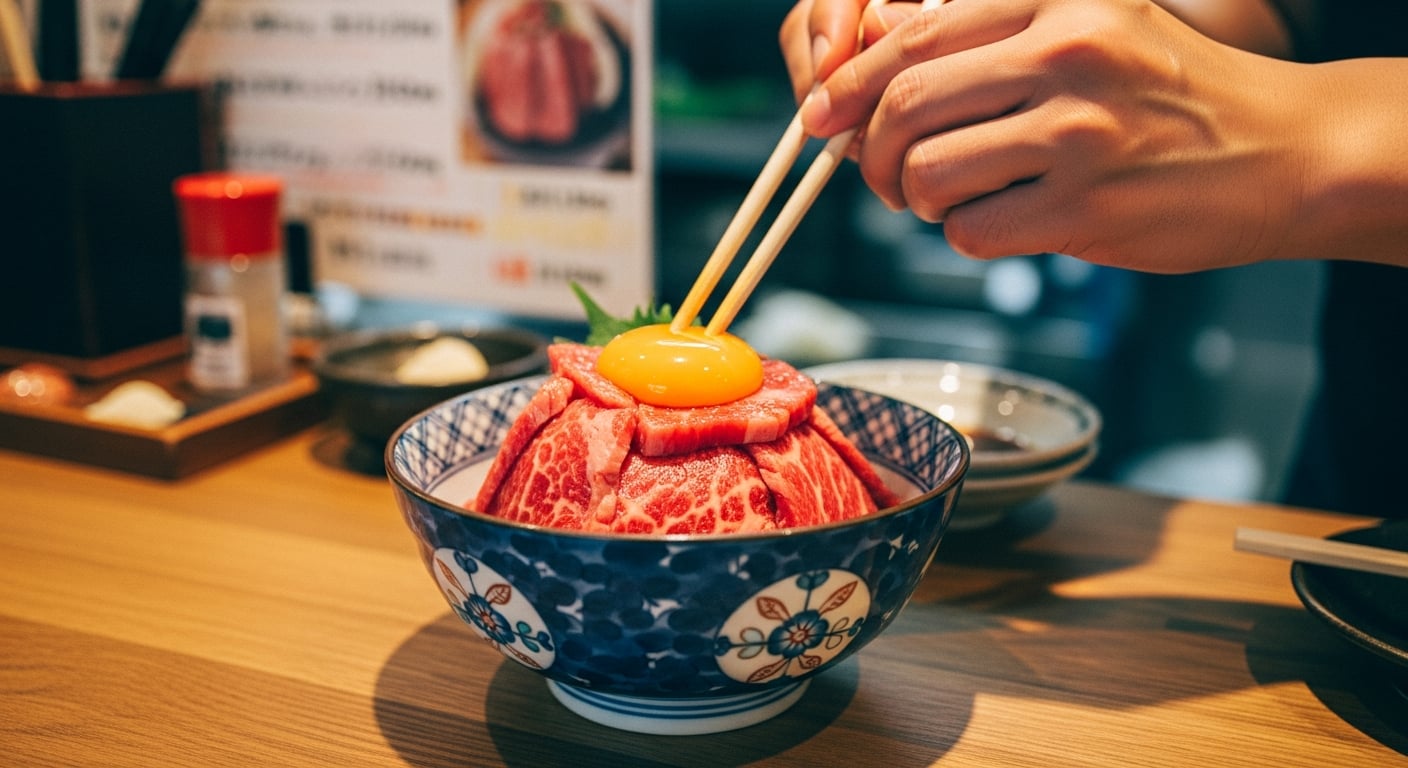
A step-by-step visual eating guide — Because Rare Wagyu Gyudon is unlike anything most international visitors have encountered before, our menu includes a five-step illustrated guide titled "How to Enjoy Rare Gyudon." It walks you through how to handle the Nagoya Cochin egg (separate the white into the miso soup, place the yolk on the beef), when to mix, when to add condiments, and how the experience is meant to unfold. It's not just instructions — it's an invitation to engage with the dish the way it was designed to be eaten.
Point-and-order simplicity — The menu is designed so that even without a single shared word between you and the staff, you can point confidently at what you want. There's no hidden complexity, no verbal customization required unless you want it.
Welcoming staff — Our team is accustomed to serving international guests. Translation apps work perfectly at our counter and tables. You'll never feel like an inconvenience here.
One guest described it simply: "The English menu with clear serving instructions made the experience stress-free."
✓ Key Takeaways
- The most common reason business travelers skip local Japanese restaurants is language anxiety — not time or preference
- Itadaki offers fully printed menus in English, Simplified Chinese, and Korean, with photos, prices, and ingredient details
- A five-step visual eating guide is included with every menu — so the dining experience is intuitive, not confusing
Understanding the Dish: Why the Five-Step Guide Matters
Let me be honest with you for a moment. Rare Wagyu Gyudon is not a dish you can fully appreciate by simply picking up your chopsticks and eating. The experience is layered — intentionally so — and the five-step guide exists because each stage of the meal reveals something different about the ingredients.
When the bowl arrives, the Nagoya Cochin egg sits whole on top of the beef. Step one is to crack it deliberately: the white goes into your miso soup (where it gently cooks in the heat of the broth), and the golden yolk stays with the beef. In the first two bites, you eat the wagyu as it is — no egg, no condiments — so you can taste the beef itself. The marbling of Horai Wagyu, fed on sake lees from the Horaisen Sora brewery, has a delicate sweetness that's worth meeting on its own terms before anything else is added.
Then the yolk goes in. The texture shifts — richer, silkier. Then you begin to explore the tabletop condiments: pickled ginger from Kimura Farm in Inazawa City, dried seaweed from Mikawa Bay, tiny chirimen jako (dried whitebait) from Minamichita, and Itadaki's original eight-spice blend. Each addition opens a slightly different version of the same bowl. The final step — a touch of wasabi — is a palate reset, clean and sharp against the richness that came before.
All of this is illustrated, step by step, in the guide. You don't need to memorize it. You don't need Japanese. You simply follow the pictures.
That's the thinking behind it: we want every guest — whether they're a wagyu connoisseur or someone who has never heard of Horai Wagyu — to have the complete experience. Not a shortened or simplified version of it.
"The lunch was the highlight of my Nagoya trip — I'm telling all my friends about it."
— Guest review
Planning Your Lunch Visit: What Business Travelers Need to Know
Itadaki operates lunch service only — Tuesday, Saturday, Sunday, and Monday from 11:00 to 15:00 (last order at 14:30). On public holidays, we open at 09:00. We're closed Wednesday through Friday. Please check our Instagram for the monthly business calendar, as irregular closures do occasionally apply.
Getting here from Nagoya Station takes approximately 10 minutes by subway: take the Higashiyama Line to Sakae, transfer to the Meijo Line, and exit at Yabacho Station, Exit 4. We're a four-minute walk from there. Look for the sign reading 元祖レア牛丼 頂 ("Ganso Rea Gyudon Itadaki") at street level, and take the stairs to the second floor.
For Horai Wagyu — our ultra-rare wagyu produced by only 3 farms in Japan with just 300 heads raised annually, strictly limited to 10 bowls per day — advance reservation via Tabelog Online is strongly recommended. When reserving, copy and paste 鳳来牛希望 into the notes field to request Horai Wagyu. Our Mikawa Beef Rare Gyudon is always available for walk-in guests and is equally crafted with the same proprietary two-stage cooking technique.
Average time per visit is around 45 to 60 minutes — comfortable for a business lunch schedule. The 18-seat dining room includes five counter seats, which are particularly well-suited for solo diners. Sofa-style seating at the tables makes the experience relaxed without feeling rushed.
We accept major credit cards, as well as Apple Pay and Google Pay. No Japanese cash is required.
A Note on the Food Safety Question
Business travelers from the US, Europe, and Australia sometimes pause when they hear "rare wagyu." The instinct is understandable — public health advice in many Western countries cautions against undercooked beef. It's a fair question, and I'd rather answer it directly than leave it as a footnote.
Our rare-style preparation uses a proprietary two-stage cooking technique that heats the beef to over 70°C at the core — fully meeting Japan's Ministry of Health, Labour and Welfare food safety standards. The texture reads as rare; the safety profile is complete. It took years to develop this technique to the point where it satisfied both criteria simultaneously, and it is one of the things that makes Itadaki genuinely different from anything else you'll find in Japan.
The mouthfeel is exceptional. The science behind it is sound. You can eat with complete confidence.
Making the Most of Your Nagoya Lunch Break
If your schedule allows even a small amount of time before or after lunch, the Osu district is worth a short walk. Osu Kannon Temple is five minutes from us on foot — one of Central Japan's most significant Buddhist sites, and a quietly beautiful place to spend 10 minutes before a meal. Hisaya-odori Garden Flarie, a free-admission urban garden featured in major English travel guides, is just three minutes from Yabacho Station — the same station you'll arrive at to reach Itadaki.
Neither requires advance planning or language skills. Both are worth the time, if you have it.
And if you don't — if today is purely a quick lunch between meetings — Itadaki is designed to work for that too. The experience is complete in an hour. The story it gives you lasts considerably longer.
For our complete menu, access details, and store information, visit our official page at https://itadaki8.com/english/
Ready to reserve your seat? Horai Wagyu is limited to 10 bowls per day — we'd love to hold one for you.
Reserve Your Rare Wagyu Experience
Not sure of your schedule yet? Follow us on Instagram to check our monthly business calendar and plan when you're ready.
Check Our Monthly Schedule on Instagram