How Our Family Discovered Itadaki Before Ghibli Park Visit
 gotowp
There's a particular kind of travel magic that happens when you weren't looking for it. You've planned the big things — the park tickets, the hotel, the train passes — and then something completely unplanned ends up being the moment everyone talks about on the flight home.
That's exactly what happened to us on our way to Ghibli Park.
We had two full days in Nagoya before heading into Aichi's countryside. Day one was earmarked for Ghibli Park in Nagakute — tickets booked months in advance, the whole routine. But Day two? We'd blocked it loosely as "Nagoya sightseeing" without much of a plan. A friend had mentioned Osu district, describing it as Nagoya's answer to Akihabara but with more soul. We decided to wander in that direction for lunch and see what found us.
What found us was Itadaki.
Who This Is For
- ✅ Families visiting Ghibli Park who want a genuinely memorable lunch stop in Nagoya
- ✅ Repeat Japan travelers tired of guidebook restaurants and looking for a local discovery
- ✅ Parents who want comfortable, relaxed seating for a real sit-down meal with young children
- ✅ Anyone curious about what "rare wagyu" actually means — and whether it's safe for the family
- ✅ Travelers who want a story from Nagoya worth telling long after the trip

Before: A Vague Lunch Plan in an Unfamiliar City
The honest before-picture wasn't dramatic. We weren't lost or hungry in a panic. We were just… a family doing what most families do mid-trip: scrolling Google Maps trying to find somewhere that didn't look like a tourist trap, wasn't a chain, and had enough space that we wouldn't feel apologetic about the kids.
We'd already done the famous Nagoya dishes — miso katsu the night we arrived, kishimen for breakfast at Nagoya Station. Both were good. Neither was the kind of meal we'd be describing to people six months later.
Osu looked interesting on the map. We knew about Osu Kannon Temple and had seen photos of the covered shopping arcade. What we didn't know was that tucked on the second floor of a building four minutes from Yabacho Station was a restaurant that had effectively invented a new category of Japanese cuisine — and had been featured on NHK and eight other major Japanese TV programs for doing so.
We found it the way most visitors find it: on foot, by noticing the sign that reads 元祖レア牛丼 頂 (the original rare wagyu gyudon, Itadaki) at street level. Up the stairs we went.
You're reading this because Nagoya is part of your itinerary but the lunch plan is still blank — and "just wander" only works when you know roughly where to wander. Itadaki posts its monthly business calendar on Instagram, so you can confirm exactly which days are open before you build the rest of your schedule around it. Takes less than a minute to check.
The Osu Discovery That Guidebooks Don't Tell You About
Here's what separates Osu from the more obvious Nagoya stops: it's a neighborhood that rewards people who aren't following a checklist. The 1,200-shop-strong shopping street has more than 400 years of history, but it feels alive rather than preserved-for-tourists. You'll find Buddhist temple visitors and cosplay enthusiasts in the same block. That combination of tradition and genuine local energy is exactly the kind of place where specialty restaurants like Itadaki quietly thrive.
Founder Masayuki Goto opened Itadaki in Osu in April 2022 with a specific mission: to build something around Aichi Prefecture's finest local ingredients, starting with the farmers who had struggled to find buyers during the pandemic. The concept he landed on was deceptively simple — a gyudon (beef bowl) — but the question he asked was anything but simple: why has every other donburi style had its premium, high-end version, while gyudon has always been associated with fast food chains?
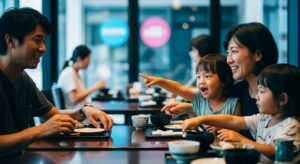
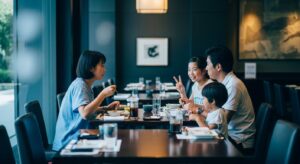
The answer he built is what we walked into that afternoon: a 18-seat restaurant with sofa-style table seating, a warm interior, and a bowl of wagyu that none of us had seen before.
For families, the seating matters more than it sounds. The large sofa table comfortably fits five. Our youngest was content to nap across the cushion while the rest of us ate. No one felt rushed. No one felt like an inconvenience. The staff made us feel genuinely welcome, which — especially when you're navigating a meal in a language you don't speak — changes everything about the experience.
If you're curious about how another family approached their first visit to Itadaki, this story about what family travelers love about Itadaki captures a lot of what we felt walking in for the first time.
✓ Key Takeaways
- Itadaki is a 4-minute walk from Yabacho Station (Meijo Line), in the heart of Osu — a district that's known to locals but rarely featured in mainstream English travel guides
- Founder Masayuki Goto created the "Rare Wagyu Gyudon" concept from scratch, sourcing entirely from Aichi Prefecture farms — including Horai Wagyu, produced by only 3 farms in Japan with just 300 heads raised annually
- The sofa-style seating and welcoming atmosphere make it one of the more comfortable lunch stops for families traveling with young children
Horai Wagyu is capped at 10 bowls a day — and if you've come this far into the article, you already know that's not a figure anyone is inflating for effect. The reservation page on Tabelog lets you lock in your bowl before your Ghibli Park day even begins. Add 鳳来牛希望 in the notes field to request Horai Wagyu specifically.
After: What "Rare Wagyu" Actually Tastes Like
The menu was in English, which immediately settled any anxiety about ordering. There's also a five-step visual guide explaining exactly how to eat the dish — separate the egg yolk from the white, rest the yolk on top of the beef, taste the wagyu on its own first, then gradually mix in the condiments. It sounds like a lot of instruction for a beef bowl. It turns out to be exactly the right amount.
The beef itself — from Aichi's Mikawa region for us, since we hadn't reserved ahead for the Horai Wagyu — arrived arranged over rice in a ceramic bowl with a quiet elegance that made everyone at the table go quiet for a moment. The texture that Goto's proprietary two-stage cooking technique creates is genuinely unlike anything labeled "gyudon" anywhere else: soft, almost silky, with a rare-style quality that the technique achieves while fully meeting Japan's Ministry of Health, Labour and Welfare food safety standards. For anyone worried about raw beef — a very reasonable concern — this is the important detail: the beef is heated to over 70°C at the core. It's safe. It just doesn't taste like it's been cooked to death.
We added the pickled ginger, sprinkled some of the tableside chirimen jako (dried whitebait from Minamichita), tried the original 8-spice blend. Each addition changed the bowl enough to feel like a new course. The miso soup — made with Hatcho miso from Okazaki, with Atsumi aosa seaweed — was the kind of thing you keep sipping even after you don't need any more warmth.
"The lunch was the highlight of my Nagoya trip — I'm telling all my friends about it."
— Guest review
That quote reflects something we've heard echoed by many visitors who stumbled into Itadaki without expecting much. When a meal outperforms its context — a random Tuesday lunch, no reservation, two kids in tow — it tends to stick.
The Detail That Makes It a Story Worth Telling
There's a reason Itadaki travels well as a dinner-table story back home, and it's not just about the taste. It's the specificity of what goes into the bowl.
Horai Wagyu, the signature ingredient available in limited quantities (strictly 10 bowls per day), is raised in the mountains of Okumikawa on sake lees from Horaisen Sora — one of Aichi's finest local breweries. Of the roughly 500,000 wagyu cattle raised in Japan, only 300 heads of Horai Wagyu are produced annually, across just three farms. That's not a marketing figure. That's the actual supply constraint that makes advance reservation via Tabelog the right call if Horai Wagyu is your goal. When making your reservation, add the Japanese note 鳳来牛希望 in the comments field to request it specifically.
We had the Mikawa Beef that day — equally treated with the same two-stage cooking technique, equally sourced from Aichi — and it was more than enough to make us want to come back. Next time, we'll book ahead.
That return-visit intention is, I think, the clearest signal of what Itadaki actually delivers. Not just a good meal. A meal that makes you plan the next trip partly around coming back for it.
If you're weaving Nagoya into a broader Aichi itinerary, there's a useful account of how another traveler built Itadaki into their trip before heading to Shirakawa-go — a similar kind of journey where the lunch stop became something more.
Planning Your Visit: Practical Notes for Families
A few things worth knowing before you go:
- Getting there from Ghibli Park: Ghibli Park is in Nagakute, accessible via the Linimo line from Fujigaoka. From Fujigaoka, take the Higashiyama Line to Sakae, transfer to the Meijo Line, and get off at Yabacho — Exit 4. About 10 minutes from Sakae to Itadaki's door.
- Hours: Itadaki is open for lunch only (11:00–15:00) on Saturdays, Sundays, Mondays, and Tuesdays. On public holidays, opening is at 9:00. Last order is 30 minutes before closing. No dinner service.
- Strollers: The restaurant is on the 2nd floor, accessible by stairs. Strollers can be brought in — staff may assist when available, though this can't be guaranteed depending on how busy the floor is.
- Kids and the menu: The Fumoto size (Mikawa Beef, 100g beef, 200g rice) is often enough for smaller appetites. No dedicated children's menu, but the à la carte format lets you order exactly what you need.
- Monthly schedule: Itadaki's calendar can include irregular closures. Before your trip, confirm the schedule on their official Instagram.
The Hidden Gem That Was Right There the Whole Time
Ghibli Park was, of course, wonderful. The kids still talk about it. But ask them what the best food was on that trip, and the answer — consistently, weeks later — is "the beef bowl place in Nagoya."
That's what a discovery feels like when it's genuine. Not a tick on a list. Not a restaurant someone else told you was Instagram-worthy. Something you found by wandering into a neighborhood that most tourists skip, going up a staircase, and sitting down to a dish that turns out to be entirely its own thing.
Osu will give you that, if you let it. Itadaki is a good place to start.
For our complete menu, access details, and store information, visit our official page at https://itadaki8.com/english/
You've read how an unplanned lunch in Osu ended up being the part of the trip everyone remembered most — and you know exactly why: a rare ingredient, a technique no other restaurant offers, and a neighborhood that rewards people who go looking beyond the obvious. The next step is straightforward: secure your spot before the 10-bowl daily limit fills up.