10 Facts About Aichi Wagyu Every Foodie Should Know
 gotowp
You've done your research on Kobe beef. You've read about Matsusaka. Maybe you've even tried Omi wagyu on a previous Japan trip. But now you're planning a stop in Nagoya — and you keep seeing mentions of something called Horai Wagyu, available at only one specialty restaurant in the city, limited to just 10 bowls a day.
Then the questions start stacking up. Will it sell out before I get there? Do I need to reserve? Can I even use a Japanese reservation platform in English? And underneath all of that: Is Aichi wagyu actually worth the detour, or is this just regional hype?
This article exists to answer those questions honestly — with facts grounded in what Aichi Prefecture's wagyu culture actually looks like, and what our guests have experienced firsthand at Itadaki.
Who This Is For
- ✅ Wagyu enthusiasts who have already tried Kobe, Matsusaka, or Omi beef and want to discover what comes next
- ✅ Travelers planning a short Nagoya stay who cannot afford to miss their target dish
- ✅ Foodies who want to understand why Horai Wagyu is genuinely rare — not just marketed as rare
- ✅ Anyone unsure how to make a reservation on a Japanese platform in English
- ✅ Repeat Japan visitors looking for an authentic discovery beyond the Golden Route
1. Aichi Wagyu Is Not One Breed — It's an Entire Regional Ecosystem
Most travelers think of wagyu as a single category. In Aichi Prefecture, it's more accurate to think of it as a family of distinct regional expressions. Horai Wagyu comes from the Okumikawa highlands in inland Aichi. Mikawa Beef is raised across the Mikawa region using a specific okara-based feed with lactic acid bacteria gut management. Both are Kuroge Wagyu (Japanese Black), but they eat differently, marble differently, and carry distinct flavor profiles shaped by their land and feed.
This regional depth is part of what draws serious wagyu enthusiasts to Nagoya — not as a consolation stop on the way to somewhere else, but as a destination in its own right.
If you're figuring out which days Itadaki is open during your specific Nagoya visit, the monthly business calendar is the one place that shows irregular closures before they catch you off guard. Our official Instagram publishes the updated schedule every month — one check now saves a wasted trip later.
2. Horai Wagyu: 300 Heads a Year, Across Just 3 Farms in Japan
Here is the fact that changes how people understand Horai Wagyu: Japan raises approximately 500,000 wagyu cattle every year. Horai Wagyu accounts for just 300 of them — produced by only 3 farms in Okumikawa, Aichi Prefecture.
The cattle are fed on sake lees from Horaisen Sora, a premium local sake from the same region. That feeding method contributes to the beef's distinctive character: not the intense marbling associated with heavily grain-fed wagyu, but a balance between lean flavor and light marbling that many guests describe as surprisingly clean on the palate.
One guest put it plainly: "I've had Kobe beef and Matsusaka beef, but Horai Wagyu at Itadaki was on another level." That's the kind of reaction we hear from guests who arrive expecting the familiar and leave with something they didn't have words for.
Because only 300 heads are produced annually, the supply reaching any single restaurant is genuinely constrained. At Itadaki, this translates to a hard limit: 10 bowls of Horai Wagyu Rare Gyudon per day. That number is not a marketing device — it reflects the actual weekly allocation we receive from our direct-supply partnership with the farms.
3. "Rare-Style" Wagyu Doesn't Mean Unsafe — Here's Why
This is one of the most common concerns we hear from guests before their first visit, and it deserves a direct answer.
Itadaki's signature preparation — what we call the two-stage cooking technique — was developed specifically to deliver the texture of rare beef while fully meeting Japan's Ministry of Health, Labour and Welfare food safety standards. The beef is heated to over 70°C at the core during preparation. The result looks and feels rare. It is not raw.
Masayuki Goto, Itadaki's founder and a Certified Food Sanitation Supervisor, built this technique over years of development before opening in 2022. It's the intellectual foundation of the restaurant — and the reason Itadaki has been featured on 8 major Japanese TV programs, including NHK, as the originator of the "Rare Wagyu Gyudon" culinary concept.
For guests with specific health considerations, the standard Mikawa Beef Rare Gyudon uses the identical cooking method — same safety standard, same texture experience, different beef. If you have concerns, feel free to ask the staff at the table.
✓ Key Takeaways
- Horai Wagyu is one of Japan's genuinely scarce wagyu varieties — 300 heads annually across 3 farms — not a manufactured rarity claim.
- Itadaki's two-stage cooking method delivers a rare-style texture while meeting Japan's full food safety standards.
- The 10-bowl daily limit on Horai Wagyu is a direct result of actual supply constraints, not artificial scarcity.
You now know the 鳳来牛希望 note to add and why the 10-bowl limit is real — the next step is locking in your date before someone else does. Tabelog's reservation form works in English, and the note field is where your Horai Wagyu request goes.
4. The 10-Bowl Limit Is Real — And Walk-Ins Do Miss Out
This is the part that matters most if you're planning your visit around Horai Wagyu.
Itadaki is open for lunch only, four days a week (Saturday, Sunday, Monday, and Tuesday, plus public holidays), from 11:00 to 15:00. During peak lunch hours — particularly on weekends — the Horai Wagyu allocation can sell out well before the last order cutoff at 14:30.
Walk-in guests who arrive at 12:30 or 13:00 on a busy day sometimes find that Horai Wagyu is no longer available. For travelers on tight Nagoya itineraries — a single afternoon between Shirakawa-go and Osaka, or one free morning before a flight — that's not a situation you want to find yourself in. For travelers who want to know which Nagoya subway stops make it easiest to plan a lunch stop, Yabacho Station on the Meijo Line is your direct access point to Itadaki.
5. How to Reserve Horai Wagyu — Step by Step, in English
The short answer: reserve via Tabelog Online, Japan's leading restaurant reservation platform. Tabelog is not as widely known outside Japan as it is domestically, but the reservation process itself can be completed in English on the website.
Here's what to do:
- Go to Tabelog and search for Itadaki (板抱き) in Nagoya.
- Select your preferred date and time slot.
- In the notes or request field, copy and paste the following phrase: 鳳来牛希望 (This tells the kitchen you'd like the Horai Wagyu — without this note, your reservation will be for the standard menu.)
- Complete the reservation form in English — no Japanese required from your side.
If you prefer to arrive without a reservation, your best strategy is to be at the door when we open at 11:00. Arriving at opening gives you the strongest chance of securing Horai Wagyu as a walk-in. If it's already gone when you arrive, Mikawa Beef Rare Gyudon is always available — prepared with the same two-stage cooking technique, and a genuinely satisfying experience in its own right.
"I've had Kobe beef and Matsusaka beef, but Horai Wagyu at Itadaki was on another level."
Guest review
6. Everything on the Table Comes from Aichi Prefecture
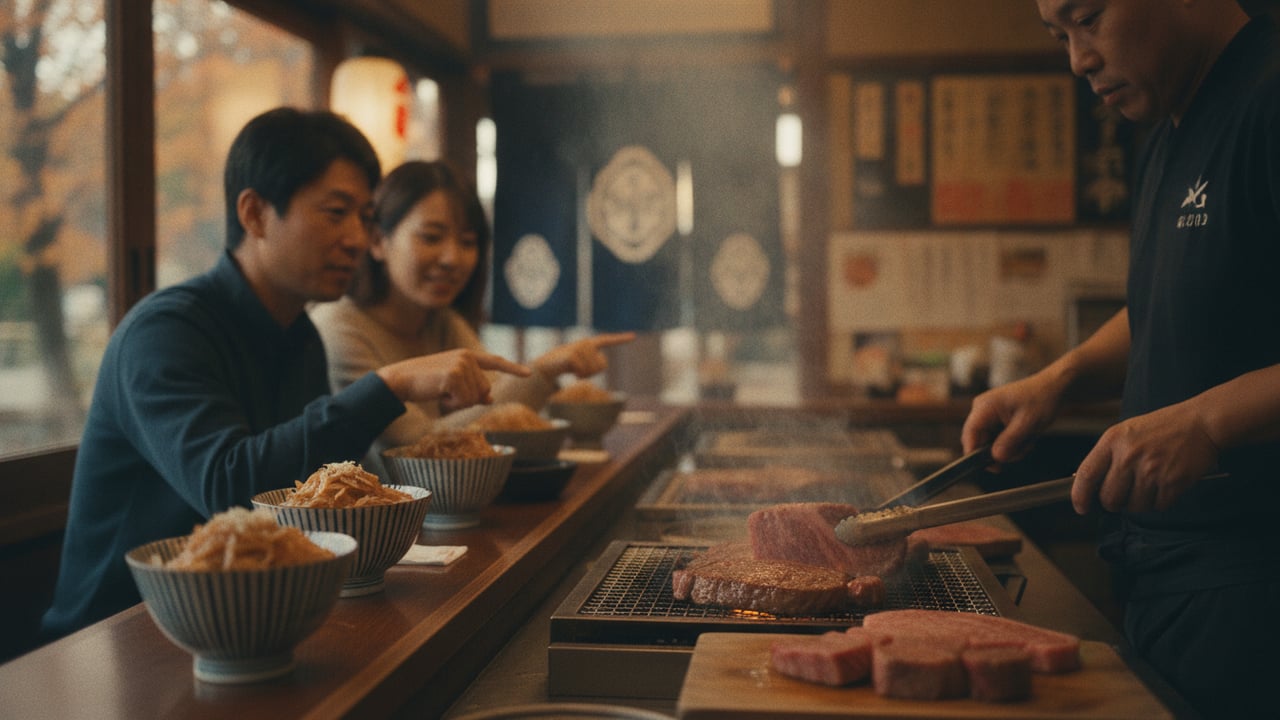
The Horai Wagyu bowl doesn't sit in isolation. Every element surrounding it — the rice, the miso soup, the pickles, the egg, the sauce — is sourced from Aichi Prefecture. Aichi no Kaori rice from Aichi-grown farms. Hatcho miso from Okazaki City. Atsumi Ichō-zuke pickles from the Atsumi Peninsula. Nagoya Cochin eggs from Yamada Poultry Farm. White soy sauce from Hekinan City forms the base of what we call the "magic sauce."
This isn't just a sourcing philosophy — it means that a single bowl of Horai Wagyu Rare Gyudon at Itadaki is a cross-section of Aichi Prefecture's food geography. For travelers interested in understanding what a region actually tastes like, that kind of coherence is rare to find in one dish. If you're curious about the depth of what Osu's dining scene offers beyond this, a guide to Osu lunch experiences for travelers covers the wider neighborhood context.
7. The Dish Unfolds in Five Steps — There's a Guide on the Table
First-time guests sometimes worry about how to eat the dish correctly. There's no wrong way, but there is a sequence that opens up the full range of flavors.
A printed five-step guide in English is available at the table:
- Separate the Nagoya Cochin egg — white goes into the miso soup, yolk sits atop the beef.
- Taste the wagyu in its purest form first.
- Mix the golden yolk with the beef for a richer, silkier texture.
- Add tabletop condiments — pickled ginger, dried nori, chirimen jako, Itadaki's original 8-spice blend — to explore new flavor combinations.
- Finish with a touch of wasabi to refresh the palate.
The guide is also available in Simplified Chinese and Korean. No Japanese required.
8. Itadaki Is in Osu — One of Nagoya's Most Walkable Districts
The restaurant is located on the 2nd floor of a building in the Osu district, a 4-minute walk from Yabacho Station Exit 4 on the Meijo Subway Line. From Nagoya Station, the total journey takes approximately 10 minutes: Higashiyama Line to Sakae, then transfer to the Meijo Line and alight at Yabacho.
Osu itself is one of central Nagoya's most layered neighborhoods — home to Osu Kannon Temple, 1,200 shops along the covered shopping street, and a concentration of subculture, vintage, and international food culture that feels unlike anywhere else in the city. Many guests combine a visit to Itadaki with a morning walk through the shopping street or a stop at the free-admission Hisaya-odori Garden Flarie, just 3 minutes from the same station. There's more to Osu than most first-time visitors realize — the district rewards an unhurried exploration.
9. Business Hours Are Specific — Check Before You Go
Itadaki operates on a schedule that differs from most restaurants, and it's worth confirming before your visit.
- Open: Saturday, Sunday, Monday, Tuesday (11:00–15:00)
- Public holidays: 09:00–15:00 (even if the holiday falls on a normally closed day)
- Closed: Wednesday, Thursday, Friday
- Last order: 30 minutes before closing (14:30 on regular days, 14:30 on holidays)
- Irregular closures may apply — the official Instagram account publishes a monthly business calendar.
October 2026 brings the closing stage of the Asian Games and the start of the Asian Para Games in Aichi Prefecture — a period when Nagoya sees significantly higher visitor numbers. If you're in the city for those events, planning your Itadaki visit early in your stay — and reserving in advance — is the most reliable approach.
10. The Name Itself Is the Philosophy
"Itadaki" comes from itadakimasu — the expression Japanese speakers say before eating, a word that carries gratitude toward the ingredients, the people who grew them, and the craft that prepared them. Founder Masayuki Goto chose it deliberately.
Before opening Itadaki in April 2022, Goto had spent 18 years in the food and beverage industry, including 14 years running MAX'S BAR. During the COVID-19 pandemic, he watched small Aichi farmers — including the producers he sourced from directly — struggle with unsold harvests. That experience shaped the restaurant's founding principle: not just sourcing locally, but building a business model that actively supports the farms behind the ingredients.
A bowl of Horai Wagyu Rare Gyudon at Itadaki is, in that sense, something more than a meal. It's a dish with a traceable story — from a specific group of farms in Okumikawa, through a technique developed over years of careful craft, to a table in Osu where a guest from somewhere far away sits down and says, without needing the word, itadakimasu.
For our complete menu, access details, and store information, visit our official page at https://itadaki8.com/english/
A short Nagoya stay doesn't leave room for arriving at 12:30 to find the Horai Wagyu gone. Securing your seat in advance — with 鳳来牛希望 in the notes field — is the one step that guarantees the bowl you came for is waiting when you walk in at 11:00.