How I Discovered Itadaki Before My Shirakawa-go Trip
 gotowp
Let me be honest with you upfront: the lunch I had in Nagoya the day before my Shirakawa-go trip completely overshadowed the trip itself. Not because Shirakawa-go wasn't breathtaking — it was. But somewhere between the thatched-roof farmhouses and the snow-dusted mountains, I kept thinking about a bowl of wagyu I'd eaten in a second-floor restaurant in Osu the afternoon before.
That restaurant was Itadaki. And if you're traveling between Nagoya and Shirakawa-go, Takayama, or anywhere in the Gifu region, I think what happened to me might happen to you too.
This is a before-and-after story — not a dramatic one, but a genuine one. Before Itadaki, Nagoya was simply a transit point on my itinerary. After it, Nagoya became the reason I'm already planning a second trip to Japan.
こんな方におすすめ
- ✅ Travelers passing through Nagoya on the way to Shirakawa-go or Takayama who want to make the most of their time in the city
- ✅ Wagyu enthusiasts curious about rare regional Japanese beef beyond Kobe or Matsusaka
- ✅ Repeat Japan visitors looking for an authentic, off-the-beaten-path lunch experience in Nagoya
- ✅ Anyone wondering whether a lunch stop in Osu is worth building into their itinerary
- ✅ Foodies who want a meal with a story — not just a dish
Before: Nagoya Was Just a Stopover
My itinerary looked like countless others I'd seen shared in travel forums. Land in Tokyo, a few days in Kyoto, then take the shinkansen west — with a night or two in Nagoya purely for logistical reasons. Nagoya was where I'd catch my bus to Shirakawa-go the following morning.
I hadn't planned much for my afternoon in the city. Maybe Nagoya Castle. Maybe a walk through Sakae. Nothing I'd specifically traveled for.
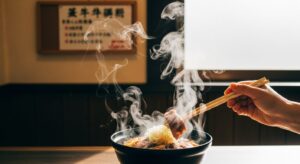
Then, scrolling through Google Maps while sitting on the shinkansen, I noticed a restaurant near Yabacho Station with a description I'd never seen before: "The Original Rare Wagyu Gyudon." The photos were striking — glistening slices of marbled beef arranged over a ceramic bowl of rice, a bright egg yolk resting on top. I almost dismissed it. I'd had wagyu before. I didn't need another wagyu experience.
But something about the phrasing stopped me. Original. Not "specialty" or "famous" — original. As in, this is where the concept began.
I added it to my plans and didn't think much more about it.
Finding Itadaki in Osu — A District I Hadn't Planned to Explore
Itadaki is located on the 2nd floor at 4-1-20 Osu, Naka-ku — a four-minute walk from Yabacho Station Exit 4 on the Meijo Subway Line. Getting there from Nagoya Station is straightforward: Higashiyama Line to Sakae, transfer to the Meijo Line, off at Yabacho. About ten minutes total.
What I hadn't expected was the neighborhood itself. Osu is one of those places that resists easy description. The main shopping street has over 1,200 shops and more than 400 years of history — but it also has anime shops, cosplay cafés, Taiwanese street food, and a Buddhist temple (Osu Kannon) that sits at the heart of it all without any apparent sense of contradiction. It's lively without being exhausting. Traditional without being frozen in time.
I arrived at 11:15 — just after opening. There was already a short queue. The sign at street level read 元祖レア牛丼 頂, and I took the stairs up.
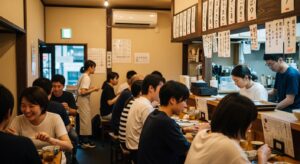
Inside: 18 seats, warm lighting, sofa-style seating that immediately made the space feel more relaxed than I'd expected. Counter seats along one side, a couple of larger tables for groups. The menu was printed in English — fully, with photos, prices, and a five-step visual guide explaining exactly how to eat the dish.
That last detail mattered more than I realized at the time.
The Dish — And the Story Behind It
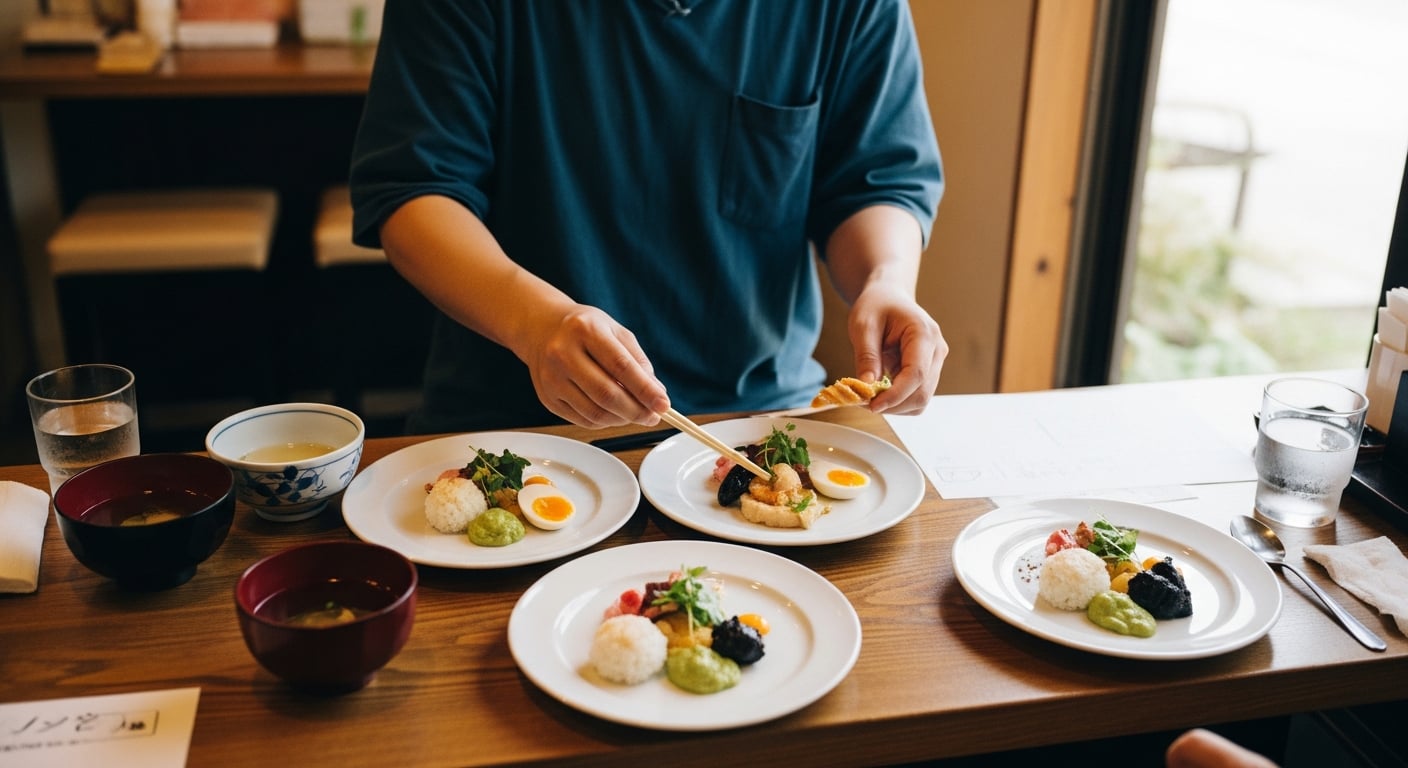
I ordered the Shinkoccho: the standard-size Rare Wagyu Gyudon featuring Horai Wagyu. ¥2,700 for 100g of beef and 200g of Aichi-grown rice, served with miso soup, traditional Atsumi pickles, shiso leaves, and a raw Nagoya Cochin egg.
The menu explained that Horai Wagyu is produced by only three farms in Japan, with just 300 heads raised annually — out of approximately 500,000 wagyu cattle in the country. These cattle are raised in Okumikawa, in the mountains of Aichi Prefecture, and fed on sake lees from Horaisen Sora, a premium local sake. That feeding method gives the beef a distinctly clean, nuanced flavor — less aggressively fatty than some of the more famous wagyu brands, but with a depth that stays with you.
The "rare" texture I'd been curious — and, honestly, slightly cautious — about comes from a proprietary two-stage cooking technique developed by founder Masayuki Goto. The beef is heated to over 70°C at the core, fully meeting Japan's food safety standards while preserving a silky, near-raw mouthfeel. It's not rawness for novelty's sake. It's a technical achievement that took years to refine.
Following the five-step guide: I separated the egg yolk onto the beef and let the white fall into the miso soup. I ate the first bite pure — just wagyu and rice, no condiments. Then with the yolk mixed in. Then I worked my way through the pickled ginger, the dried seaweed, the chirimen jako (tiny dried whitebait), and finally the wasabi. Each variation was genuinely different. The guide wasn't a gimmick. It was a real sequence, and it changed how the dish tasted at each step.
"Perfect lunch during our Nagoya stay before our Shirakawa-go trip the following day."
— Guest review
"The five-step eating guide made the dish even more enjoyable and memorable."
— Guest review
✓ ここまでのポイント
- Itadaki is a four-minute walk from Yabacho Station (Meijo Line) — easily accessible during a Nagoya stopover en route to Shirakawa-go or Takayama
- Horai Wagyu is limited to 10 bowls per day and is produced by just 3 farms in Japan with 300 heads annually — advance reservation via Tabelog is strongly recommended
- The two-stage cooking technique delivers a rare-style texture while meeting Japan's food safety standards — no need to hesitate about the preparation method
After: Nagoya Became a Destination in Its Own Right
I left Itadaki just before noon, caught my bus to Shirakawa-go the following morning as planned, and spent two days walking through UNESCO-listed farmhouses in the snow. It was exactly as beautiful as the photographs suggest.
But here's what I didn't expect: I kept coming back to the lunch in Osu. Not with disappointment about Shirakawa-go — but with a growing appreciation for what that meal had actually been. It wasn't just a good beef bowl. It was a coherent statement about a place. Every ingredient on that tray came from Aichi Prefecture. The rice, the sauce, the egg, the pickles, the beef — all of it sourced from within the same prefecture, from farmers that Goto works with directly. The dish tasted like Aichi, even if I hadn't fully understood that while eating it.
Goto founded Itadaki in April 2022 after the COVID-19 pandemic pushed him to rethink what he could offer — and who he could support. He'd been running MAX'S BAR since 2008, and when local farmers he sourced from struggled with unsold harvests, he felt personally compelled to act. The gyudon format allowed him to operate with a small team and minimal space while building something that created long-term demand for rare Aichi ingredients. The name Itadaki comes from itadakimasu — the expression of gratitude spoken before every meal in Japan. Respect for the farmers, the land, the craft.
That philosophy comes through in the food. It's not theatrical or self-congratulatory. It just tastes like someone paid attention to every single element, from the variety of shiso leaf to the temperature of the rice cooker, adjusted each year to match that year's harvest.
I've since told three friends who are planning Japan trips to add Itadaki to their Nagoya day. Two of them already have reservations.
Practical Notes if You're Planning to Go
Itadaki is open for lunch only — 11:00 to 15:00 on Saturdays, Sundays, Mondays, and Tuesdays, with last order 30 minutes before closing. On public holidays, the restaurant opens at 9:00. Wednesday through Friday are regular closing days. The monthly schedule is posted on Instagram, and irregular closures do occasionally happen, so it's worth checking before you go.
Horai Wagyu is strictly limited to 10 bowls each day. If it sells out before you arrive, the Mikawa Beef Rare Gyudon (from ¥1,800) is prepared using the same two-stage cooking technique and is available for walk-in guests. It's an excellent dish in its own right — don't treat it as a fallback. But if Horai Wagyu is specifically what you're after, I'd recommend making a reservation via Tabelog and noting "Horai Wagyu request" (鳳来牛希望) in the comments field when you book. The Tabelog reservation page works in English.
The restaurant has 18 seats with sofa-style seating throughout — comfortable for lingering, easy for families, and genuinely welcoming to solo diners. There are five counter seats if you prefer to eat alone without feeling isolated. The printed menu in English made ordering completely stress-free, and staff were warm and unhurried even during a busy lunch hour.
No dinner service. No takeaway. The dish is designed to be eaten fresh, at the table, in the order the guide suggests.
A Final Thought Before You Leave Nagoya
If your Nagoya itinerary looks anything like mine did — a night or two sandwiched between more "famous" destinations — I'd gently suggest reconsidering the city as a transit point. The Osu district alone is worth a morning's exploration: Osu Kannon Temple, the sprawling shopping street, and the free-admission Hisaya-odori Garden Flarie just a short walk from Yabacho Station. Pair that afternoon with lunch at Itadaki, and Nagoya stops being a stopover and starts being a reason to come back.
I'm already planning mine.
For our complete menu, access details, and store information, visit our official page at https://itadaki8.com/english/
Horai Wagyu sells out early on busy days — if you'd like to secure your bowl before your Shirakawa-go or Takayama departure, we'd love to have you. Reserve Your Rare Wagyu Experience via Tabelog — reservations can be made in English, and the process takes just a few minutes.
For our opening calendar and any schedule updates, Check Our Monthly Schedule on Instagram before your visit. We look forward to welcoming you.