Why Legoland Families Now Include Itadaki in Their Nagoya Day
 gotowp
You've booked the Legoland tickets, mapped out the Nagoya Port Aquarium, and maybe penciled in Ghibli Park for the following day. The itinerary looks great — until you realize that nobody has figured out lunch. Somewhere between the brick-building workshops and the rides, a question surfaces that every traveling parent eventually faces in Japan: Where do we actually eat something worth remembering?
More and more families visiting Nagoya are answering that question with a short detour to Osu — and to Itadaki, the restaurant that invented the Rare Wagyu Gyudon. But for many parents, especially those from Western countries, a second question arrives close behind: Is it safe for us to eat rare-style beef? What about the kids?
That's the question this article is here to answer — honestly, specifically, and without any pressure. Because a family lunch decision deserves real information, not reassuring generalities.
Who This Is For
- ✅ Families visiting Legoland Nagoya, Nagoya Port Aquarium, or Ghibli Park who want a memorable lunch stop in the city
- ✅ Parents from Western countries who are cautious about rare-style beef and want to understand exactly how it's prepared
- ✅ Traveling families looking for a welcoming, sofa-seated restaurant where everyone — including young children — can settle in comfortably
- ✅ Anyone wondering whether Itadaki's wagyu gyudon is genuinely safe, or whether the "rare" label is cause for concern
- ✅ Families who want their Nagoya day to include something more than a chain restaurant between attractions
The Question Every Western Parent Asks First
In the United States, Australia, the United Kingdom, and much of Europe, food safety guidelines are clear: cook beef thoroughly. The warnings exist for good reason — undercooked ground beef in particular can carry E. coli and other bacterial risks that are very real. Parents traveling with children are, understandably, the most cautious group of all.
So when families in Osu see the words "Rare Wagyu Gyudon" on our sign, the instinct is often hesitation. The word "rare" triggers a familiar alarm.
Here's what we want you to know, plainly and directly: the "rare" in our dish refers to the texture and experience of the beef — not to a food safety shortcut. Every bowl served at Itadaki is prepared using our proprietary two-stage cooking technique, which heats the beef to over 70°C at the core. That temperature fully meets Japan's Ministry of Health, Labour and Welfare food safety standards — the same government body that sets the standards for hospitals, school lunches, and public food service across the entire country.
Our founder Masayuki Goto holds a Certified Food Sanitation Supervisor qualification and operates Itadaki under a Licensed Restaurant Operator permit issued by the Aichi Prefecture Public Health Center. The two-stage technique he developed wasn't just a creative idea — it was built from the ground up with compliance as the foundation. The goal was always to create something that felt extraordinary and was completely safe to serve.
That combination is what makes this dish unlike anything else in Japan.
You're still weighing whether the "rare" preparation is the right call for your family — and that's a completely fair place to be. Our monthly business calendar (including any irregular closures that might affect your planned Nagoya day) is posted each month on our official Instagram. Takes about 30 seconds to check before you finalize your itinerary.
Why the Beef Itself Matters — and How Horai Wagyu Is Raised
Food safety is never just about the kitchen. It starts long before the beef arrives at our door.
Itadaki sources exclusively from Aichi Prefecture — and that commitment isn't just a brand statement. It means we know exactly where our beef comes from, how it was raised, and under what conditions. Our premium Horai Wagyu comes from only three farms in Aichi's Okumikawa region, with just 300 heads raised annually across all three. These animals are raised under rigorous quality control by farmers Goto works with directly as a sourcing partner.
Our second wagyu, Mikawa Beef, comes from the Mikawa region of Aichi and is raised on okara feed with lactic acid bacteria gut management — a meticulous approach to animal health that reflects the same care you see in the final dish.
When you sit down at Itadaki, you're not eating commodity beef that passed through a dozen hands before reaching the kitchen. You're eating beef from farms Goto visits personally, sourced through relationships built over years. That traceability is part of what makes our rare-style preparation possible — and safe.
✓ Key Takeaways
- Itadaki's rare wagyu is cooked to over 70°C at the core using a proprietary two-stage technique — fully meeting Japan's Ministry of Health, Labour and Welfare food safety standards.
- All beef is sourced directly from trusted Aichi Prefecture farms under rigorous quality control, with full traceability from farm to bowl.
- The "rare" texture is an intentional culinary achievement, not a food safety compromise.
Horai Wagyu is strictly limited to 10 bowls per day — and families visiting on a Legoland itinerary often arrive mid-morning when those bowls go quickly. Securing your bowl in advance means one less thing to worry about on the day. Reservation is available in English through Tabelog Online.
What Families Actually Experience at the Table
Beyond the safety question, families tell us the same thing: they didn't expect to feel so at ease.
"The staff were welcoming and made us feel at home even without perfect Japanese."
— Guest review
That warmth is intentional. Our name, Itadaki, comes from itadakimasu — the expression of gratitude spoken before every meal in Japan. It's a philosophy that shapes how we welcome every visitor, whether they arrive fluent in Japanese or pointing at the menu with a translation app open on their phone.
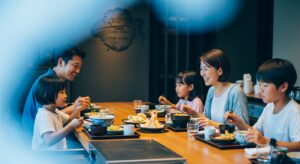
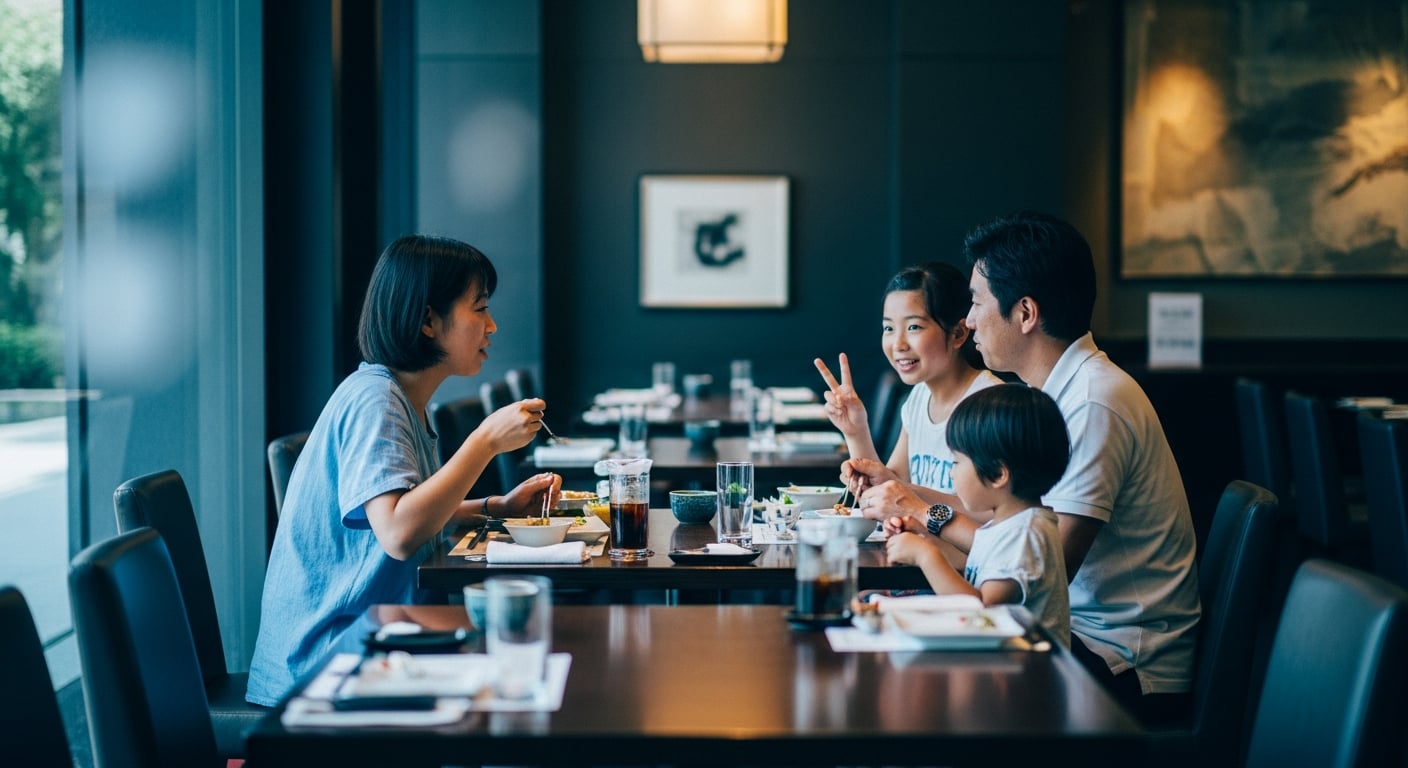
For families specifically, the physical space matters as much as the welcome. Itadaki has 18 seats total, with all table seats featuring comfortable sofa seating. There's a sofa table for five people — ideal for a family group — along with tables for four and for two. Parents have brought infants and used the sofa seats for bottle feeding and naps. The unhurried lunch format (we're open 11:00–15:00, with last order at 14:30) means no one is rushing you out the door.
Our printed menu is available in English, Simplified Chinese, and Korean, with photos and a five-step visual guide — "How to Enjoy Rare Gyudon" — that shows exactly how to separate the egg, how to mix the ingredients, and how to move through the dish. Families have told us this guide turned the meal into something interactive and memorable for the whole table, not just the adults.
For parents deciding what to order for younger children: the smallest size, Fumoto (Mikawa Beef, 100g beef with 200g rice, ¥1,800), is often well-suited for children. The Nagoya Cochin egg that comes with every bowl can be removed at request. As with any rare-style preparation, parents should make that choice at their own discretion — and our staff is happy to talk through any questions at the table.
How to Build This Into Your Nagoya Day
Legoland Nagoya is located at Nagoya Port — a short subway ride or taxi from the city center. Many families combine it with the Nagoya Port Aquarium next door, making for a full morning of attractions before heading back toward central Nagoya for lunch.
Itadaki is a 4-minute walk from Yabacho Station Exit 4 on the Meijo Subway Line, in the heart of Osu. From Nagoya Port area, the Meijo Line connects directly — making the journey straightforward without backtracking. After lunch, the Osu Kannon Temple and Osu Shopping Street are right there for families to explore before catching the subway onward.
One practical note for families planning to bring a stroller: Itadaki is located on the 2nd floor, accessed by a staircase. Strollers can be brought into the restaurant, and staff may be able to assist depending on the situation at the time — though we can't guarantee assistance will always be available. It's worth keeping that in mind when planning your visit.
If your family is hoping to try the ultra-rare Horai Wagyu — limited to just 10 bowls per day — a reservation via Tabelog is strongly recommended. When filling out the reservation notes, copy and paste this phrase: 鳳来牛希望 (meaning "Horai Wagyu requested"). Reservations can be made in English through the Tabelog website. For walk-in families, our Mikawa Beef Rare Gyudon is always available and prepared with the same two-stage technique and the same care.
For families who enjoy discovering places that feel genuine rather than tourist-facing, Itadaki sits in a neighborhood where that kind of discovery is exactly the point. Osu is where Nagoya locals spend their weekends — and why repeat visitors to Japan increasingly choose Itadaki as their Nagoya lunch destination rather than anywhere more obvious.
If your Nagoya day also includes a side trip — perhaps toward Shirakawa-go or Takayama the following morning — building Itadaki into your Nagoya stop before heading to Takayama is a route that other travelers have found works very naturally. A meaningful lunch in Osu, then onward to the mountains.
A Lunch Worth Telling the Story Of
The Legoland day will be full of moments your children will remember. But the meal your family shares in between the rides — the one where everyone leaned in to watch the egg yolk get placed on the wagyu, where someone asked "wait, is this actually safe?" and got a real answer — that might be the story you're still telling at dinner tables back home years from now.
That's the kind of lunch Itadaki was built to give you.
For our complete menu, access details, and store information, visit our official page at https://itadaki8.com/english/
Your Nagoya day is planned — now make sure the lunch lives up to the rest of it. The 10 daily Horai Wagyu bowls go to whoever reserves first, and walk-in availability during peak family hours isn't guaranteed. Locking in your spot takes a few minutes and means your family sits down to exactly what you came for.
Reserve Your Table at Itadaki — Rare Wagyu Gyudon in Osu, Nagoya