Is There an English-Friendly Wagyu Restaurant Near Nagoya Station?
 gotowp
Yes, there is — and it's closer to Nagoya Station than most visitors expect. Itadaki, located in the Osu district of Naka-ku, is a 10-minute subway ride from Nagoya Station and a 4-minute walk from Yabacho Station (Meijo Line). More importantly, it was designed from the start to welcome international visitors: English menus, a photographic step-by-step eating guide, and a team trained to make every guest feel at ease regardless of language.
But the access and the language support are almost secondary to the bigger question — what kind of experience are you actually walking into? The short answer: one you won't find anywhere else in the world.
Who This Is For
- ✅ Travelers who want at least one meal on their Japan trip that goes beyond "really good food" into something genuinely irreplaceable
- ✅ Wagyu enthusiasts who've already tried Kobe or Matsusaka beef and are searching for their next discovery
- ✅ First-time visitors to Nagoya wondering whether the city has a must-visit food experience to match Tokyo or Kyoto
- ✅ Solo diners, couples, and families who want a welcoming, stress-free lunch with full English support
- ✅ Anyone wondering whether "rare wagyu" is safe — and how exactly it's prepared
What Makes Itadaki Different from Other Wagyu Restaurants Near Nagoya?
Most wagyu restaurants in Japan serve high-quality beef in familiar formats — yakiniku, shabu-shabu, sukiyaki, or steak. Itadaki does none of those things. It invented an entirely new category: the Rare Wagyu Gyudon.
Founder Masayuki Goto — who has 18 years of industry experience and holds a Certified Food Sanitation Supervisor qualification from Japan's Ministry of Health, Labour and Welfare — spent years asking a question no one in the restaurant world seemed to be asking: why does gyudon, Japan's beloved beef bowl, have no premium version? Katsudon has one. Oyakodon has one. Kaisendon has one. But gyudon had always been synonymous with fast food chains.
Goto's answer was Itadaki, which opened in April 2022 in Osu, Nagoya. The concept: take the humble gyudon, reimagine it using the rarest wagyu in Aichi Prefecture, cook it with a proprietary two-stage technique, and serve it with every single ingredient sourced from Aichi Prefecture farms. The result was featured on 8 major Japanese TV programs, including NHK — and recognized nationally as the originator of "Rare Wagyu Gyudon."
That's the difference. Other wagyu restaurants near Nagoya serve great beef. Itadaki serves a concept that was invented here and cannot be replicated anywhere else.
You now know Itadaki is open only on specific days and that Horai Wagyu is limited to 10 bowls daily — which means showing up without checking the calendar is a real risk. The monthly business schedule is posted on our official Instagram, so you can confirm open dates before you build your Nagoya itinerary around this lunch. Takes 30 seconds to check.
Is Rare Wagyu Actually Safe to Eat?
This is the question we hear most often from first-time visitors, and it deserves a direct answer: yes, fully and completely safe under Japan's food safety standards.
The "rare" appearance of our wagyu is achieved through a proprietary two-stage cooking technique developed under Goto's direction. The beef is heated to over 70°C at the core — the threshold required by Japan's Ministry of Health, Labour and Welfare — while preserving the silky, tender mouthfeel that raw-style preparations are known for. It is a technical achievement, not a shortcut. The method is difficult to replicate, which is part of why it represents Itadaki's intellectual property in culinary innovation.
Guests who arrive nervous about this almost universally leave converted. The texture is unlike anything most people have experienced in a beef bowl — or in wagyu served any other way.
What Is Horai Wagyu, and Why Does It Matter?
Of all the ingredients that go into a bowl at Itadaki, none carries more story than Horai Wagyu.
There are approximately 500,000 wagyu cattle raised in Japan at any given time. Horai Wagyu accounts for just 300 of them, raised annually across only 3 farms in the Okumikawa region of Aichi Prefecture. What makes these cattle so singular is their feed: sake lees from Horaisen Sora, a renowned local premium sake produced in the same region. This gives the beef a distinctive character — light marbling combined with genuine lean-meat flavor, a combination rarely found in wagyu.
Itadaki is one of the few restaurants in Nagoya that sources Horai Wagyu directly from these farms. Goto established a direct-supply partnership specifically to bring this ingredient to the table — and to support the small producers behind it. That supply is strictly limited to 10 bowls per day. If you want to try it, planning ahead matters more than most visitors realize.
The standard size — Shinkoccho (100g beef, 200g rice, ¥2,700 tax included) — is the entry point most visitors choose. Larger sizes are available if you want more.
✓ Key Takeaways
- Itadaki invented the "Rare Wagyu Gyudon" — a culinary category that exists nowhere else in the world, recognized on national Japanese television
- The rare-style preparation is fully safe, achieved through a proprietary two-stage cooking method certified to Japan's Ministry of Health standards
- Horai Wagyu — the restaurant's signature ingredient — is produced by just 3 farms with 300 heads annually, and limited to 10 bowls per day
The five-step eating guide and the story behind Horai Wagyu are things you read about here — but the 10-bowl daily limit means the gap between knowing and actually tasting it closes fast on busy days. Reserving your bowl via Tabelog locks in your spot before you arrive in Nagoya.
What Is the English Support Actually Like?
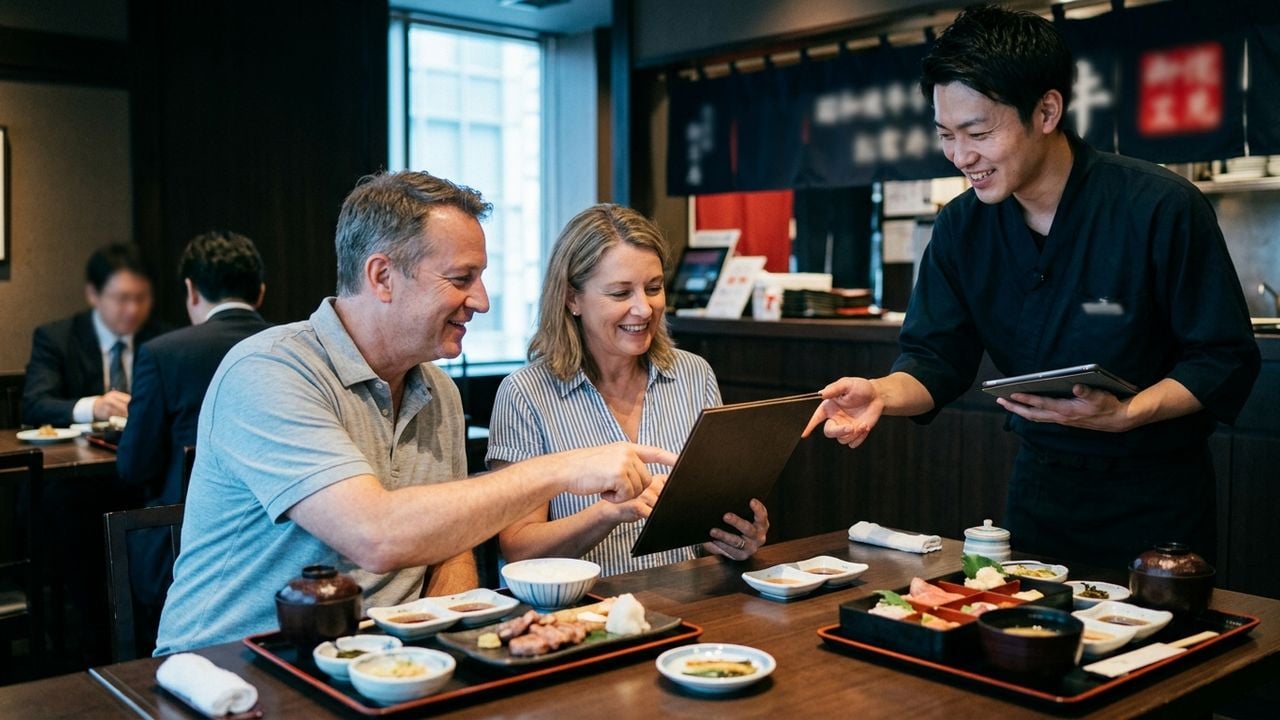
International visitors are not an afterthought at Itadaki — they're a core part of why the restaurant exists. Goto's own love of international travel and discovering unfamiliar food cultures directly shaped how the restaurant communicates with guests from abroad.
Printed menus are available in English, Simplified Chinese, and Korean. But the element that consistently draws the most comments from overseas visitors is the five-step eating guide — a photographic, illustrated walkthrough of exactly how to enjoy the Rare Wagyu Gyudon from first bite to last.
"The five-step eating guide made the dish even more enjoyable and memorable."
— Guest review
The guide walks you through: separating the Nagoya Cochin egg (white into the miso soup, yolk over the beef), tasting the wagyu in its purest form first, then mixing in the egg yolk, then layering in the complimentary condiments — pickled ginger, dried seaweed from Mikawa Bay, chirimen jako, Itadaki's original 8-spice blend — and finishing with wasabi for a clean, bright final note. Each step changes the flavor profile of the bowl. It's not a gimmick; it's a genuine tasting journey designed into a single dish.
Staff members are trained to help international guests feel comfortable. Perfect English is not guaranteed, but warmth and patience are.
If you're traveling Nagoya during a busy event period and want to know more about navigating English-friendly dining in the city, this guide to English-friendly restaurants in Nagoya 2026 covers practical tips worth bookmarking.
How Do I Get There, and Do I Need a Reservation?
From Nagoya Station, the journey is straightforward: take the Higashiyama Subway Line to Sakae Station, transfer to the Meijo Line, and get off at Yabacho Station (Exit 4). Walk 4 minutes. Total journey time: approximately 10 minutes. Itadaki is located on the 2nd floor at 4-1-20 Osu, Naka-ku — the same station also serves Hisaya-odori Garden Flarie, a free-admission urban garden that many visitors explore before or after lunch.
For access from Osu Kannon Temple or the Osu Shopping Street, Itadaki is within comfortable walking distance from multiple nearby stations including Kamimaezu and Osu Kannon Station as well.
On reservations: Itadaki is open for lunch only (11:00–15:00), on Saturdays, Sundays, Mondays, and Tuesdays — with public holidays running 09:00–15:00. Wednesday through Friday are closed. Irregular closures do happen, so checking the monthly business calendar on the official Instagram account before you travel is a good habit.
For Horai Wagyu specifically, a reservation via Tabelog is strongly recommended. With only 10 bowls prepared each day, they do sell out during peak hours — and arriving without a reservation is a risk not worth taking when the whole point of the visit is to try this specific beef. Mikawa Beef Rare Gyudon (from ¥1,800) is always available without a reservation, so walk-ins are never left without options.
The restaurant has 18 seats in total, including 5 counter seats ideal for solo diners, and sofa-style table seating that families with young children find particularly comfortable. All seats are non-smoking. The restaurant is located on the 2nd floor, accessible by staircase.
Is This the Kind of Meal Worth Planning a Day Around?
That depends on what you're looking for. If you want a quick lunch between sightseeing stops, Itadaki works for that too — it's compact, efficient for a lunch-only restaurant, and located in one of Nagoya's most enjoyable neighborhoods to walk around.
But if your question is whether this is the kind of meal that becomes the meal — the one you tell people about when they ask what you ate in Japan — then yes. A culinary experience that was literally invented at one specific address, using beef produced by just 3 farms in the entire country, prepared with a technique that took years to develop: that's not something you accidentally stumble across. It's the kind of thing that makes wagyu enthusiasts choose Itadaki over every other option once they understand what they're choosing between.
The name Itadaki comes from "itadakimasu" — the expression of gratitude spoken before every meal in Japan. It reflects Goto's belief that food is a gift: from the farmers who raise the animals, from the land that shapes the flavors, from the craft that transforms ingredients into something worth remembering. Every bowl carries that philosophy, quietly, from first bite to last.
For our complete menu, access details, and store information, visit our official page at https://itadaki8.com/english/
You've read about the two-stage cooking technique, the 300-head annual supply of Horai Wagyu, and the five-step tasting journey — now the only thing standing between you and that bowl is a reservation. Secure your seat via Tabelog before the day fills up.