How Do I Find English-Friendly Restaurants During Nagoya 2026?
 gotowp
The short answer: look for restaurants that were built for international guests from day one — not ones that added an English menu as an afterthought. During Nagoya 2026, when the city welcomes visitors from across Asia and beyond for the Asian Games and Asian Para Games, the difference between a forgettable lunch and a once-in-a-lifetime culinary experience often comes down to exactly that distinction.
This isn't about finding a place where someone speaks English. It's about finding a place where the entire experience — the menu, the dish concept, the story behind every ingredient — was designed to be understood, shared, and remembered. That's a much higher bar, and it's the bar worth aiming for when you only have one or two days in Nagoya.
Who This Is For
- ✅ Visitors arriving in Nagoya for the 2026 Asian Games or Asian Para Games who want a lunch worth planning around
- ✅ Travelers who want more than a meal — you want a story to bring home
- ✅ Wagyu enthusiasts ready to discover something beyond Kobe or Matsusaka beef
- ✅ Anyone who's ever wished their Japan trip had one truly unforgettable food moment
- ✅ First-time visitors to Nagoya who want to experience the city's food culture at its most authentic
What Makes a Restaurant Truly "English-Friendly" — and Why It Matters in 2026?
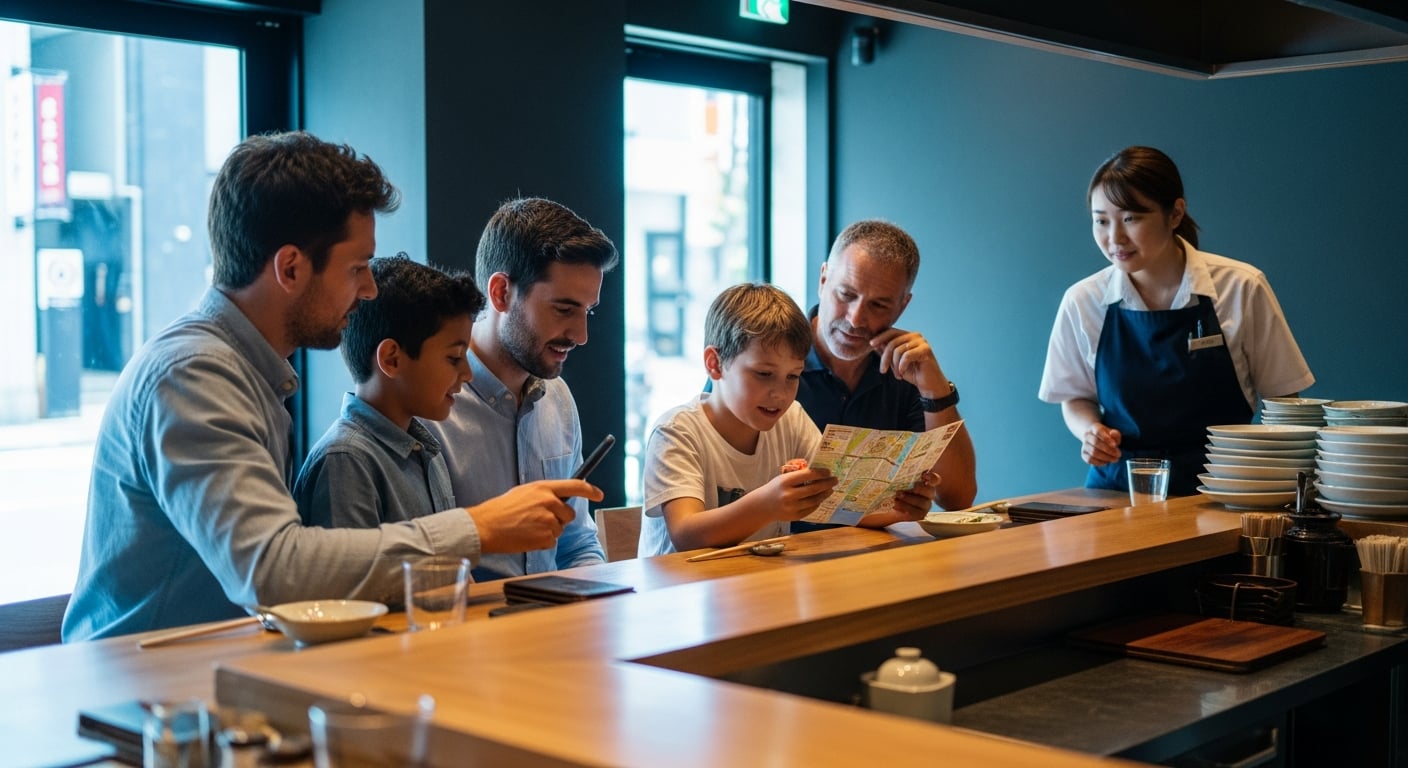
An English-friendly restaurant isn't simply one with a translated menu. That's the minimum. A genuinely international dining experience means the staff communicate with warmth even across a language gap, the menu explains not just what the dish is but how to eat it, and the concept itself is interesting enough that you'd want to tell someone about it afterward.
Nagoya in 2026 is not a city that needs to improvise hospitality for international guests. The city has been building toward this moment — hosting the Asian Games from September to October 2026 at venues across Aichi Prefecture, welcoming athletes, families, and fans from dozens of countries. The food scene that awaits them is not a backup plan. Nagoya's restaurants, especially in the Osu district, have been ready for visitors like you for years.
What to look for when choosing where to eat:
— A printed menu in your language, with photos and clear explanations (not just machine-translated text)
— A dish concept that can only be experienced at this specific location
— Ingredients with a story — not generic sourcing, but provenance you can trace
— A staff culture that welcomes guests without making them feel like outsiders
Why Is the Osu District the Right Place to Look?
If you're staying in central Nagoya or visiting the Asian Games venues, the Osu district is four minutes by foot from Yabacho Station (Meijo Subway Line, Exit 4) — and it represents exactly the kind of Nagoya that repeat visitors describe when they say the city surprised them.
Osu is not a tourist zone constructed for foreign audiences. It's a living neighborhood with over 400 years of history, 1,200 shops along its covered shopping street, and a genuine local crowd. Osu Kannon Temple sits at one end. Independent specialty restaurants sit quietly on second floors, known to those who seek them out.
This matters for your 2026 visit because it means the restaurants here were not opened to serve event crowds — they were already here, built around a clear culinary philosophy, and they'll be here long after the closing ceremony. The experience you find in Osu is not a pop-up or an event-season offering. It's the real thing.
✓ Key Takeaways
- English-friendly means more than translation — look for restaurants designed for international guests from the concept stage
- The Osu district offers authentic, locally rooted dining 4 minutes from Yabacho Station, well-suited for 2026 visitors
What Should I Actually Order to Create a Once-in-a-Lifetime Culinary Experience?
Here's where the question gets interesting. Most travelers visiting Japan have wagyu on their list. Many have already had Kobe beef or Matsusaka beef on previous trips. What you may not know yet is that Aichi Prefecture is home to one of Japan's most extraordinary wagyu varieties — and it's almost entirely unknown outside Japan.
Horai Wagyu is produced by just three farms in the entire country. Fewer than 300 heads are raised annually — compared to roughly 500,000 wagyu cattle produced in Japan each year. These animals are raised in the Okumikawa highlands of Aichi and fed on sake lees from Horaisen Sora, one of the region's finest breweries. The result is a beef with a flavor profile that reflects its environment in a way that no marketing campaign could manufacture.
At Itadaki, in Osu, this wagyu is served as the centerpiece of a dish that founder Masayuki Goto invented from scratch: the Rare Wagyu Gyudon. Goto — who has spent 18 years in the food and beverage industry and holds a Certified Food Sanitation Supervisor qualification from Japan's Ministry of Health, Labour and Welfare — developed a proprietary two-stage cooking technique that heats the beef to over 70°C at its core, fully meeting Japan's strict food safety standards, while preserving a tender, rare-style mouthfeel that is unlike anything else in the gyudon tradition.
The dish is served in a traditional Japanese ceramic bowl with Aichi-grown rice, a Nagoya Cochin egg, handmade miso soup using Hatcho miso from Okazaki, and a set of complimentary condiments — each one sourced from a specific farm or producer within Aichi Prefecture. A printed English menu walks you through the experience step by step, including a five-stage visual guide for how to eat the dish in sequence.
"Instagram-worthy presentation and unforgettable taste. My followers keep asking about it."
Guest review
That response — followers asking about it — is what happens when a dish has both visual impact and a story worth telling. The bowl is photogenic by design, not by accident. But what makes people reach for their phones is the combination: a concept that doesn't exist anywhere else, an ingredient that almost no one outside Japan has heard of, and a preparation technique that makes the whole thing feel almost impossible.
How Do I Reserve and What Should I Know Before I Go?
Horai Wagyu is limited to 10 bowls per day. This is not a marketing scarcity — it reflects the actual annual production of 300 heads across three farms. When it's gone, it's gone for the day.
Advance reservation via Tabelog Online is strongly recommended, especially during the busy 2026 event season. When making your reservation, copy and paste the following phrase into the notes field to request Horai Wagyu: 鳳来牛希望. Reservations can be made in English on the Tabelog website.
If you prefer to walk in, Itadaki's second signature — the Mikawa Beef Rare Gyudon — is always available and prepared with the same two-stage technique. Arriving right at 11:00 opening gives you the best chance of enjoying Horai Wagyu without a reservation.
A few things to know before you arrive:
— Itadaki is open on Saturdays, Sundays, Mondays, and Tuesdays, 11:00–15:00 (last order 30 minutes before closing). Public holidays: 09:00–15:00. Closed Wednesday through Friday.
— The restaurant is located on the 2nd floor at 4-1-20 Osu, Naka-ku, Nagoya. Look for the sign reading 元祖レア牛丼 頂 at street level and take the stairs up.
— All 18 seats feature sofa-style seating — comfortable for solo diners, couples, and small groups alike.
— The printed menu is available in English, Simplified Chinese, and Korean.
— Irregular closures do happen. Check the monthly business calendar before your visit.
Is This the Kind of Experience Worth Planning My Nagoya Day Around?
One visitor put it this way: "The lunch was the highlight of my Nagoya trip — I'm telling all my friends about it." Another traveled to Nagoya specifically for this meal. These are not outliers. They reflect what happens when a once-in-a-lifetime culinary experience is defined not by how much you spend, but by what you discover — and the story you walk away carrying.
Nagoya in 2026 is a city in its moment. The Asian Games, the new IG Arena designed by Kengo Kuma, the energy of Osu during a summer of international events — it's the right time to be here, and a remarkable time to find the kind of lunch that earns its place in your Japan travel story.
The Rare Wagyu Gyudon at Itadaki is not the loudest option in Nagoya. It doesn't need to be. It's the kind of place that rewards the traveler who asks: what can I find here that I genuinely cannot find anywhere else? The answer — 300 heads of Horai Wagyu, a cooking technique developed over years, a bowl assembled entirely from Aichi's finest farms — is waiting four minutes from Yabacho Station.
We'd love to welcome you. For our complete menu, access details, and store information, visit our official page at https://itadaki8.com/english/
When you're ready to secure your bowl — especially if Horai Wagyu is on your list — we recommend booking in advance:
Reserve Your Rare Wagyu Experience
And since our schedule can change, especially around event periods in 2026:
Check Our Monthly Schedule on Instagram