The Wagyu Discovery Guide: Beyond Famous Brands Into Aichi's Best
 gotowp
Let's start with the answer: yes, Horai Wagyu at Itadaki can sell out before you arrive — and yes, there is a reliable way to prevent that from happening. If you're planning a visit to Nagoya and Horai Wagyu is on your list, this guide will walk you through exactly what to do, step by step.
Horai Wagyu is one of Japan's most genuinely scarce wagyu varieties — only 300 heads raised annually across just 3 farms in the country. At Itadaki, we serve it in a rare-style preparation that took years of technique to develop. But because we can only prepare a limited number safely each day, we cap it at 10 bowls per day. That limit is not a marketing choice. It reflects the reality of working with an ingredient this rare.
We've had guests arrive from overseas specifically for this bowl. And we've had guests arrive just slightly too late and miss it. Both experiences shaped how we think about communicating availability honestly — so you can plan with confidence.
Who This Is For
- ✅ Travelers spending one or two days in Nagoya who cannot afford to miss their target dish
- ✅ Wagyu enthusiasts who have already experienced Kobe and Matsusaka beef and want to discover what comes next
- ✅ First-time users of Japanese reservation platforms who want a clear, step-by-step guide in English
- ✅ Visitors combining Nagoya sightseeing with trips to Shirakawa-go, Takayama, or other Central Japan destinations
- ✅ Anyone who wants to understand the difference between Horai Wagyu and Mikawa Beef before deciding what to order
Why Horai Wagyu Sells Out — and Why That Matters to Your Trip
To understand the sell-out risk, it helps to understand the ingredient itself. Horai Wagyu is raised in Okumikawa, in the mountainous interior of Aichi Prefecture. The cattle are fed on the lees of Horaisen Sora, a premium local sake — a feeding method that influences the fat composition and flavor in ways that cannot be replicated by other breeds or other regions. Across all of Japan, only 3 farms produce this wagyu, and the annual yield is approximately 300 heads. For context: there are roughly 500,000 wagyu cattle raised in Japan each year. Horai Wagyu represents a fraction of a fraction.
At Itadaki, we receive a carefully allocated portion through our direct-supply partnership with those farms. That allocation determines how many bowls we can serve. When we say 10 bowls per day, that ceiling is firm. On weekends and public holidays, we often reach that limit well before noon.
For foreign visitors with short Nagoya stays — often sandwiched between Shirakawa-go the day before and the Shinkansen home the next morning — arriving at 12:30 to find the Horai Wagyu sold out is a genuinely painful outcome. We've seen it happen. And it doesn't need to happen to you.
If you're curious about how Horai Wagyu compares to other wagyu varieties from Central Japan, this guide on Nagoya Wagyu versus Hida Wagyu covers the regional differences in depth.
You now know that Horai Wagyu is capped at 10 bowls per day — but our open days also change monthly, and irregular closures do apply. Our Instagram shows the exact business calendar for each month, updated in advance so you can plan your visit around confirmed open days.
The Reservation Process: Step by Step, in English
Tabelog is Japan's leading restaurant reservation platform — equivalent in importance to OpenTable in North America, but far less familiar to international visitors. The good news: Tabelog's reservation system is available in English, and the process is straightforward once you know where to look.
Here is how to secure your Horai Wagyu bowl:
- Visit Tabelog Online and search for Itadaki, or use the direct reservation link on our website at itadaki8.com/en.
- Select your preferred date and time. Our lunch service runs from 11:00 to 15:00 (last order at 14:30) on Saturdays, Sundays, Mondays, and Tuesdays. We are closed Wednesdays, Thursdays, and Fridays. On public holidays, we open at 09:00. Please check our monthly business calendar on Instagram before booking, as irregular closures do occasionally apply.
- In the notes or request field, copy and paste the following Japanese phrase: 鳳来牛希望 — This tells our team that you would like Horai Wagyu reserved for your visit. You do not need to translate it or explain it further. Just paste it exactly as written.
- Complete the reservation in English. No Japanese is required beyond that one phrase in the notes field.
That phrase — 鳳来牛希望 — is the single most practical thing you can take away from this article. Save it to your phone now.
✓ Key Takeaways
- Horai Wagyu is capped at 10 bowls per day due to genuine supply limitations — not policy. It regularly sells out during peak lunch hours on weekends.
- Reservations via Tabelog can be made entirely in English. Paste 鳳来牛希望 into the notes field to request Horai Wagyu specifically.
- If you cannot reserve in advance, arriving right at 11:00 opening significantly improves your chances as a walk-in guest.
You have the phrase — <strong>鳳来牛希望</strong> — and you know the steps. The only thing left between you and a confirmed Horai Wagyu bowl is completing the Tabelog reservation. The form is available in English, and the notes field is where that phrase goes.
What Happens If Horai Wagyu Is Already Gone When You Arrive
This is the scenario that worries most visitors who couldn't reserve in advance. Here's the honest picture.
If you walk in without a reservation and Horai Wagyu is sold out, you will be offered our Mikawa Beef Rare Gyudon — always available, prepared with the same proprietary two-stage cooking technique, and using a lean uchimomo cut from Aichi's Mikawa region. Mikawa cattle are raised on okara feed with lactic acid bacteria gut management, which produces a clean, distinct flavor. It is not a consolation prize. It is a genuinely different and equally exquisite bowl.
That said, if your heart is set on Horai Wagyu — and after reading this far, it probably is — please reserve.
One guest put it plainly after visiting:
"I've had Kobe beef and Matsusaka beef, but Horai Wagyu at Itadaki was on another level."
That's not a sentiment we manufactured. It reflects something real about what makes this wagyu different — the combination of scarce genetics, sake-lees feeding, and a rare-style preparation that has been refined through years of work by our team. If that's what you're coming for, give yourself the best chance of tasting it.
For a closer look at what the daily service actually looks like — including how those 10 bowls are prepared and allocated — this behind-the-scenes account of a day at Itadaki gives an honest picture of the kitchen and the rhythm of the lunch service.
Two Practical Scenarios: Planning Your Visit
Scenario A: You have one day in Nagoya and Horai Wagyu is the goal.
Reserve via Tabelog. Include 鳳来牛希望 in the notes. Book the first available slot at or after 11:00. If you're arriving from outside Nagoya, note that Itadaki is a 4-minute walk from Yabacho Station Exit 4 on the Meijo Subway Line — approximately 10 minutes from Nagoya Station with one transfer at Sakae. From the station, a brief stroll through the Osu district or past Hisaya-odori Garden Flarie makes for a pleasant approach before lunch.
Scenario B: You're passing through Nagoya between Shirakawa-go and your next destination, with no time to pre-plan.
Head to Itadaki as close to 11:00 as your schedule allows. On weekdays (Monday or Tuesday), your chances of walk-in Horai Wagyu availability are meaningfully better than on weekends. If the Horai Wagyu is gone, the Mikawa Beef Rare Gyudon starting from ¥1,800 (Fumoto size: 100g beef, 200g rice) is an entirely satisfying bowl — prepared with the same technique, sourced from the same commitment to Aichi ingredients.
On public holidays, we open earlier at 09:00, which means walk-in guests who arrive right at opening have a genuine shot at Horai Wagyu — even without a reservation.
Our business calendar changes monthly. Before your visit, we recommend confirming open days via our Instagram account, where we post the schedule each month.
A Note on What You're Actually Reserving
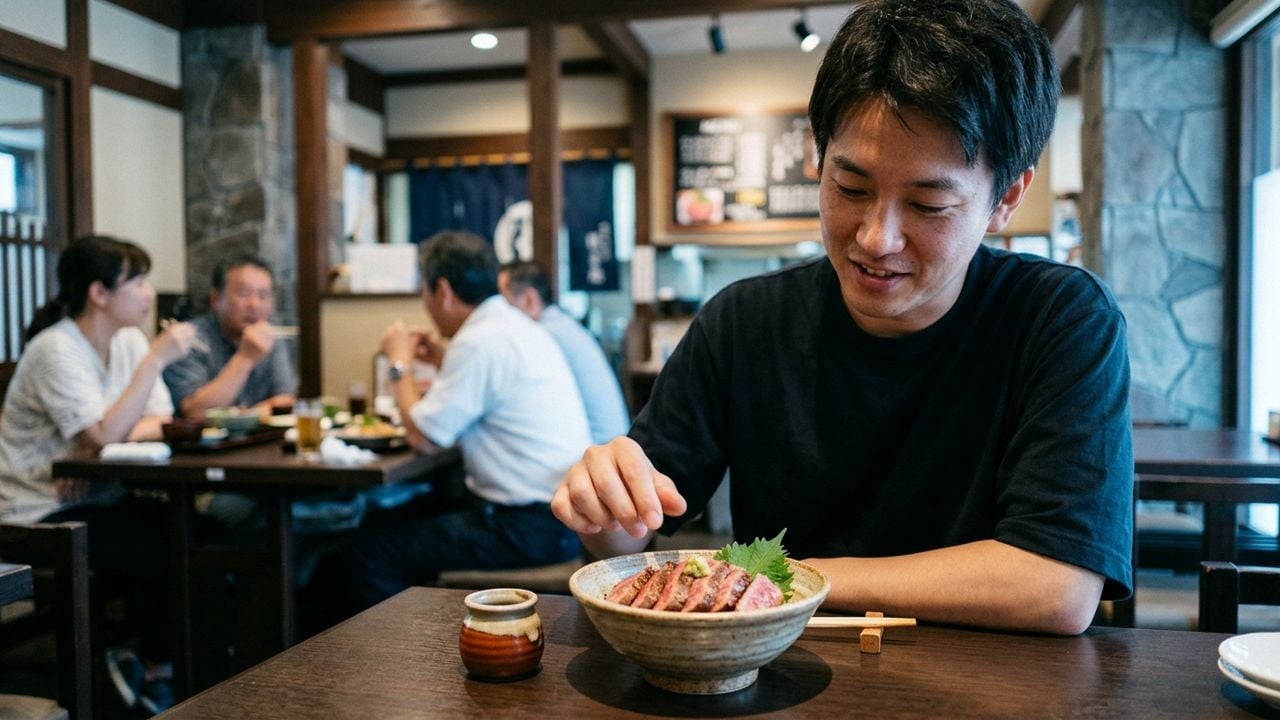
The Horai Wagyu Rare Gyudon (Shinkoccho, our standard size) is ¥2,700, and includes 100g of Horai Wagyu prepared rare-style, served over Aichi no Kaori brand rice, with Hatcho miso soup, Atsumi Ichō-zuke pickles, Toyohashi-grown shiso leaves, and a Nagoya Cochin egg from Yamada Poultry Farm. Every element comes from Aichi Prefecture — that's a commitment we've held since the day we opened in April 2022.
The experience unfolds in five steps that we walk every guest through — beginning with separating the egg (white into the miso soup, yolk over the beef) and moving through different flavors and textures as you add condiments. It's not just a bowl you eat. It's a sequence you move through. Many guests tell us it's the most deliberately structured single dish they've encountered in Japan.
For a deeper dive into the wagyu landscape in Aichi and how Horai Wagyu fits into it, this guide to wagyu brands beyond Kobe is a useful read before your visit.
For our complete menu, access details, and store information, visit our official page at itadaki8.com/en.
Horai Wagyu: 300 heads a year, 10 bowls a day, and no guarantee for walk-ins during peak hours. If this is the bowl you're coming to Nagoya for, the reservation is the one step that removes all uncertainty. Tabelog takes the booking in English — paste 鳳来牛希望 in the notes, and your visit is secured.