Wagyu Bowl vs Wagyu Steak in Japan: Two Ways to Experience Wagyu
 gotowp
Here's the honest answer upfront: both a wagyu steak and a wagyu bowl can be extraordinary — but they are not interchangeable experiences, and the one you choose should depend on what kind of traveler you are, how much time you have in Nagoya, and, critically, whether you've secured your spot before arriving.
That last point matters more than most visitors realize. If you've come to Nagoya specifically to try Horai Wagyu — one of Japan's rarest wagyu breeds, raised by only 3 farms with just 300 heads annually — then the question isn't just "bowl or steak?" It's "have I reserved, or am I gambling?"
Let's break down the comparison properly, and then walk through exactly what you need to do to make sure your wagyu moment actually happens.
Who This Is For
- ✅ Wagyu enthusiasts who have tried Kobe or Matsusaka beef and want to understand what makes a wagyu bowl experience different from a steak dinner
- ✅ Travelers on a tight Nagoya schedule (one or two days) who cannot afford to arrive and find their target dish sold out
- ✅ First-timers to Tabelog who aren't sure how to make a reservation in Japan as a foreign visitor
- ✅ Foodies weighing the practical trade-offs between a high-end wagyu restaurant and a specialty lunch concept
- ✅ Anyone curious about what "rare-style" wagyu preparation actually means — and whether it's safe
What You're Actually Comparing
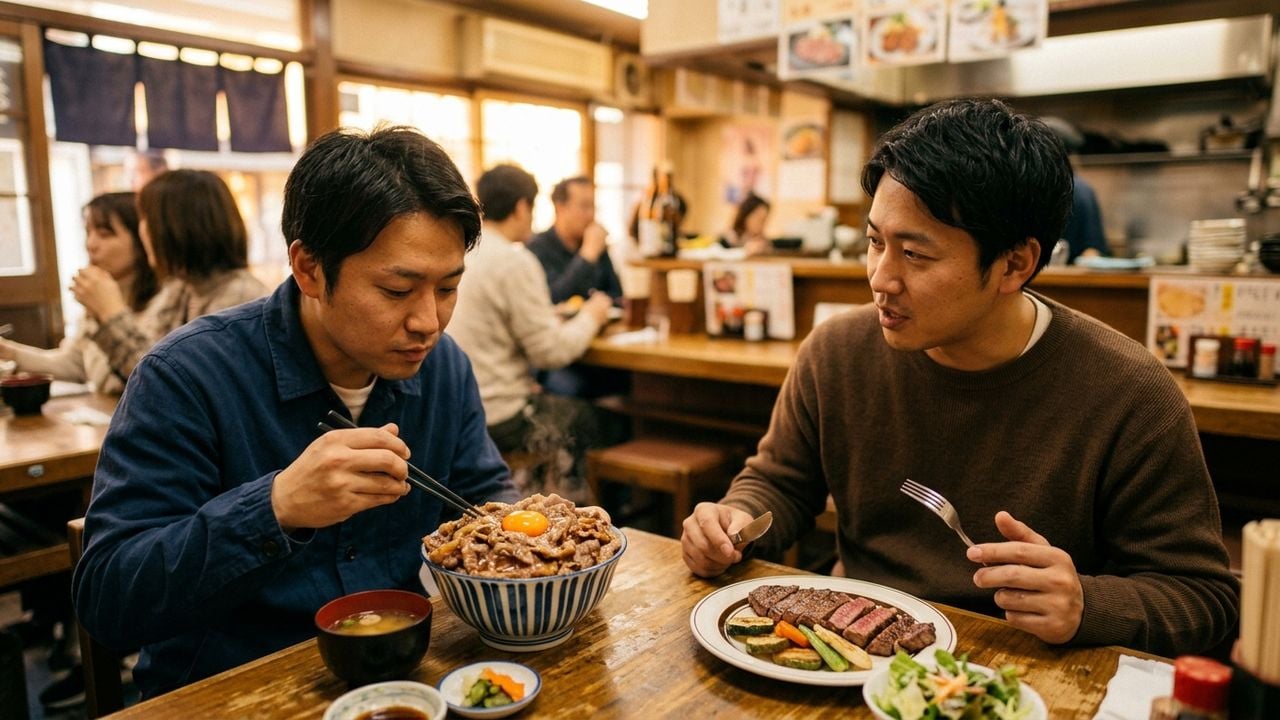
A wagyu steak dinner at a high-end restaurant is a performance. Teppanyaki chefs work in front of you, courses unfold over two hours, wine pairings are suggested, and the bill reflects all of it. The beef is the centerpiece, but so is the theater around it. For many travelers, that full-evening experience is exactly what they want.
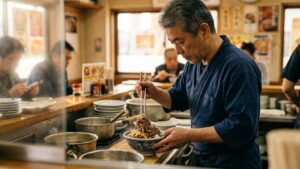
A wagyu bowl — specifically the Rare Wagyu Gyudon at Itadaki in Osu — works on a completely different logic. It's a lunch-only, single-dish experience built around one question: what happens when you take Japan's most humble everyday food format (the beef bowl) and fill it with beef that has no business being in a bowl?
The answer, it turns out, is something that steak dinners rarely deliver: surprise. When you sit down expecting something familiar and receive something you've never tasted before, that gap between expectation and reality becomes the memory.
At Itadaki, the Horai Wagyu arrives over Aichi-grown rice, accompanied by a raw Nagoya Cochin egg, miso soup made with Hatcho miso from Okazaki, and pickled radish from the Atsumi Peninsula. Every element is from Aichi Prefecture. The beef itself is cooked using a proprietary two-stage technique — heating to over 70°C at the core, fully meeting Japan's food safety standards — while preserving a texture that reads as rare to the palate. It is not raw. It is not a workaround. It is a technically achieved result that took years to develop.
If you're curious about why this experience has made Itadaki a destination in itself for wagyu travelers, the contrast with a conventional steak dinner is where the story begins.
If the 10-bowl daily limit is already making you recalculate your Nagoya schedule, that's the right instinct — Horai Wagyu availability varies by day, and the monthly calendar tells you exactly when Itadaki is open before you book flights or train tickets. The official Instagram posts the business calendar each month so you can plan around confirmed open days.
The Trade-Off: Exclusivity Without the Price Tag of a Steak Dinner
Wagyu steak restaurants in Japan's major cities typically run ¥15,000 to ¥30,000 per person for a full course. The quality is real, but so is the price. A solo traveler on a two-week Japan trip may budget for one such dinner and spend the rest of their meals on convenience store onigiri.
The Horai Wagyu Rare Gyudon at Itadaki starts at ¥2,700 for the standard size (Shinkoccho: 100g beef, 200g rice). That's not a budget meal in the gyudon-chain sense — it's a price that reflects what Horai Wagyu actually is: a beef produced in such limited quantities that most people in Japan have never encountered it either.
To put the rarity in perspective: there are approximately 500,000 wagyu cattle raised in Japan at any given time. Horai Wagyu accounts for 300 of them. The cattle are raised in Okumikawa, deep in Aichi's mountains, and fed on sake lees from Horaisen Sora — a premium local sake. That feeding method contributes to a flavor profile that sits between rich marbling and lean depth, a combination that's genuinely unusual in the wagyu world.
A wagyu steak gives you more of the same beef in a larger format. The gyudon gives you an entirely new frame — one that, according to guests who have eaten both, often produces the stronger memory.
"I discovered Itadaki through Google Maps and it became the best meal of our Japan trip."
— A guest who visited during their Nagoya stay
✓ Key Takeaways
- Wagyu steak and wagyu bowl offer fundamentally different experiences — one is a long-form dinner event, the other is a concentrated lunch discovery built around a single extraordinary ingredient.
- Horai Wagyu, used at Itadaki, is produced by only 3 farms with 300 heads annually — a scarcity that is genuine, not manufactured.
- The two-stage cooking technique delivers a rare-style texture while fully meeting Japanese food safety standards — no compromise on either front.
You've now got the phrase to paste into the notes field — 鳳来牛希望 — but the reservation itself still needs to be placed before someone else takes the last bowl. Tabelog's booking page is available in English, and securing your seat takes only a few minutes.
The Real Risk You Need to Plan Around
Here's where the comparison becomes practical advice rather than philosophy. A wagyu steak restaurant typically seats many guests and serves beef it has ordered in quantity. You book a table, you show up, the beef is there.
Itadaki is different. Horai Wagyu is limited to 10 bowls per day. That's it. On busy weekend lunches or during peak travel seasons — and late September in Nagoya, with autumn tourism building and the city still buzzing from the summer's events, is absolutely a busy period — those 10 bowls can be gone by 12:30.
Foreign visitors staying just one or two days in Nagoya face a specific problem: there's no "I'll come back tomorrow" option. If you walk in at 12:45 and the Horai Wagyu is sold out, you've lost your window. The Mikawa Beef Rare Gyudon (starting at ¥1,800) is always available and prepared with the same two-stage technique — it's genuinely excellent — but if your intention was Horai Wagyu, that's a different outcome than you planned for.
This is why I want to be direct about what "walk-in" actually means at Itadaki: it's a gamble with your travel schedule, not a casual option.
How to Reserve (Even If You've Never Used Tabelog)
Tabelog is Japan's most widely used restaurant review and reservation platform. It's not well known outside Japan, which is why many foreign visitors have never heard of it — and feel uncertain about using it. Here's the reality: the reservation process at Itadaki's Tabelog page is available in English, and it's straightforward.
The one step that confuses guests is how to specifically request Horai Wagyu. Because the bowl is limited and not automatically guaranteed even with a reservation, you need to add a note when booking. Copy and paste the following phrase into the notes field:
鳳来牛希望
That phrase means "Horai Wagyu requested" in Japanese. You don't need to type it — just copy it from here and paste it. That's the whole trick. Staff will see it and set aside your bowl.
If you prefer not to reserve, arriving right at 11:00 when the doors open gives you the best walk-in chance. Itadaki is open for lunch only (11:00–15:00, last order at 14:30) on Saturdays, Sundays, Mondays, and Tuesdays. The restaurant is on the 2nd floor, a 4-minute walk from Yabacho Station Exit 4 on the Meijo Subway Line — easily reachable from Nagoya Station in about 10 minutes total.
Because the monthly schedule can shift — Itadaki does observe occasional irregular closures — checking the official Instagram before your visit is always a good habit. The business calendar is posted there each month.
For a deeper look at how wagyu tourism in Japan has evolved beyond the major brands and why regional finds like Horai Wagyu are drawing travelers off the Golden Route, that broader context is worth reading before you plan your Nagoya day.
Which Should You Choose?
If you want a long, celebratory dinner with multiple courses, theatrical cooking, and a wine list — a wagyu steak dinner at one of Nagoya's dedicated teppanyaki or yakiniku restaurants is the right call. That experience exists and it's genuinely worthwhile.
If you want a lunch that gives you something you genuinely cannot find anywhere else in the world — a culinary concept invented from scratch, featuring one of Japan's rarest wagyu breeds, prepared with a technique that took years to perfect, inside a neighborhood that mixes 400-year-old temple culture with cosplay shops and Taiwanese street food — then the choice is Itadaki.
The two aren't in competition. But if your Nagoya schedule allows for only one wagyu moment, the bowl offers a complete story in a single hour: the rarity of the ingredient, the specificity of Aichi's food culture, and a dish format that surprises even guests who consider themselves seasoned wagyu travelers.
The 10-bowl daily limit is not a marketing device. It's a natural consequence of sourcing an ingredient produced by three farms. Plan accordingly, and the experience is waiting for you.
For our complete menu, access details, and store information, visit our official page at https://itadaki8.com/english/
You're planning a one- or two-day Nagoya stop, you know which bowl you want, and you have the note to paste — the only remaining step is locking in the reservation before you arrive. Tabelog's English-language booking page is where the 10 bowls per day are held.