Authentic Japan Food Story: The Rare Wagyu Gyudon Journey
 gotowp
You've been planning this Japan trip for months — maybe years. You have the temples, the castles, the ryokan. But somewhere on your list, there's a question that keeps coming back: What will be the meal I remember? Not just a good meal. The meal. The one you describe to friends back home, the one that turns into a story.
A once-in-a-lifetime culinary experience in Japan isn't defined by price. It's defined by uniqueness — by the fact that what you're eating exists nowhere else on earth, was invented in this very room, with ingredients that only a handful of people in the world can access. That's the standard worth chasing.
Who This Is For
- ✅ Travelers who want at least one meal on their Japan trip that becomes a story, not just a memory
- ✅ Wagyu enthusiasts who have tried the famous brands and are ready to discover what's next
- ✅ Repeat visitors to Japan seeking authentic experiences beyond Tokyo, Kyoto, and Osaka
- ✅ Food-focused travelers who value the story and origin of a dish as much as the taste itself
- ✅ Anyone staying in Nagoya — even for a single day — and wondering where to go for lunch

What Makes a Meal Truly "Once in a Lifetime" — and Why Most Wagyu Experiences Miss the Mark?
A once-in-a-lifetime meal isn't about spending more. It's about encountering something that simply cannot be reproduced — not in another city, not in another country, not even in another restaurant in the same neighborhood. The experience becomes irreplaceable because of two things working together: an ingredient so rare it barely exists, and a concept so original it was born in one specific place.
Most wagyu experiences, even excellent ones, fall short of that standard. You eat beautifully marbled beef. It's extraordinary. But the format — the steakhouse, the shabu-shabu, the yakiniku — exists in dozens of cities around the world. The ingredient changes; the concept doesn't.
At Itadaki in Nagoya's Osu district, the concept itself is the invention. Masayuki Goto — founder of Itadaki and the originator of what is now recognized across Japan as "Rare Wagyu Gyudon" — asked a question nobody had asked before: Why does gyudon, Japan's most beloved beef bowl, have no premium version? Katsudon has one. Kaisendon has one. Only gyudon was left behind, stuck in the world of fast-food chains. Goto changed that in April 2022, and the story of how Itadaki became the world's first Rare Wagyu Gyudon restaurant is one worth reading before you visit.
You're planning the kind of Japan trip where every lunch counts — and the one detail that could derail it is arriving at Itadaki on a day the restaurant isn't open. The monthly business calendar, including any irregular closures, is shared on our official Instagram so you can lock in the right date before you finalize your itinerary. No account needed to view it.
What Is Horai Wagyu — and Why Does It Matter to Your Food Story?
The ingredient at the center of this culinary journey is Horai Wagyu — a Japanese black wagyu raised in Okumikawa, deep in Aichi Prefecture, by just three farms. Only 300 heads are produced annually across all of Japan. To put that in perspective: there are roughly 500,000 wagyu cattle raised in Japan each year. Horai Wagyu represents a fraction of a fraction.
What makes Horai Wagyu distinct isn't just its scarcity. These cattle are fed on sake lees from Horaisen Sora, a renowned local premium sake from the same mountain region. This creates a flavor profile unlike typical heavily marbled wagyu — a balance of lean meat depth and delicate fat that surprises even guests who have eaten Kobe and Matsusaka beef many times before.
Itadaki is one of the few restaurants in Nagoya with a direct sourcing partnership with these farms. The Horai Wagyu Rare Wagyu Gyudon — called Shinkoccho in the standard size — is strictly limited to 10 bowls per day. That limit isn't a marketing device. It's simply the honest reality of working with an ingredient this rare.
"I've had Kobe beef and Matsusaka beef, but Horai Wagyu at Itadaki was on another level."
— Guest review
✓ Key Takeaways
- A truly once-in-a-lifetime meal is defined by uniqueness of concept and ingredient, not price alone
- Horai Wagyu is produced by only 3 farms in Japan, with just 300 heads raised annually — genuine scarcity, not manufactured storytelling
- Itadaki invented the "Rare Wagyu Gyudon" category — this dish exists nowhere else in the world
Horai Wagyu is limited to 10 bowls per day — and as you've just read, this scarcity is real, not staged. Arriving without a reservation means risking that all 10 bowls are gone before your bowl reaches the table. Tabelog online reservation takes only a few minutes and secures your place in one of Nagoya's most limited lunch experiences.
Is It Safe to Eat "Rare" Wagyu in a Beef Bowl?
This is the question many guests carry through the door — and it deserves a direct, honest answer.
Goto spent years developing a proprietary two-stage cooking technique that heats the beef to above 70°C at the core, fully meeting Japan's Ministry of Health, Labour and Welfare food safety standards. The result delivers the visual and textural experience of rare-style beef, while being completely safe by Japanese regulatory standards. Goto holds certification as a Food Sanitation Supervisor and operates under a license from the Aichi Prefecture Public Health Center. This isn't a loophole — it's a technical achievement that required both culinary creativity and rigorous food safety expertise to develop.
The technique has been recognized by NHK and seven other major Japanese television broadcasters as the defining innovation behind the "Rare Wagyu Gyudon" concept. The complete story of how this technique came to exist — from a pandemic-era idea to a nationally recognized culinary invention — is a journey worth following.
How Does the Eating Experience Actually Unfold?
Part of what makes a meal memorable is when it asks something of you — when it has a structure, a rhythm, a way of unfolding that turns eating into an event.
Itadaki offers every guest a five-step guide to experiencing the dish, printed in English (with menus also available in Simplified Chinese and Korean). It goes something like this:
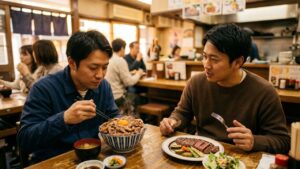
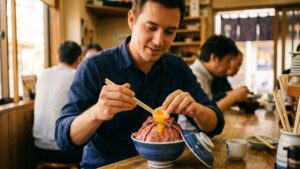
First, you separate the raw Nagoya Cochin egg — white into the miso soup, golden yolk resting on top of the wagyu. Then you eat the beef as it is, without any additions, to appreciate the rare texture and the specific flavor of Horai Wagyu on its own. From there, you mix the yolk through the beef for a richer, silkier layer of flavor. The complimentary tabletop condiments — pickled ginger from Inazawa, dried seaweed from Mikawa Bay, chirimen jako from Minamichita, Itadaki's original 8-spice blend — let you build new flavor combinations with each bite. Finally, a touch of wasabi closes the experience with a clean, refreshing note.
Every ingredient on that table, from the rice (Aichi no Kaori, grown in Aichi) to the miso soup (Hatcho miso from Okazaki) to the shiso leaves (Aikei No.1 variety from Toyohashi), comes from Aichi Prefecture. The bowl isn't just a wagyu dish — it's a portrait of an entire region's food culture, assembled in a single ceramic vessel.
"I traveled to Nagoya specifically to eat here — it was 100% worth it."
— Guest review
How Do You Plan a Visit — and What Should You Know Before You Go?
Itadaki is open for lunch only: Tuesday, Saturday, Sunday, and Monday from 11:00 to 15:00, and on public holidays from 9:00 to 15:00. Wednesday, Thursday, and Friday are closed. Last order is 30 minutes before closing. Because the restaurant follows a scheduled calendar rather than fixed weekly hours, it's worth checking the monthly schedule on Instagram before finalizing your plans.
The restaurant is located on the 2nd floor at 4-1-20 Osu, Naka-ku, Nagoya — a four-minute walk from Yabacho Station Exit 4 on the Meijo Subway Line. From Nagoya Station, the journey takes roughly ten minutes by subway. The Osu district itself is one of Nagoya's most rewarding neighborhoods to explore: Osu Kannon Temple, the 1,200-shop Osu Shopping Street, and the nearby Hisaya-odori Garden Flarie (three minutes from Yabacho Station) are all easy additions to the same afternoon.
Because Horai Wagyu is limited to 10 bowls per day, reservation via Tabelog is strongly recommended — especially during peak hours. The 18-seat restaurant (all sofa-style table seating, with counter seats ideal for solo visitors) fills quickly on weekend mornings. If you're building a Japan itinerary around memorable meals, this is one booking worth making before the trip rather than on the day.
For anyone exploring why Itadaki deserves a dedicated trip to Nagoya rather than a casual walk-in, the answer tends to come back to the same thing: you can't replicate this elsewhere. The ingredient doesn't exist in this volume anywhere else. The concept was invented here. And the story — of a founder who built a restaurant to support struggling Aichi farmers during a pandemic, who invented an entirely new culinary category to give the humble gyudon its long-overdue premium moment — is one of those rare food stories that actually holds up once you taste it.
The meal that becomes a story worth telling isn't always the most expensive one. It's the one with the most honest reason to exist.
For our complete menu, access details, and store information, visit our official page at https://itadaki8.com/english/
You've read through what makes this bowl different — the 300-head annual production, the two-stage cooking technique, the five-step eating journey built from Aichi ingredients. The next step is straightforward: claim one of the 10 daily Horai Wagyu bowls before someone else does. Reservation via Tabelog is available now.