Perfect Route: Meiji Mura Morning, Itadaki Nagoya Afternoon
 gotowp
Here's a number that might surprise you: 29.7% of visitors from Hong Kong have been to Japan ten or more times. For travelers at that level of experience, the question is no longer "What should I see in Japan?" — it's "What haven't I found yet?"
That shift in mindset is exactly what makes a day like this one so satisfying. Meiji Mura in the morning — one of Japan's most atmospheric open-air architectural museums — followed by lunch at a specialty restaurant in Nagoya's Osu district that most guidebooks haven't caught up with yet. Before this kind of day, you might have felt like you'd already seen the best Japan had to offer. After it, you realize the country still has more to give.
This article maps out that route in practical terms, and explains why the second half — the lunch — tends to be the part visitors talk about longest.
Who This Is For
- ✅ Repeat visitors to Japan who feel they've done Tokyo, Kyoto, and Osaka and are ready to go deeper
- ✅ Travelers spending a day or more in Nagoya who want to combine sightseeing with a genuine local food discovery
- ✅ History and architecture enthusiasts visiting Meiji Mura who need a satisfying lunch plan nearby
- ✅ Foodies seeking a one-of-a-kind wagyu experience that isn't on the mainstream tourist circuit
- ✅ Anyone who wants a day itinerary they can actually tell a story about when they get home
Why Meiji Mura Sets the Perfect Tone for a Day of Discovery
Meiji Mura, located about 30 minutes north of Nagoya by train and bus, is the kind of place that rewards curiosity. More than 60 original buildings from Japan's Meiji era — the late 19th and early 20th centuries — have been relocated and preserved here across a vast hillside landscape. You can walk through the lobby of the original Imperial Hotel designed by Frank Lloyd Wright, step inside a Meiji-period prison, and look out over reconstructed streets that feel genuinely lived-in rather than staged.
What makes it relevant to the "hidden gem" mindset is that Meiji Mura draws a thoughtful crowd — people who are interested in Japan's history of transformation, not just its postcard moments. It takes at least two to three hours to do it justice, which means you'll arrive back in Nagoya's city center somewhere around early to mid-afternoon, ready for a meal that matches the quality of what you've just experienced.
The connection between these two destinations is more than logistical convenience. Both reward visitors who are willing to look a little harder and go a little further than the obvious choices. If you want to understand more about how the Meiji Mura visit compares with other Nagoya day-trip combinations, this piece on combining Meiji Mura with an Itadaki lunch in Nagoya goes deeper into the practical timing.
You're reading about a route built around finding what most visitors don't — and knowing whether Itadaki is actually open on the day you're planning is the first practical question that matters. The monthly business calendar on Instagram shows confirmed operating days, including any irregular closures that don't appear elsewhere. It takes about 30 seconds to check.
Before Lunch: What Most Visitors Feel Walking Into Osu
The Osu district sits about a 10-minute subway ride from central Nagoya. Before you visit, the name might mean very little. Most English-language travel guides give it a passing mention as "Nagoya's retro shopping street" or a spot for anime merchandise. That framing undersells it significantly.
Osu is where Nagoya's locals actually spend their weekends. It has Buddhist temples, vintage electronics stalls, Taiwanese street food, and maid cafés all within a few minutes' walk of each other. It has 400 years of history and a subculture scene that draws cosplay enthusiasts from across Asia every summer for the World Cosplay Summit. It is not a place designed for tourists — which is precisely why repeat visitors to Japan find it so satisfying.
Before finding Itadaki, most visitors to this area don't know exactly what they're looking for. They're browsing, exploring, open to surprise. That openness is the right frame of mind for what comes next.
✓ Key Takeaways
- Meiji Mura and Osu are both destinations that reward curiosity over convenience — they suit the same type of traveler
- The route works naturally as a morning-to-early-afternoon sequence, with lunch in Osu fitting the return timing from Meiji Mura
- Osu is a neighborhood known to Nagoya locals but still largely undiscovered by mainstream international tourism
Horai Wagyu is capped at 10 bowls a day — and you've just read why this particular beef is unlike anything else on offer in Nagoya. Reserving your bowl in advance via Tabelog is the one step that turns this route from a plan into a confirmed experience. The reservation form is straightforward and requires no Japanese.
After Lunch: How the Meal Changes the Story You Tell
Itadaki opened in Osu in April 2022 — founded by Masayuki Goto, who had spent nearly two decades in the Nagoya bar and restaurant world. His original question was a simple one: every other Japanese donburi style had a premium version — kaisendon with premium tuna, oyakodon with Nagoya Cochin chicken, katsudon with kurobuta pork. Only gyudon, the beef bowl, remained stubbornly associated with fast food chains. Why?
That question led to "Rare Wagyu Gyudon" — a culinary concept Goto invented from scratch. The dish uses beef from Aichi Prefecture — including Horai Wagyu, raised by only three farms in Japan with just 300 heads produced annually — prepared using a proprietary two-stage cooking technique that delivers a rare-style texture while fully meeting Japan's Ministry of Health, Labour and Welfare food safety standards. Every single ingredient on the table comes from Aichi Prefecture: the rice, the sauce, the egg, the pickles, the shiso leaves, even the condiments.
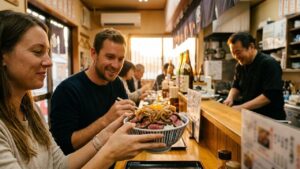
The experience unfolds in five deliberate steps guided by a printed English menu — starting with the Nagoya Cochin egg, separating the white into the miso soup and placing the yolk over the beef, then working through the dish with different condiment combinations until finishing with wasabi. It is, genuinely, a culinary journey built into a single bowl.
One guest put it plainly:
"I traveled to Nagoya specifically to eat here — it was 100% worth it."
Visitor, Itadaki guest review
That kind of comment — traveling to a specific city for a single restaurant — doesn't happen at places you find in standard guidebooks. It happens when someone has done enough research to know that what they're about to eat exists nowhere else in the world. And in Itadaki's case, that's factually accurate: Goto is recognized as the originator of the "Rare Wagyu Gyudon" concept, featured on eight major Japanese TV programs including NHK, Japan's national public broadcaster.
If you're planning a broader day in this part of Nagoya, the step-by-step Nagoya Castle, Osu Kannon, and Itadaki route is another combination worth reading — it shows how well the Osu district connects with Nagoya's main historical sites in a single afternoon.
The Practical Route: Timing and Access
Here's how the day actually flows:
Morning at Meiji Mura (approx. 9:00–12:30)
Meiji Mura is accessible from Nagoya Station by Meitetsu Line to Inuyama Station, then a direct bus to the museum entrance. Plan for two to three hours inside the museum. Leaving by around 12:00–12:30 gives you comfortable travel time back toward the city.
Transit to Osu (approx. 30–40 minutes)
Return by bus and Meitetsu Line to Inuyama, then connect to Nagoya's subway Meijo Line. Yabacho Station Exit 4 puts you four minutes from Itadaki on foot. The address is 4-1-20 Osu 2F, Naka-ku — look for the second floor entrance.
Lunch at Itadaki (approx. 13:00–14:00)
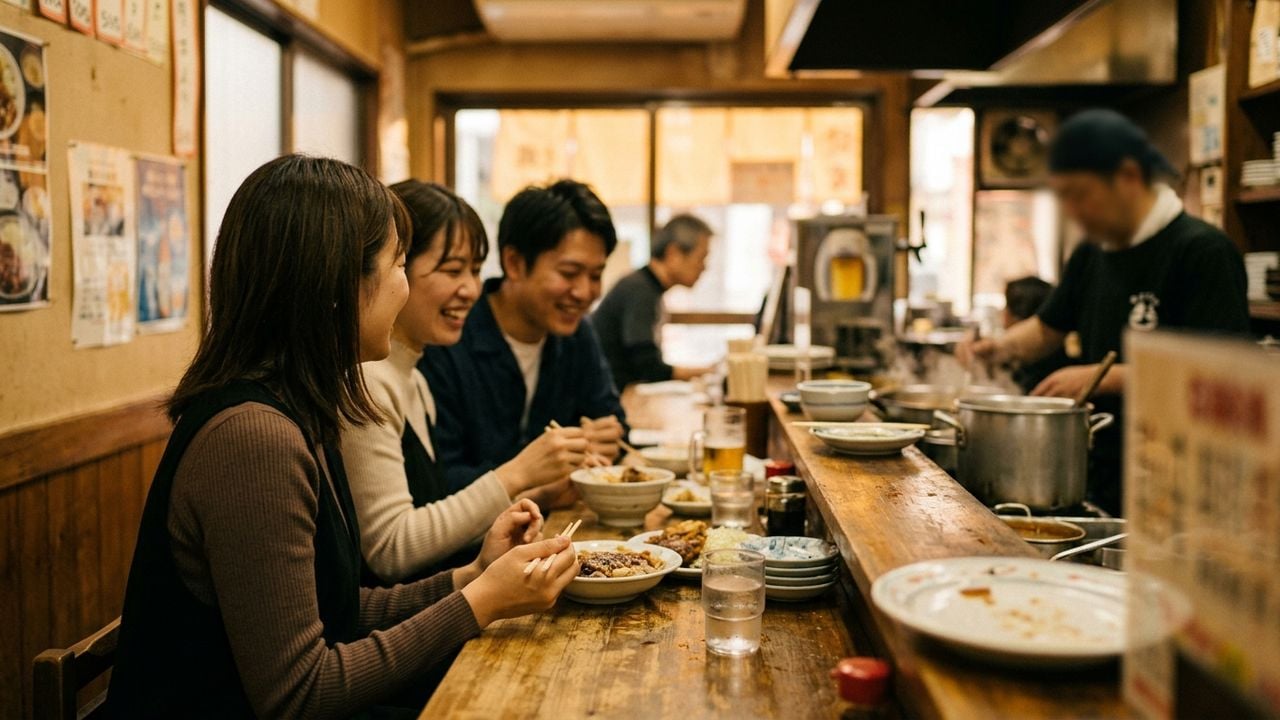
Itadaki serves lunch only, with last orders 30 minutes before the 15:00 closing time on regular operating days (Saturday, Sunday, Monday, and Tuesday). On public holidays — and September 2026 has a few to be aware of — opening is from 9:00. The restaurant has 18 seats with comfortable sofa-style table seating, plus five counter seats ideal for solo travelers.
One important note: the Horai Wagyu option is limited to 10 bowls per day and can sell out during peak hours. If you have your heart set on this particular beef — and if you've come this far in your research, you likely do — booking in advance via Tabelog is strongly recommended. For anyone traveling during a busier period like a long weekend, this is not a detail to leave to chance.
The Mikawa Beef Rare Wagyu Gyudon (starting at ¥1,800 for the Fumoto size) is always available and follows the same cooking philosophy and all-Aichi sourcing commitment, making it an excellent choice if you arrive later in service or prefer a more accessible starting point.
For travelers with accessibility considerations or planning with family, the Nagoya accessibility food guide featuring Itadaki has relevant details about the restaurant's layout and access conditions.
What Changes After a Day Like This
There's a particular kind of satisfaction that comes from returning home after a trip and realizing that the meal you remember most wasn't the one at the famous restaurant everyone told you to visit. It was the one you found yourself — in a neighborhood you'd never heard of, eating something that didn't exist anywhere else.
That's the before-and-after this route creates. Before: a well-traveled visitor looking for the next layer of Japan. After: someone who has walked through Meiji-era architecture in the morning and sat down to a beef bowl unlike any they'd encountered in years of Japan travel — built on ingredients most people have never heard of, prepared with a technique no other restaurant uses.
The story of Horai Wagyu — 300 heads out of approximately 500,000 wagyu cattle raised across all of Japan, fed on sake lees from a renowned local brewery — is the kind of detail that stays with you. It also happens to be the kind of detail your friends back home will ask you to explain more than once.
For complete menu details, access information, and store hours, visit the official English page at https://itadaki8.com/english/.
The Meiji Mura morning is easy to plan — the lunch is the part that requires a little more intention. With only 10 Horai Wagyu bowls available each day, the guests who secure theirs in advance are the ones who leave with the story worth telling. Make your reservation now before your travel date fills the calendar.