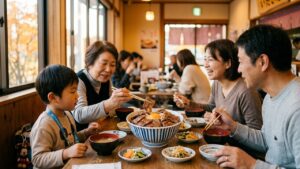
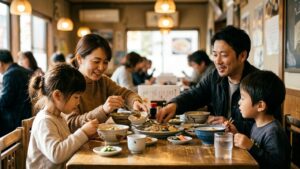
Family Lunch Nagoya vs Theme Park Food: The Real Choice
 gotowp
A family came in on a Tuesday last month — two parents and two children who had just spent the morning at Legoland Nagoya. They sat down, looked at the menu, and the mother said something that has stayed with me: "We almost just ate at the park again. I'm so glad we didn't."
That small remark captures a decision that more families face than I expected when I opened Itadaki in 2022. Nagoya is now a city with serious theme park credentials — Legoland, Ghibli Park, Nagashima Spa Land — and those parks all have food options. So the question is real: when you have children in tow, limited time, and everyone is hungry, is it worth stepping outside the park gates for lunch? Or is it simply easier to eat wherever you happen to be?
I've thought about this a lot. And I want to give you an honest answer — not a sales pitch.
Who This Is For
- ✅ Families visiting Nagoya's theme parks who want to know if a proper lunch stop is worth the effort
- ✅ Parents who want at least one meal on their Japan trip that becomes a genuine memory — not just fuel
- ✅ Travelers who have a full Nagoya day planned and are weighing how to use their lunchtime wisely
- ✅ Anyone wondering whether Osu district is worth adding to a family itinerary that already includes a theme park
- ✅ Repeat Japan visitors who want something different from what theme parks or tourist corridors typically offer
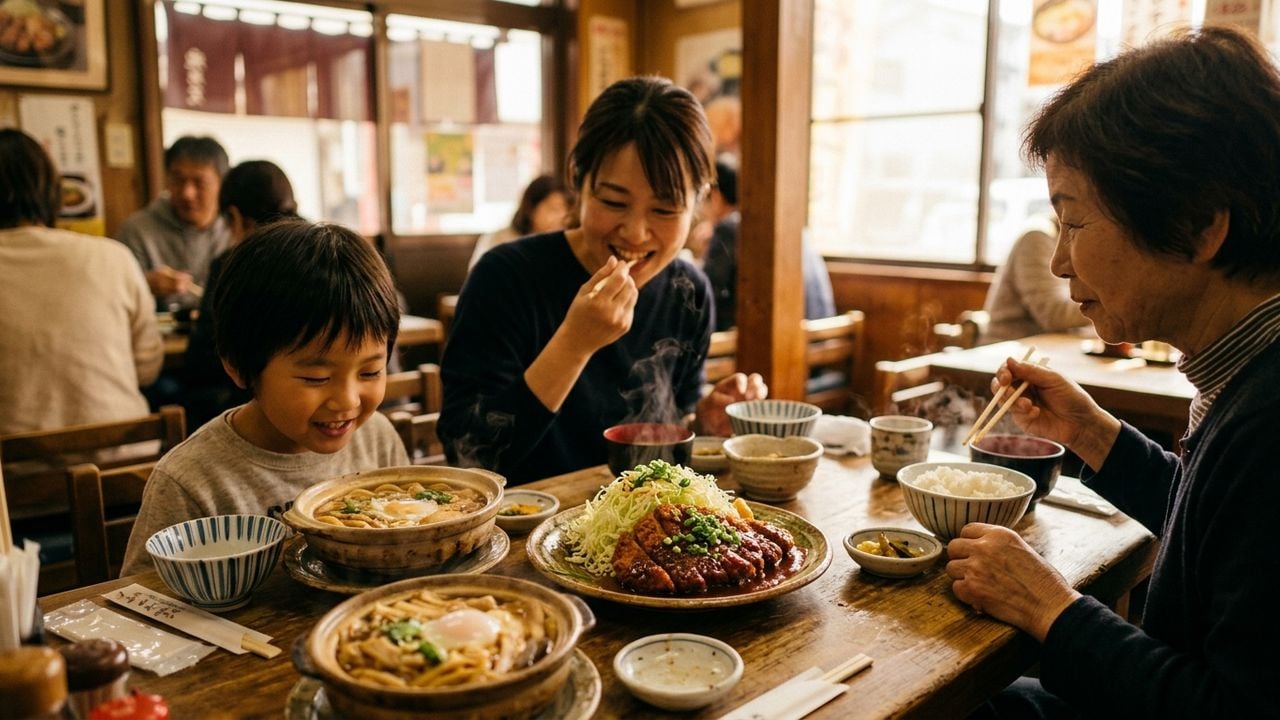
What Theme Park Food Actually Offers — And Where It Falls Short
Let's be fair. Theme park food in Japan is not bad. It's often fun, themed, and visually entertaining for children. Ghibli Park in particular has food that fits the experience — eating something Totoro-shaped inside a Totoro world has its own logic. And when you're already inside, the convenience is undeniable.
But there's a ceiling to what theme park food can be. It's designed to serve hundreds of guests simultaneously, which means standardization. It's priced for captive audiences. And it doesn't carry a story that travels beyond the park gates. A year from now, your children will remember the rides. They're unlikely to remember what they ate.
If your goal for the day is simply to keep energy levels up while maximizing time inside the park, eating there makes complete sense. Nobody should feel guilty about that choice. But if even one person in your group has been looking forward to a memorable Japanese food experience — and for many families visiting Japan, that person exists — then eating inside the park is a missed opportunity on a day that could have offered both.
You're weighing whether the detour is worth it — and part of that calculation is knowing whether we'll actually be open the day your family is in Nagoya. Our schedule runs on specific days and can shift, so the monthly calendar is the most reliable place to check before you plan around us. It takes less than a minute to confirm.
The Case for Building Lunch Into Your Nagoya Itinerary
Here's what I've noticed about families who plan lunch in Osu as part of their Nagoya day: they rarely feel it was too much effort. Most of Nagoya's major attractions — Nagoya Castle, Osu Kannon Temple, the Osu Shopping Street — are clustered in a way that makes a proper sit-down lunch not a detour, but a natural pause.
The Osu district itself is part of the experience for families. Children who are into anime, cosplay, or retro games find Osu Shopping Street genuinely exciting. The 1,200-shop arcade has been running for over 400 years, and somehow it still feels alive and unpredictable. Parents can explore vintage finds or step into Osu Kannon Temple for a quiet moment while kids absorb the street energy. And then — lunch, with everyone seated and comfortable, before the afternoon continues.
For families staying in Nagoya as part of a wider Japan itinerary — perhaps planning a day trip to Shirakawa-go or Takayama later in the week — this kind of grounded, meaningful lunch in the city becomes part of the story. It's not just calories. It's a chapter.
If you're weighing how to structure a full Nagoya day around the Asian Games 2026 schedule or other events, The Complete Guide to Nagoya Lunch During Asian Games 2026 offers a practical framework for fitting a proper lunch into a packed itinerary.
✓ Key Takeaways
- Theme park food serves a purpose — but it has a ceiling when it comes to creating lasting food memories.
- Osu district is within easy reach of Nagoya's major attractions, making a lunch stop there a natural part of a well-planned family day.
- The question isn't "theme park or restaurant" — it's "what kind of day do you want to remember?"
The Horai Wagyu is limited to 10 bowls a day, and families visiting during the Asian Games period are finding it sells out faster than usual. If the five-step experience — and the story behind 300 heads a year — is the kind of lunch you want to build into your Nagoya day, locking in a time in advance is the straightforward move. Reservation is handled through Tabelog online.
What Makes a Lunch Experience Actually Memorable for Families
I've been in the restaurant and bar business for 18 years, and I've watched a lot of groups walk in and walk out. The meals people talk about years later almost always share one quality: they had a story built into them. Not the kind of story a marketing team writes, but the kind that comes from a dish that was genuinely surprising — a flavor they hadn't expected, an ingredient they'd never heard of, a way of eating that made them slow down and pay attention.
At Itadaki, that story starts before the bowl arrives. When families sit down and I or one of our team explains what Horai Wagyu actually is — that only 300 heads are raised each year across just 3 farms in all of Japan, that the cattle are fed on sake lees from a local premium sake called Horaisen Sora, that this beef exists in genuine scarcity and cannot be found anywhere else in Nagoya — something shifts at the table. Children start asking questions. Parents lean forward. The meal hasn't started yet, and it's already more interesting than anything a park concession stand could offer.
Then the bowl arrives with what we call the five-step eating guide — a photographic card that walks you through how to experience the dish in sequence: separating the Nagoya Cochin egg, tasting the wagyu first on its own, adding the yolk, then building with condiments, finishing with wasabi. One guest put it simply:
"The five-step eating guide made the dish even more enjoyable and memorable."
That comment matters. The guide isn't just a gimmick — it's a way of slowing people down so they actually taste what's in front of them. For families with children, it also becomes a shared activity. Everyone at the table is doing something, noticing something, comparing notes. That's a memory being made in real time.
Making the Comparison Practical: Time, Access, and the Children Question
I want to be direct about the practical side, because families deserve honest information, not just enthusiasm.
Time: Itadaki is a lunch-only restaurant, open 11:00–15:00 on Saturdays, Sundays, Mondays, and Tuesdays (last order 30 minutes before closing, with adjusted hours on public holidays — please check our monthly business calendar on Instagram). We have 18 seats, and the experience moves at a comfortable pace. Most groups are in and out within 45–60 minutes, which fits naturally between a morning at a theme park and an afternoon of city exploring — or vice versa.
Access: We're a 4-minute walk from Yabacho Station Exit 4 on the Meijo Subway Line, and also within walking distance from Sakae, Kamimaezu, and Osu Kannon stations. From Nagoya Station, it's roughly 10 minutes by subway. No need to rent a car or plan a complicated route.
Children: All our table seats are sofa-style, which makes a real difference for families with young children. Past guests have brought infants and used the sofa seating for bottle feeding and naps while parents finished their meal. For smaller appetites, the Fumoto (Mikawa Beef, 100g beef with 200g rice) is often a good fit. Strollers can be brought in — please be aware that our entrance requires stairs, and while staff will assist when possible, we can't guarantee that will always be available depending on conditions at the time.
On the ultra-rare Horai Wagyu: We limit this to 10 bowls per day, and it does sell out on busy days. Reservation via Tabelog is the most reliable way to secure it. For families who want to be sure, booking ahead removes the uncertainty entirely.
For a broader look at how Nagoya's lunch scene compares across different traveler types, The Complete Guide to Nagoya Lunch for Second-Time Japan Visitors covers the landscape in depth.
The Real Choice: What Kind of Story Do You Want to Carry Home?
September in Nagoya is a full month. The Asian Games 2026 are underway, the city is energized, and families are moving through it with a lot on their plates — literally and figuratively. The question of where to eat lunch is real, and it deserves a real answer.
If your day is entirely inside a theme park and there's no flexibility, eat at the park. That's the right call for that day.
But if you have even a two-hour window in Nagoya's city center — before or after the park, or on a separate sightseeing day — then a lunch that carries genuine craft, a genuinely rare ingredient, and a way of eating that your family will talk about on the flight home is worth planning for. The difference between a good meal and a memorable one isn't always about effort. Sometimes it's just about choosing a place that was built to create exactly that kind of moment.
Itadaki was built for that.
For our complete menu, access details, and store information, visit our official page at https://itadaki8.com/english/
You've read the comparison — theme park food has its place, but it isn't where family memories of Japan tend to live. If you want your Nagoya lunch to be the meal your family brings up on the plane home, the next step is straightforward: secure your seat before the 10-bowl daily limit is gone. Reservation is open now on Tabelog.