A Day at Itadaki: Serving Solo Business Travelers From Around the World
 gotowp
You've just wrapped up a full day of meetings near Nagoya. You open Google Maps, search for something worth the trip, and Itadaki appears. The photos stop you — slices of glistening wagyu draped over a bowl of rice, a golden yolk resting on top, and a presentation that looks nothing like the gyudon you know from airport food courts. You tap the reviews. "Life-changing." "A once-in-a-lifetime lunch." "Unlike anything I've ever had."
And then you read the words: rare-style wagyu.
Your finger hovers over the reservation button. You want to go. But a question you can't shake rises quietly: Is this actually safe to eat?
That moment of hesitation — that's exactly what I want to talk about today. Because it's a question we hear often at Itadaki, and it deserves a real, honest answer.
Who This Is For
- ✅ Business travelers in Nagoya looking for a memorable solo lunch beyond hotel dining
- ✅ Wagyu enthusiasts who've heard about Horai Wagyu but aren't sure what "rare-style" actually means
- ✅ Visitors from Western countries with genuine concerns about the safety of undercooked beef
- ✅ Travelers who want to understand what makes Itadaki's cooking technique different before committing to a reservation
- ✅ Anyone who's been intrigued by the photos but hesitated to book because of food safety questions
The Question We Hear More Than Any Other
I've been running restaurants in Nagoya for 18 years. I know food. And I know that when a guest from London, Sydney, or Chicago sits down and sees a beef bowl labeled "rare," their first instinct — however quietly — is caution.
In the UK, the US, Australia, and much of Europe, food safety authorities have long advised against eating undercooked ground or whole-cut beef in uncontrolled settings. The risks — E. coli, salmonella — are real, and the cultural conditioning around them is deep. I don't dismiss that. I respect it.
But here's what I need you to understand about what we do at Itadaki: the word "rare" in our name does not mean undercooked. It means something very specific — something we developed, tested, and built our entire menu around.
The food safety question has an answer — but knowing when we're actually open and whether Horai Wagyu will still be available on your specific day is the next piece of the puzzle. Our monthly business calendar, posted on Instagram, shows confirmed open days, schedule changes, and real-time updates before you commit to a detour. Takes under a minute to check.
What "Rare-Style" Actually Means at Itadaki
When I was developing the concept for Itadaki before we opened in April 2022, one challenge occupied most of my thinking: How do you give guests the experience of rare wagyu — that silky, melt-in-the-mouth texture that no well-done preparation can replicate — while meeting Japan's strictest food safety standards?
The answer became what we now call our proprietary two-stage cooking technique.
Without revealing every detail of a method we've spent years refining, here's what matters for you as a guest: every piece of wagyu served at Itadaki is heated to a core temperature of over 70°C — the threshold required by Japan's Ministry of Health, Labour and Welfare. This isn't a workaround. It's a deliberate culinary engineering solution that fully satisfies Japanese food safety law while preserving the texture and flavor profile that makes rare wagyu so extraordinary.
I hold a Certified Food Sanitation Supervisor qualification issued by Japan's Ministry of Health, Labour and Welfare, and Itadaki operates under a full Licensed Restaurant Operator permit from Aichi Prefecture Public Health Center. Food safety isn't a marketing talking point for us — it's the foundation on which the entire restaurant was built.
The beef we use — Horai Wagyu from Okumikawa and Mikawa Beef from the Mikawa region — is sourced directly from farms I've built long-term relationships with. Both are raised under rigorous quality control. When I say I know where this beef comes from, I mean that literally: I know the farms, the farmers, and the feeding methods. Horai Wagyu is raised on sake lees from Horaisen Sora, a renowned local sake — producing beef with a flavor profile unlike any wagyu brand more widely known abroad.
✓ Key Takeaways
- Itadaki's "rare-style" wagyu is cooked to over 70°C at the core — fully meeting Japan's Ministry of Health, Labour and Welfare food safety standards.
- The two-stage cooking technique was developed specifically to deliver a rare texture without compromising safety — it is Itadaki's culinary intellectual property.
- All beef is sourced directly from Aichi Prefecture farms with strict quality control — Horai Wagyu and Mikawa Beef, both raised to standards Goto knows personally.
You now know the two-stage technique is why the texture feels rare without the safety risk — but with only 10 bowls of Horai Wagyu available each day, the gap between knowing and actually tasting it comes down to whether you've secured your seat. The Tabelog reservation form is where that happens. No sign-up or membership required to complete a booking.
The Moment It All Clicked for One Guest
A few months after we opened, a solo business traveler came in during a quiet Tuesday lunch. He'd been to Japan many times — he knew his wagyu. He'd eaten at celebrated restaurants serving Kobe beef. He'd tried Matsusaka. He sat down, looked at the menu explanation, and asked me directly: "How is this different? And how is it safe?"
I walked him through exactly what I've described above. He listened carefully. Then he ordered the Shinkoccho — our standard-size Horai Wagyu Gyudon, limited to 10 bowls per day — and worked through the five-step eating guide we provide on the table.
When he finished, he said something I've thought about many times since:
"I've had Kobe beef and Matsusaka beef, but Horai Wagyu at Itadaki was on another level."
Solo business traveler, multiple Japan visits
That's not a phrase I use lightly. It came from someone with a reference point that most wagyu lovers don't have — someone who'd tasted Japan's most celebrated beef brands and still found something new here in Osu, Nagoya.
What made the difference? I think it was the combination of the two-stage technique preserving a texture that normal cooking destroys, and the distinctive character of Horai Wagyu itself — only 300 heads raised annually across three farms in all of Japan, fed on sake lees that give the beef a subtle complexity you can't manufacture.
For a deeper look at what a typical service day looks like when we're running those 10 bowls, you might find it useful to read what actually happens on a day we serve all 10 bowls of the world's rarest wagyu — it gives a sense of the care that goes into each one.
Why This Matters Especially for Solo Business Diners
Traveling alone for work in a city like Nagoya means most lunches happen quickly, practically, safely. You find somewhere close, something familiar, and you move on. I understand that rhythm — it's efficient, and efficiency has its place.
But here's what I've noticed about the solo business travelers who make their way to Itadaki: they almost always arrive with a mix of curiosity and caution. They've done their research. They want the experience. They just want to be sure they won't regret it physically before an afternoon meeting.
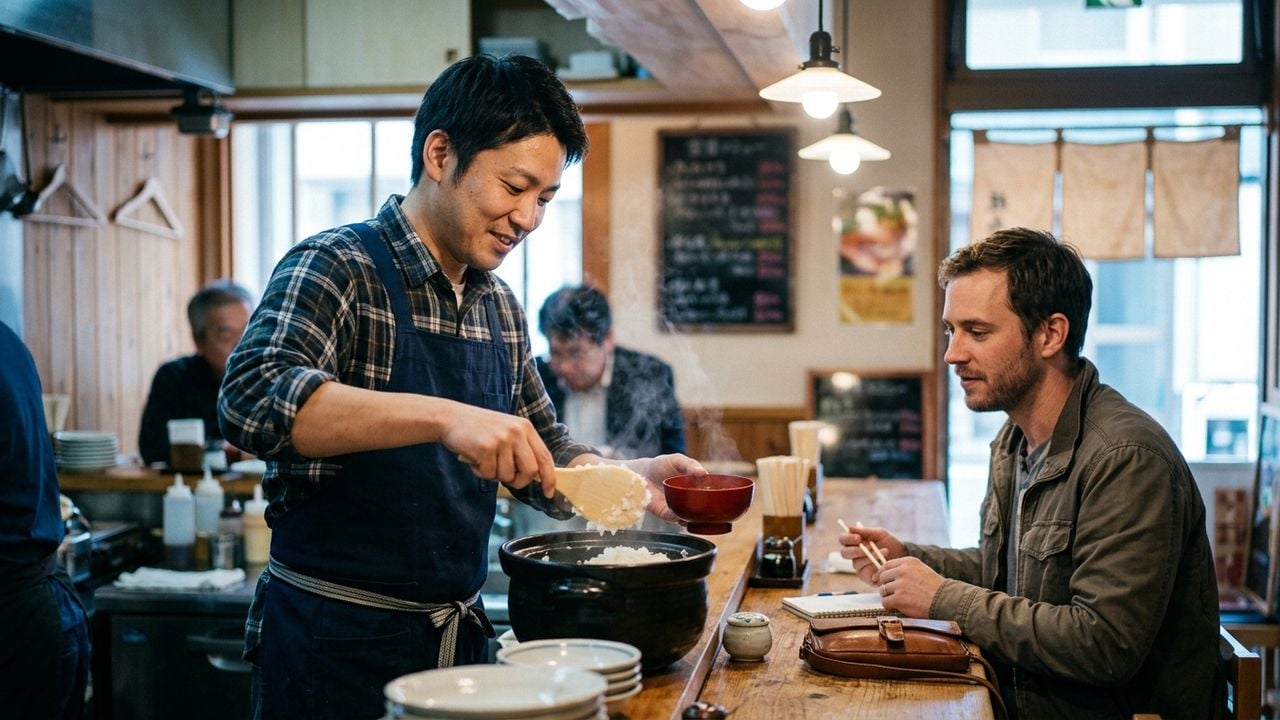
That's exactly the guest we built the restaurant for. Our counter seating — five seats designed with solo diners in mind — offers a comfortable, unhurried space. The English menu and five-step visual eating guide remove the guesswork. And knowing that the technique behind every bowl is grounded in food safety certification and direct farm relationships means you can focus entirely on what's in front of you.
If you're weighing Itadaki as part of a Nagoya business trip itinerary, the perspective shared in an inside look at Itadaki through the eyes of a business diner might help you picture how the lunch unfolds from arrival to the last bite.
A Few Practical Notes Before You Book
Itadaki is open for lunch only — 11:00 to 15:00 — on Saturdays, Sundays, Mondays, and Tuesdays. We're closed Wednesdays through Fridays. Last order is 30 minutes before closing. If your business schedule puts you in Nagoya mid-week, please check our monthly calendar on Instagram to confirm the schedule for your dates, as irregular closures can apply.
Horai Wagyu is strictly limited to 10 bowls per day. During busy periods, it does sell out before the lunch service ends. If the Horai Wagyu experience is your reason for coming — and for many guests it is — I'd recommend booking in advance via Tabelog to hold your place.
We're a four-minute walk from Yabacho Station Exit 4 on the Meijo Subway Line, which connects easily to Nagoya Station (around ten minutes by subway with one transfer at Sakae). From most central Nagoya hotels, you're looking at fifteen to twenty minutes door to door.
English menus are always available. If your visit coincides with a sightseeing afternoon before an evening flight or a morning factory visit, the Osu area around us — including Hisaya-odori Garden Flarie just three minutes from Yabacho Station — gives you plenty to explore before or after lunch without needing to travel far.
The Honest Answer to an Honest Question
Food safety concerns about rare beef aren't irrational. They come from real experiences and real advice in real countries. I take those concerns seriously, which is why we built the two-stage technique before we opened, not after the fact.
What I can tell you plainly: the rare wagyu at Itadaki is not raw. It is not undercooked by any legal standard in Japan. It is a result of two years of development work to meet a precise scientific and culinary goal — and it is unlike anything else being served in a gyudon context anywhere in the world.
That solo business traveler who compared our Horai Wagyu to Kobe and Matsusaka — he came back the following month. Different city, different itinerary, but he rerouted through Nagoya. That's the experience we're trying to create: not just a safe meal, but a meal worth remembering long after the meetings are over.
For our complete menu, access details, and store information, visit our official page at https://itadaki8.com/english/
You came here with one question — is rare wagyu actually safe? — and now you have the full answer. The next step is straightforward: hold your seat before those 10 daily bowls of Horai Wagyu are gone. Use the Tabelog link below to lock in your lunch date at Itadaki.