When Visiting for Factory Tours, Choose Itadaki for Authentic Lunch
 gotowp
You've just wrapped up a full-morning factory tour somewhere in Aichi — maybe a Toyota plant, an automotive supplier, or one of the many precision manufacturing facilities that define this region. You're hungry, your group is ready for lunch, and someone pulls up Google Maps. There it is: a local wagyu specialty restaurant nearby, rated highly, photos look incredible. Then comes the familiar hesitation: "But will they have an English menu? Can we even order without speaking Japanese?"
That moment of doubt sends many business travelers straight toward the nearest hotel buffet or international chain — a safe choice, but a forgettable one. After 18 years working in Nagoya's food and hospitality scene, I've seen this happen too many times. And it's exactly why, when I opened Itadaki in Osu in April 2022, building a genuinely language-barrier-free experience wasn't a nice-to-have. It was the foundation.
Here are the five things that make Itadaki the right lunch stop after your Aichi factory tour — ranked by how directly they solve the language-barrier problem that most visitors quietly worry about.
Who This Is For
- ✅ Business travelers on factory tours in Aichi who want an authentic local lunch without language stress
- ✅ International corporate visitors who've been burned by confusing menus at local Japanese restaurants
- ✅ Technical delegation members or MICE participants looking for a meaningful lunch experience in Nagoya
- ✅ Anyone curious about trying rare wagyu gyudon but unsure how to order or eat it correctly
- ✅ Solo business travelers who want a comfortable, welcoming dining experience with no awkward guessing
1. A Fully Printed Multilingual Menu — No App Required
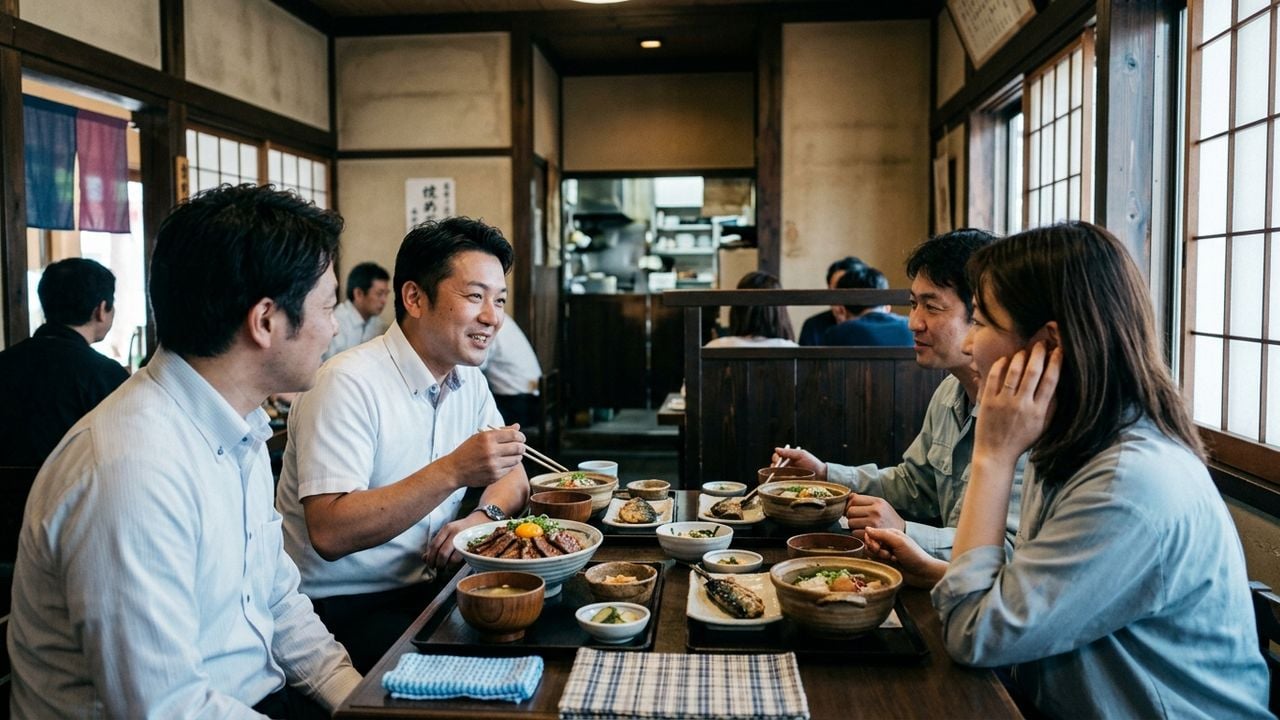
When you sit down at Itadaki, the first thing placed in front of you is a printed menu in English, Simplified Chinese, and Korean. Not a QR code linking to a machine-translated webpage. Not a laminated sheet with tiny photos and no explanations. A properly designed, clearly laid out menu with photos, prices in yen, and plain-language descriptions of every dish.
Each item lists the key ingredients, the cut of beef, the weight, and the rice portion. If you have a soy allergy, you'll see that our sauce contains white soy sauce from Hekinan City. If a colleague doesn't eat eggs, they'll spot immediately that the Nagoya Cochin egg can be removed at -¥150. The menu is designed so that pointing and ordering works — no Japanese words needed, no guessing, no apologetic gestures across the counter.
For a group arriving straight from a manufacturing site visit, this matters. Decision fatigue is real after a long technical morning. A clear, honest menu in your own language removes one more obstacle between you and a genuinely good meal.
The five-step eating guide and multilingual menu answer most questions — but Itadaki's schedule is different from a standard restaurant, and it changes monthly. Our Instagram shows the exact business calendar for each month, so you can confirm we're open on the day your factory tour lands. Takes about 30 seconds to check.
2. The 5-Step Visual Guide — So You Know Exactly What You're Doing
Rare wagyu gyudon isn't something most visitors have encountered before. Even guests who have eaten Kobe beef or Matsusaka beef at conventional steakhouses will find the format unfamiliar. The beef arrives with a melt-in-your-mouth rare texture, a raw Nagoya Cochin egg resting on top, and a collection of condiments on the side. Without guidance, it's easy to just mix everything together immediately and miss the point entirely.
That's why our printed menu includes a five-step visual guide: How to Enjoy Rare Gyudon. It walks you through the exact sequence — separating the egg white into the miso soup first, placing the yolk on the beef, tasting the wagyu on its own before adding anything else, then layering condiments, and finishing with wasabi. Each step is illustrated and written in English.
This guide exists because the dish is designed to be experienced in a particular order. The flavor of Horai Wagyu — raised in Okumikawa, Aichi, on sake lees from the renowned Horaisen Sora brewery, with only 300 heads produced annually across three farms in Japan — deserves to be tasted properly, not rushed. The guide makes that possible for every guest, regardless of whether they've ever eaten a beef bowl in their life.
One guest recently wrote: "Instagram-worthy presentation and unforgettable taste. My followers keep asking about it." That reaction comes partly from the visual impact of the dish, and partly from understanding what they were looking at and why it mattered.
3. Staff Who Are Genuinely Welcoming to International Guests
Language support isn't just about the printed menu. It's also about whether you feel welcome when you walk through the door.
Itadaki's team is trained to work comfortably with international guests. The multilingual menu means that pointing-and-ordering is a completely natural, frictionless interaction — there's no moment where a staff member looks uncertain about what you're trying to ask. Translation apps work well in our space, and we encourage guests to use them freely. Nobody will rush you or make you feel like a burden for taking an extra moment to cross-check an ingredient.
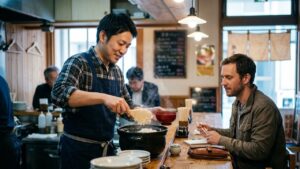
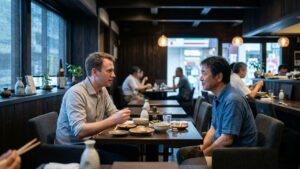
We have 18 seats — five counter seats that are ideal for solo travelers or pairs, and several sofa-style table seats that work well for small groups from a corporate delegation. The space is calm enough for a conversation after a busy morning, and small enough that no one gets lost in the shuffle.
✓ Key Takeaways
- Itadaki's fully printed multilingual menu (English, Chinese, Korean) with photos and ingredient details removes the need to speak any Japanese to order confidently.
- The five-step visual guide in English explains exactly how to experience the rare wagyu gyudon — so the dish makes sense from the first bite, not the last.
- Staff are trained to welcome international guests, and translation apps work comfortably in the restaurant.
You now know the Horai Wagyu is limited to 10 bowls a day — and that factory tour lunches tend to arrive around noon, right at peak hours. Securing your bowl before you board the subway from Nagoya Station is the one step that turns a plan into a guaranteed experience. Reservation is handled entirely online through Tabelog.
4. Honest Allergen Information You Can Act On
For many international corporate visitors — especially those traveling in mixed groups with different dietary backgrounds — allergen information is non-negotiable. In Japan, this information is often buried in verbal explanations that require fluent Japanese to extract.
At Itadaki, the key allergens present in our dishes are clearly noted in the menu. Soy is present in our soy sauce, miso, and pickled radish. Wheat is in the soy sauce. The Nagoya Cochin egg is standard with all gyudon but can be omitted. The complimentary tabletop chirimen (dried whitebait) topping contains sesame; guests with sesame allergies should avoid this particular condiment. Our original 8-spice blend does not contain sesame.
We don't hold Halal certification, and our beef is not Halal-certified — guests with strict Halal requirements should plan accordingly. For guests with severe allergies, we recommend noting this at the time of reservation, as our kitchen is small and cross-contamination cannot be fully guaranteed.
That level of straightforward communication — including acknowledging what we can't offer — is something I built into Itadaki from the start. Guests deserve accurate information, not vague reassurances.
"The English menu with clear serving instructions made the experience stress-free."
Guest review via Google Maps
5. Practical Planning Details — The Logistics That Matter for Business Travelers
Getting to Itadaki from the major factory tour corridors in Aichi is straightforward by public transport. From Nagoya Station — the hub most corporate visitors pass through — it's approximately 10 minutes by subway: take the Higashiyama Line to Sakae, transfer to the Meijo Line, and exit at Yabacho Station (Exit 4). We're a four-minute walk from the exit, on the 2nd floor of a building at 4-1-20 Osu, Naka-ku.
We serve lunch only, Tuesday through Monday (closed Wednesday, Thursday, and Friday), from 11:00 to 15:00, with last order at 14:30. On public holidays, we open from 09:00. Because our schedule can shift, I always recommend checking our monthly business calendar on Instagram before you plan your visit — especially if you're coordinating a group lunch around a tight factory tour schedule.
Horai Wagyu is limited to 10 bowls per day and can sell out during peak hours. If your visit includes a factory tour in the morning and you're planning to arrive around noon, a reservation via Tabelog is the safest way to secure your bowl. Reservations can be made in English through the platform, and no Japanese proficiency is required to complete the booking.
If you're coordinating a larger group — say, a delegation of eight to twelve — full restaurant buyout is available for up to 18 people. Please reach out via Instagram DM in advance to check availability.
Payment is accepted by credit card and electronic payments, so there's no need to prepare exact cash.
If your Nagoya itinerary extends beyond the factory tour itself, Itadaki pairs naturally with a walk through the Osu district afterward — why Osu is worth discovering as authentic Nagoya is something many repeat Japan visitors tell us they wish they'd known sooner. And if your trip includes a day visit to Shirakawa-go or Takayama before or after your business days, making Itadaki part of your Nagoya stay before Shirakawa-go is a combination that works beautifully.
The Bottom Line for Factory Tour Visitors
The anxiety of navigating a local Japanese restaurant in a language you don't speak is real — and it's one of the reasons so many international business travelers end up eating at places they could find anywhere in the world. Itadaki was built, in part, to make that anxiety unnecessary.
A multilingual printed menu. A visual eating guide in English. Staff who work comfortably with international guests. Honest allergen information. Clear logistics for reservations and access. These aren't features we added as an afterthought — they're part of how the restaurant was designed from the very first day we opened in Osu in April 2022.
After a morning spent inside one of the world's most sophisticated manufacturing environments, you deserve a lunch with an equally compelling story. Horai Wagyu — 300 heads per year, raised on sake lees in Okumikawa — is that story. And you won't need to speak a word of Japanese to experience it properly.
For our complete menu, access details, and store information, visit our official page at itadaki8.com/english/.
You've read through the multilingual menu, the 5-step guide, the allergen details, and the access route — the only thing left is to lock in your seat before the Horai Wagyu sells out on the day you arrive. Tabelog reservations take a few minutes and require no Japanese.