Can I Trust Rare-Style Beef at Japanese Restaurants?
 gotowp
You've done your research. You've seen the photos. You know wagyu is supposed to be extraordinary. But then the words "rare-style beef" appear on a menu — and a small voice in your head asks: Is this actually safe? And then come the follow-up doubts: What if I get sick? What does "rare-style" even mean in a Japanese restaurant? Is this just sushi-bar logic applied to beef?
These are completely reasonable questions. And they're exactly the kind that stand between a traveler and what could be the most memorable meal of their entire Japan trip. This article answers them directly — so you can make a fully informed choice, not just a brave one.
Who This Is For
- ✅ Travelers who want at least one unforgettable, story-worthy meal during their Japan trip
- ✅ Anyone who has seen "rare wagyu" on a menu and felt genuinely curious — but also a little uncertain
- ✅ Wagyu enthusiasts who have tried Kobe or Matsusaka beef and are ready to go deeper
- ✅ Visitors to Nagoya or Osu who want to understand what makes a restaurant truly worth the journey
- ✅ Anyone who refuses to settle for "just a good meal" when traveling in Japan
Is Rare-Style Beef at Japanese Restaurants Actually Safe?
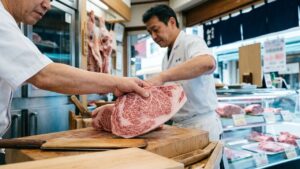
Yes — when it is prepared by a licensed, trained kitchen following Japan's food safety regulations, rare-style wagyu is safe to eat. The key phrase here is "rare-style," not "raw." These are not the same thing.
Japan's Ministry of Health, Labour and Welfare sets strict temperature standards for beef served in restaurants. For a dish to be legally served with a "rare" texture, the beef must be heated to a core temperature that fully eliminates surface and internal pathogens — while preserving that silky, tender mouthfeel that makes wagyu extraordinary. This is not a loophole. It is a technical achievement that requires precision, training, and proper certification.
At restaurants that specialize in this preparation — and I want to emphasize specialize, not just dabble — every step of the cooking process is designed around meeting that standard. It is nothing like leaving beef undercooked by accident. It is a deliberate, controlled culinary technique built on food science. You can read more about the specifics in our deeper breakdown: Is Rare Wagyu Safe to Eat in Japan?
You now know what "rare-style" means — but knowing whether this month's schedule includes the day you're in Nagoya is a different question entirely. Itadaki operates on a curated monthly calendar, and the team posts each month's open days on Instagram before the month begins. A quick check takes under a minute and tells you exactly which days you can plan around.
What Makes a "Rare-Style" Cooking Method Trustworthy?
Not all rare-style preparation is equal. The trustworthiness of the result depends entirely on the method, the credentials behind it, and the transparency of the kitchen.
At Itadaki in Osu, Nagoya, the approach is what we call a two-stage cooking technique — a proprietary method developed by founder Masayuki Goto over years of research. The beef is brought to over 70°C at the core, fully satisfying Japan's food safety requirements, while the process is carefully controlled to preserve the rare-style texture that makes the dish unlike anything else.
Goto holds a Certified Food Sanitation Supervisor credential from Japan's Ministry of Health, Labour and Welfare, and Itadaki operates under a Licensed Restaurant Operator permit issued by the Aichi Prefecture Public Health Center. These aren't decorative certificates — they are the legal foundation that makes rare-style wagyu possible in a Japanese restaurant setting.
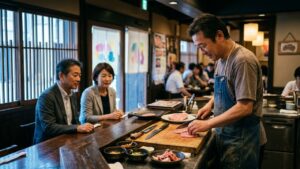
What distinguishes a trustworthy kitchen is not just what they serve, but how they explain it. A restaurant worth your trust will tell you exactly what technique they use and why it is safe — without making you feel like you're asking an awkward question.
✓ Key Takeaways
- "Rare-style" wagyu is not the same as raw beef — it meets strict Japanese food safety temperature standards
- Trustworthy rare wagyu requires licensed operators, certified supervisors, and a reproducible proprietary cooking method
- Itadaki's two-stage technique was developed specifically to achieve the rare texture safely and legally
Horai Wagyu is limited to 10 bowls per day — and now that you understand why that number is real, not theatrical, the next step is making sure one of those bowls has your name on it. Reservation via Tabelog is the only way to secure your place before arriving at the restaurant. It takes just a few minutes online.
Why Does the Story Behind the Beef Matter?
Here is where the question of trust expands beyond food safety — into the question of whether an experience is worth having at all.
The most memorable meals from a Japan trip are rarely the most expensive ones. They are the ones with a story you couldn't have found anywhere else. That story is what you bring home. It's what you tell people at dinner parties three years later.
At Itadaki, the beef at the center of that story is Horai Wagyu — a Japanese black wagyu raised in the Okumikawa mountains of Aichi Prefecture, produced by only three farms in Japan, with just 300 heads raised annually. For context: Japan raises approximately 500,000 wagyu cattle each year. Horai Wagyu represents a fraction of a fraction of that number.
The cattle are fed on sake lees from Horaisen Sora, a renowned local premium sake — which contributes to the beef's distinctive character: lighter marbling than you might expect from wagyu, with a clean, expressive flavor that reveals itself slowly. It is not the richest wagyu you will ever taste. It may be the most interesting. You can explore the full story here: What Is Horai Wagyu and Why Is It So Rare?
And the Horai Wagyu Gyudon — the dish built around this beef — was invented at Itadaki. It does not exist anywhere else in the world. That is not marketing language. It is simply a fact about how the concept came to be.
"I discovered Itadaki through Google Maps and it became the best meal of our Japan trip."
— Guest review
What Does the Experience Actually Look Like?
Understanding the safety and the story is one thing. But you're probably wondering: what does it feel like to actually eat this?
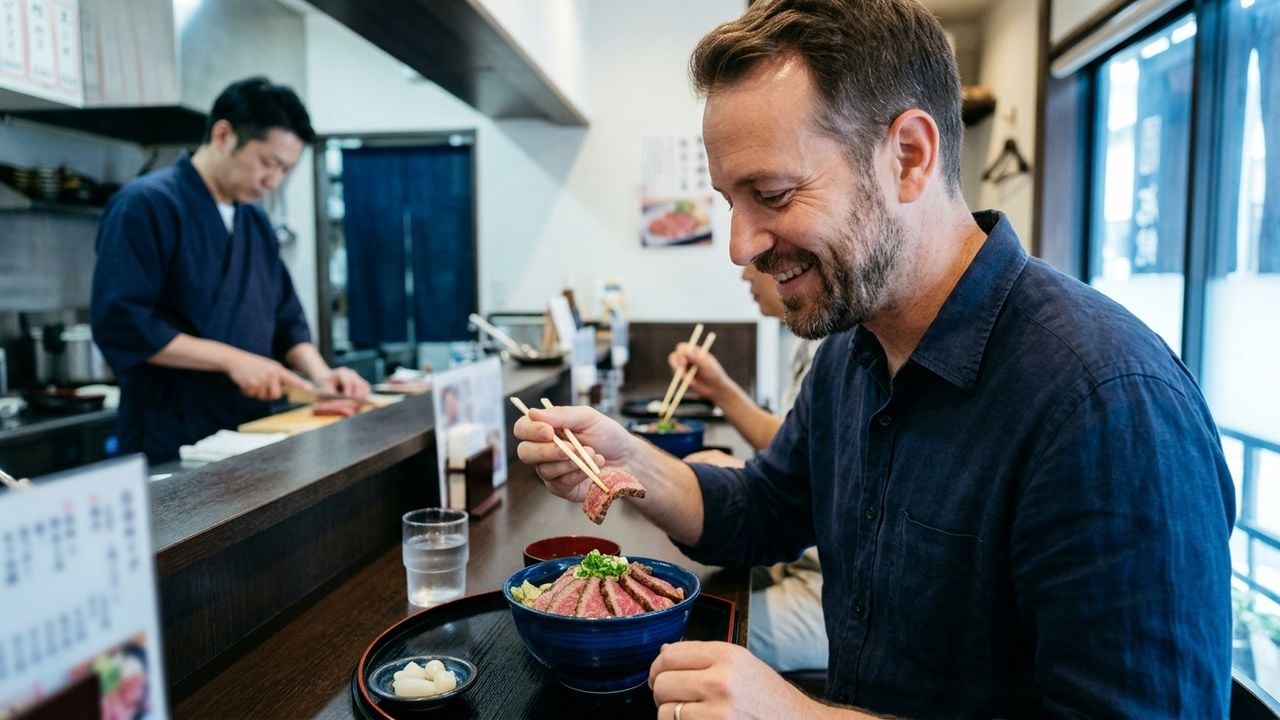
The dish arrives as a bowl of warm Aichi-grown rice, draped with rare-style Horai Wagyu, accompanied by a raw Nagoya Cochin egg, miso soup made with Hatcho miso from Okazaki, traditional Atsumi pickles, and shiso leaves from Toyohashi. Every single ingredient comes from Aichi Prefecture — a commitment Goto made from the very beginning, to build something that could only exist here.
There is a five-step guide printed in English (as well as in Simplified Chinese and Korean) that walks you through how to enjoy the dish — when to separate the egg, when to mix the yolk into the beef, which condiments to add at which point. It transforms a bowl of food into a sequence of distinct tastes and textures, each slightly different from the last.
The experience of rare wagyu at this preparation level is genuinely difficult to describe without sounding like you're overselling it. The texture is unlike well-done beef — or even medium-rare beef as you might know it from a steakhouse. It has a softness that gives way without resistance. The flavor is clean, without the heaviness that very high-marbled beef can sometimes carry. If you have already tried Kobe beef or Matsusaka beef, Horai Wagyu will surprise you in a different direction.
How Do I Know Itadaki Is the Right Place to Try This?
This is perhaps the most important question of all — and it deserves a direct answer.
Itadaki has been featured on eight major Japanese television programs, including NHK, Japan's national public broadcaster, as well as Chukyo TV, CBC, Nagoya TV, and Tokai TV. It is recognized by these broadcasters as the originator of the "Rare Wagyu Gyudon" culinary concept — a category that did not exist before Goto created it in 2022.
Goto spent 18 years in the food and beverage industry before opening Itadaki. The concept was born during the COVID-19 pandemic, when small Aichi farmers — including those producing the premium ingredients he had long admired — found themselves with unsold harvests and no buyers. He wanted to build something that would support them directly, and sustainably. That is why every ingredient on the menu traces back to an Aichi farm, and why Itadaki operates on a direct-supply partnership with Horai Wagyu farms.
The restaurant seats 18 guests, operates only during lunch hours (Tuesday through Monday, closed Wednesday through Friday), and limits Horai Wagyu to 10 bowls per day. That limitation is not a sales tactic — it is a direct reflection of how little of this beef exists and how seriously the kitchen takes freshness. Reservations via Tabelog are recommended, particularly during busy seasons. For the current monthly schedule, the team posts updates regularly on Instagram.
If your Japan trip includes time in Nagoya — whether you're based in the city, passing through on the way to Shirakawa-go or Takayama, or simply carving out a day from the Golden Route — Itadaki is a four-minute walk from Yabacho Station Exit 4 on the Meijo Subway Line, on the second floor at 4-1-20 Osu, Naka-ku.
The question of trust — in the safety, the sourcing, the technique, and the people behind the kitchen — is one this restaurant was built to answer. Not through reassurances, but through credentials, transparency, and a dish that carries its story in every detail.
For our complete menu, access details, and store information, visit our official page at https://itadaki8.com/english/
You came to this article with a genuine question about trust — in the cooking, the sourcing, and the experience. That question has a concrete answer at Itadaki: a licensed kitchen, a proprietary technique, 300 heads of Horai Wagyu produced annually, and a dish that exists nowhere else in the world. The only remaining step is reserving your seat for lunch.