What Is Horai Wagyu and Why Is It So Rare?
 gotowp
It's late August in Nagoya, and the city is buzzing. The summer heat lingers, festivals are winding down, and travelers are making their way through Central Japan — some heading toward Shirakawa-go, some leaving Takayama, many simply discovering that Nagoya deserves far more than a shinkansen stopover. If you've been researching wagyu and stumbled across the name "Horai Wagyu," you're probably asking the same question that many of our guests ask before their visit: What exactly is it, and why is it so hard to find?
Horai Wagyu is a Japanese black wagyu (Kuroge Wagyu) raised in the Okumikawa region of Aichi Prefecture — one of the most geographically remote and pristine farming areas in Central Japan. Only 300 heads are produced annually across just 3 farms in the entire country. To put that in perspective: there are approximately 500,000 wagyu cattle raised in Japan at any given time. Horai Wagyu accounts for 300 of them.
Who This Is For
- ✅ Wagyu enthusiasts who've already tried Kobe or Matsusaka beef and want to discover what comes next
- ✅ Travelers planning a Nagoya lunch stop who feel uncertain about navigating the Osu district
- ✅ First-time visitors to Itadaki who want to understand exactly what they're eating — and how to find us
- ✅ Anyone who has searched "Horai Wagyu" and wants a clear, honest answer about its rarity and flavor
- ✅ Repeat visitors to Japan seeking an authentic ingredient story beyond well-known brands
What Makes Horai Wagyu Different from Other Wagyu?
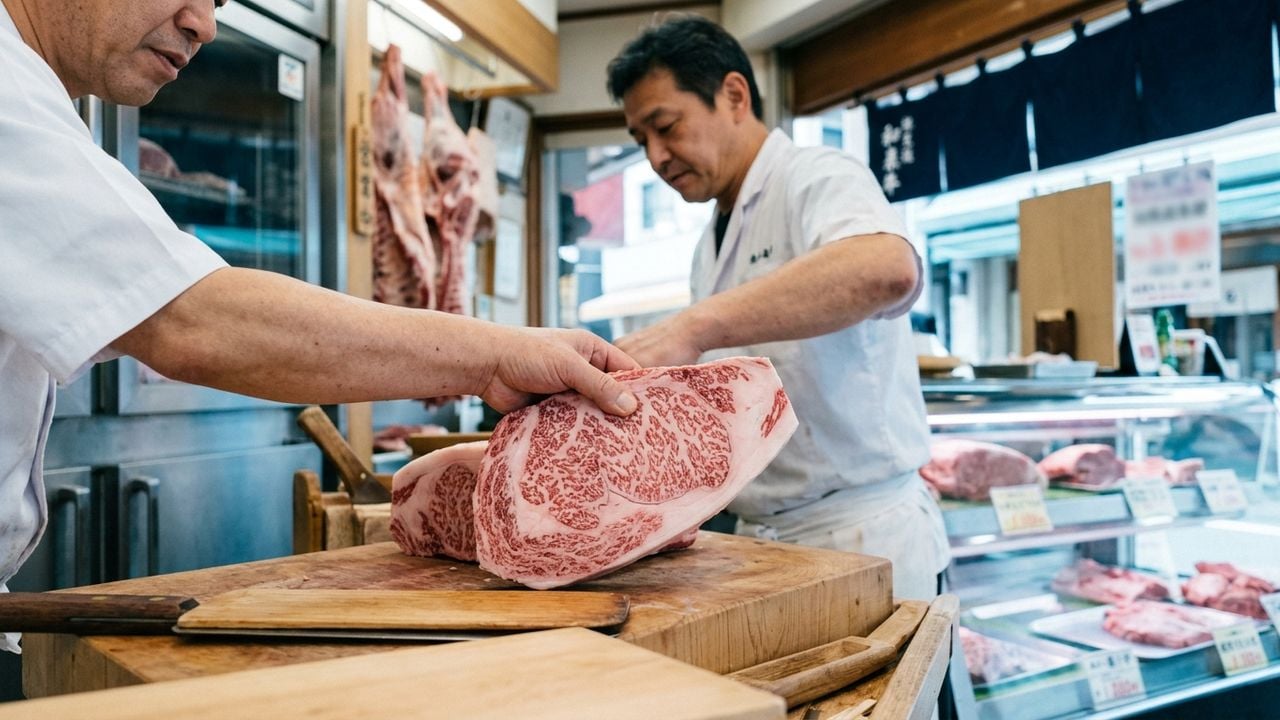
Most wagyu breeds are defined by their marbling — the intricate web of fat that creates that characteristic melt-in-your-mouth richness. Horai Wagyu has marbling, yes, but what sets it apart is the balance. The cattle are raised on a diet that incorporates sake lees from Horaisen Sora — a premium sake produced in the same Okumikawa region. This unusual feeding method imparts a subtle, clean sweetness to the beef's fat, while the lean meat retains its own distinct depth of flavor.
The result is a wagyu that doesn't overwhelm you. Where some heavily marbled beef can feel rich to the point of excess, Horai Wagyu offers layers: a gentle sweetness from the fat, a savory undercurrent from the lean, and a texture that exists somewhere between silk and substance. It's the kind of beef that makes experienced wagyu eaters pause mid-bite.
If you'd like to explore how Horai Wagyu compares side-by-side with more widely known brands, our article on Horai Wagyu vs Kobe Beef: which rare wagyu deserves your trip goes deeper into the distinctions.
You now know why Horai Wagyu is limited to 10 bowls a day — and that Itadaki operates on a schedule that changes monthly, including irregular closures. Our Instagram is where we publish the monthly business calendar, so you can confirm we're open before making the trip to Osu. Takes less than a minute to check.
Why Is Horai Wagyu So Rare — and Why Does That Matter?
Scarcity in the food world can be manufactured. Limited-edition packaging, artificially restricted supply, clever marketing — these are tools. But Horai Wagyu's rarity is structural, not strategic.
Only 3 farms in Japan raise these cattle. The Okumikawa region's geography and microclimate — combined with the specific sake lees feeding program — cannot simply be replicated elsewhere and scaled up. Each farm maintains a small herd, prioritizing the quality of each animal over volume. The 300-head annual figure isn't a branding decision; it's a reflection of what the land and the farming practice can honestly sustain.
This matters to us at Itadaki because our founder, Masayuki Goto, built this restaurant on exactly that principle: that the story of the ingredient should be true, not told. When you hold a bowl of Horai Wagyu Gyudon at Itadaki, the rarity you're experiencing is real — not a number someone invented in a marketing meeting.
We limit Horai Wagyu to just 10 bowls per day. That's not a gimmick. It's simply the honest ceiling of what we can source with integrity and prepare with the care the beef deserves.
✓ Key Takeaways
- Horai Wagyu is raised by only 3 farms in Japan, with just 300 heads produced annually — genuine scarcity rooted in geography and farming practice, not marketing.
- The sake lees feeding method creates a flavor profile that balances marbling and lean depth in a way that distinguishes it from more heavily marbled wagyu breeds.
- At Itadaki, Horai Wagyu is limited to 10 bowls per day — and reservations via Tabelog are strongly recommended to avoid missing out.
You've read why the 10-bowl daily limit for Horai Wagyu is real, not a marketing figure — which means walk-ins during peak weekend hours carry genuine risk of missing it entirely. A Tabelog reservation is the one step that removes that uncertainty from your visit.
Where Can You Actually Eat Horai Wagyu in Nagoya?
This is where most searches hit a wall. Horai Wagyu is rarely on restaurant menus — not because chefs don't want it, but because the supply is genuinely limited and requires a direct sourcing relationship with the farms. Itadaki is one of the very few restaurants in Nagoya that sources Horai Wagyu directly, and we serve it exclusively in our Rare Wagyu Gyudon format — a culinary concept that Goto developed specifically to showcase Aichi Prefecture's finest ingredients in a single, focused bowl.
Every element in that bowl comes from Aichi: the rice, the sauce, the pickles, the egg, the miso — and of course, the beef. If you've been curious about Aichi's food culture beyond its well-known miso dishes, a Horai Wagyu bowl at Itadaki is one of the most concentrated expressions of it you'll find anywhere. For more on how this fits into the broader Aichi wagyu story, discovering Aichi's rare Horai Wagyu after trying Kobe beef is worth reading before your visit.
"Instagram-worthy presentation and unforgettable taste. My followers keep asking about it."
— A guest who visited Itadaki during a Nagoya trip
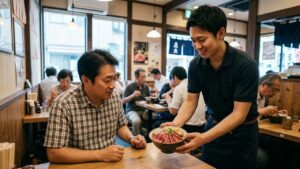
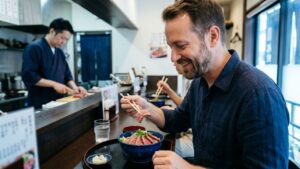
That reaction comes up often. The visual presentation — vibrant beef, golden Nagoya Cochin egg yolk, fresh shiso, ceramic bowls — is striking in a way that photographs honestly. But what guests tend to remember most, long after the photo is posted, is the flavor itself.
How Do You Get to Itadaki from Nagoya Station or Your Hotel?
Here's where things get practical — and where we hear the most pre-visit anxiety. Osu is a wonderful neighborhood, but it's also genuinely maze-like. Streets double back on themselves, covered arcades lead into open courtyards, and Google Maps can place you at an intersection that looks nothing like the map suggests. We want to give you a clear, step-by-step route so that navigation is the last thing on your mind when you arrive.
From Nagoya Station:
Take the Higashiyama Subway Line from Nagoya Station toward Fujigaoka. Ride two stops to Sakae Station. At Sakae, transfer to the Meijo Subway Line (follow the signs — it's within the same station complex). Take the Meijo Line one stop to Yabacho Station. Use Exit 4. From Exit 4, Itadaki is a 4-minute walk. Total journey from Nagoya Station: approximately 10 minutes.
Finding us once you're at Yabacho Exit 4:
Look at street level for a sign that reads 元祖レア牛丼 頂 (pronounced "Ganso Rea Gyudon Itadaki"). We are on the 2nd floor — take the stairs up from street level. This is the detail that catches most people off guard: because we're elevated, it's easy to walk past the entrance if you're scanning storefronts at eye level. Look for the sign above, then look for the staircase.
Nearby landmarks to orient yourself:
Osu Kannon Temple is one of Central Japan's most recognizable sites, and it's within the same neighborhood. The main entrance to Osu Shopping Street is also close. If you can see either of these, you're in the right area — our Google Maps link on the website will guide you the final stretch with precision.
Coming from Sakae, Kamimaezu, or Osu Kannon Station:
All three stations are within walking distance of Itadaki. If you're already exploring Osu or Sakae, you don't need to return to Nagoya Station at all — Yabacho Station is the most direct approach, but any of these stations puts you within a reasonable walk of our entrance.
A note about staircase access:
Itadaki is on the 2nd floor, accessed by staircase. If you're traveling with a stroller, please note that strollers can be brought into the restaurant, and staff may be able to assist with carrying depending on the store's situation at that moment. We want to be honest about this rather than make promises we can't always keep — so please plan accordingly and feel free to reach out via Instagram DM in advance if you have specific access questions.
What Should You Know Before Your First Visit?
A few practical points that make the difference between a smooth visit and a frustrating one:
Hours: Itadaki is open for lunch only — 11:00 to 15:00 on Saturdays, Sundays, Mondays, and Tuesdays (last order 30 minutes before closing). On public holidays, we open earlier at 9:00. We are closed Wednesdays, Thursdays, and Fridays. Irregular closures do occur, so always check our monthly business calendar on Instagram before making the trip.
The 10-bowl limit for Horai Wagyu: During peak hours — especially weekends and public holidays — the Horai Wagyu allocation sells out. If experiencing the Shinkoccho (our standard Horai Wagyu Gyudon at ¥2,700) is the reason you're coming, a reservation via Tabelog is the only way to secure your bowl. Walk-ins are welcome for our Mikawa Beef option, which is always available.
Menus in English: We offer printed menus in English (as well as Simplified Chinese and Korean), and a photographic five-step guide to enjoying the dish. You will not need Japanese to navigate the experience.
For our complete menu, access details, and store information, visit our official page at itadaki8.com/english/.
Horai Wagyu exists in small numbers because good farming doesn't scale without compromise. We think that's worth preserving — and worth making a detour for. If your Nagoya itinerary has room for one lunch that tells a genuine story about this region's food culture, this is the one we'd point you toward. We'll see you on the 2nd floor.
You've now got the route from Nagoya Station, the landmark to look for (元祖レア牛丼 頂 on the 2nd floor), and a clear picture of why Horai Wagyu is worth the trip. The one thing left is securing your bowl before the 10-bowl daily allocation fills up.