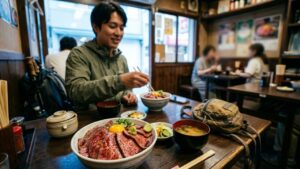
Behind the Scenes: Why Locals Guard Itadaki as Their Secret
 gotowp
Here is a number that rarely appears in travel guides: according to survey data from Japan's tourism industry, 29.7% of Hong Kong visitors to Japan have made the trip ten times or more. For Taiwan, that figure is 19.4%. These are not first-time tourists chasing cherry blossoms at Kyoto temples. These are experienced travelers who have already done the Golden Route — and who now arrive in Japan with a single question: Where do people actually eat?
The answer, more often than they expect, is somewhere that has no English signage on the front door. Somewhere that a Japanese friend once mentioned in passing. Somewhere like Osu, Nagoya — and, specifically, the second floor of a quiet building on 4-chome, where a restaurant called Itadaki has been quietly doing something that has never been done before.
Locals who know about it tend not to broadcast it widely. This article is about why — and what happens when a traveler manages to find it anyway.
Who This Is For
- ✅ Repeat visitors to Japan who feel they've "seen everything" and are searching for something genuinely new
- ✅ Travelers planning time in Nagoya as part of a broader itinerary — Shirakawa-go, Takayama, or the Gifu region
- ✅ Wagyu enthusiasts who have tried Kobe or Matsusaka beef and want to understand what Aichi Prefecture produces
- ✅ Anyone curious about why a humble beef bowl is quietly being discussed in the same breath as fine dining
- ✅ Visitors to Osu district looking for a lunch destination that tells a story worth sharing
The Discovery That Locals Don't Want to Advertise
There is a specific kind of restaurant that experienced Japan travelers learn to recognize. It has no queue of tourists outside. The menu is not laminated. There is usually one specialty — one dish that the kitchen has refined over years — and the people who eat there regularly tend to recommend it only to people they trust.
Itadaki fits that description precisely, which is why it tends to spread the way it does: one person tells another person quietly, the way you share something you don't want to become crowded.
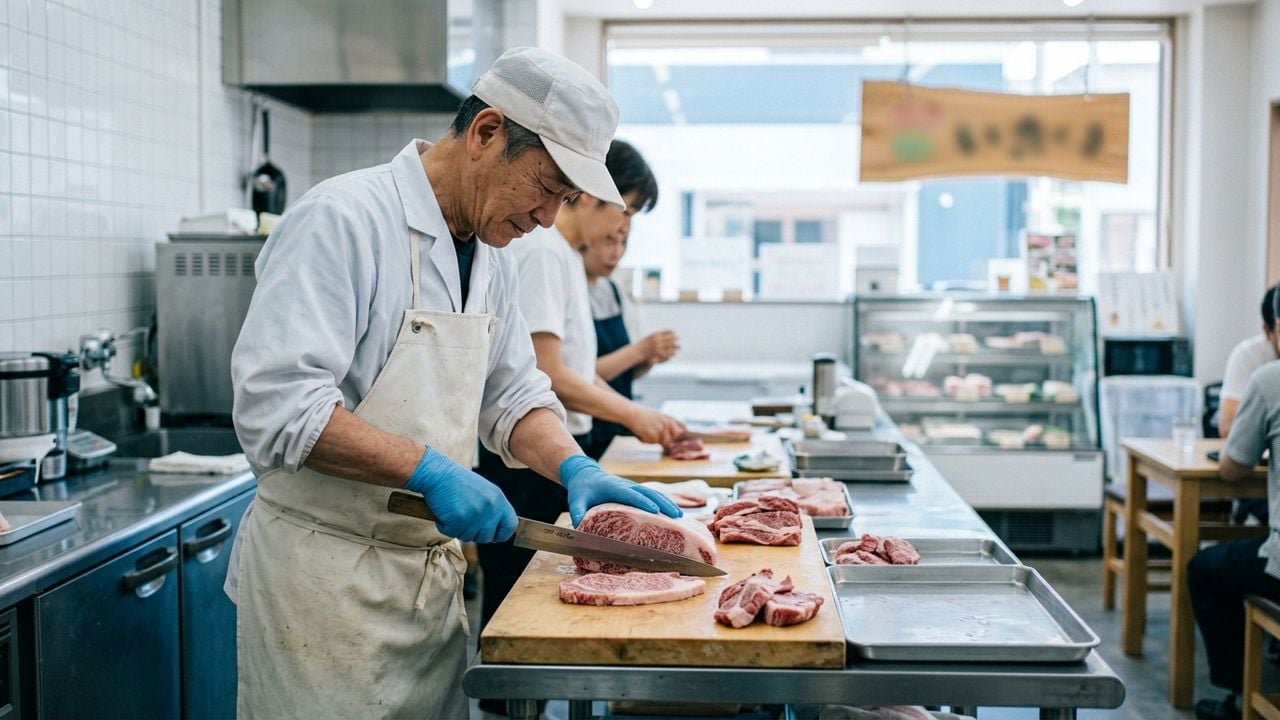
The restaurant was founded in April 2022 by Masayuki Goto, who had spent 18 years in Nagoya's food and beverage industry. During the pandemic, he watched small Aichi Prefecture farms — producers of wagyu, eggs, rice, vegetables — struggle with unsold harvests while the restaurant industry contracted around them. His response was not to wait for conditions to improve. He conceived a restaurant built entirely around direct sourcing from those farms, built on a concept so specific it had never existed before: Rare Wagyu Gyudon.
The name "Itadaki" comes from itadakimasu, the Japanese expression of gratitude spoken before a meal. It was not chosen for branding purposes. It reflects Goto's actual conviction: that food is a gift from farmers, land, and craft — something that deserves to be treated with care at every step of the process.
Itadaki operates only four days a week, and the Horai Wagyu allocation of 10 bowls per day can sell out before midday — knowing the exact dates the restaurant is open before you finalize your Nagoya plans makes the difference between arriving and missing it. The monthly business calendar, including any irregular closures, is posted on Instagram so you can confirm open days before making any plans. A quick check takes under a minute.
Why Osu, and Why This Dish
The Osu district of Nagoya is the kind of neighborhood that rarely appears in the first draft of a visitor's itinerary. It is known to locals as a place where 400-year-old temple grounds sit alongside vintage clothing shops and cosplay cafés — a particular Nagoya combination that has no equivalent in Tokyo or Osaka. International travel guides have begun to notice it, but it has not yet acquired the queue culture of more famous districts.
Into this neighborhood, Goto brought a question he had been sitting with for years: why, when katsudon has a premium version, when kaisendon has become a fine dining experience, had no one ever made a truly exceptional gyudon? The beef bowl had always belonged to fast food chains. Nobody had tried to elevate it.
The answer he arrived at was Horai Wagyu — a Japanese black wagyu raised in the Okumikawa region of Aichi Prefecture, produced by only three farms in Japan, with just 300 heads raised annually. To put that in context: there are approximately 500,000 wagyu raised in Japan each year. Horai Wagyu represents a fraction of a fraction. The cattle are fed on sake lees from Horaisen Sora, a premium local sake, which contributes to a flavor profile unlike anything produced at scale — a balance between light marbling and lean meat character that wagyu enthusiasts who have tried Kobe and Matsusaka beef consistently describe as surprising.
But sourcing rare beef alone is not the story. The story is what Goto's team does with it.
The two-stage cooking technique developed at Itadaki heats the wagyu to above 70°C at the core — fully meeting Japan's Ministry of Health, Labour and Welfare food safety standards — while preserving the texture that most people associate with rare preparation. It is a technical achievement that took time to develop and is not replicable from the outside. Every bowl produced by the kitchen follows Goto's precise recipe and quality standards, regardless of who is preparing it on a given day.
✓ Key Takeaways
- Itadaki was built around direct farm sourcing during the pandemic — a supply chain with real relationships, not a marketing story
- Horai Wagyu represents roughly 300 out of 500,000 wagyu raised in Japan annually — genuine rarity, not manufactured exclusivity
- The two-stage cooking technique delivers rare-style texture while meeting Japan's food safety standards — a proprietary process developed over time
The pattern in the cases described above is consistent: the guests who had a genuinely seamless experience all reserved in advance — specifically because Horai Wagyu is limited to 10 bowls per day and sells out on busy afternoons. Reservation is handled through Tabelog online, which accepts international bookings without requiring a Japanese phone number. The process is straightforward and takes only a few minutes.
The Cases That Make the Pattern Clear
One of the most telling patterns at Itadaki is the guest who arrives as part of a broader itinerary — and leaves having adjusted their entire mental map of what a lunch can be.
A case that captures this well: a couple staying in Nagoya the night before their departure to Shirakawa-go. They had an afternoon of moderate sightseeing planned, needed a lunch that was close to their accommodation and easy to navigate in English, and had searched enough to know they did not want another meal at a tourist-facing restaurant. Someone in a travel forum had mentioned Itadaki specifically — not as "a great wagyu place" but as "the kind of lunch I still think about."
They reserved through Tabelog, arrived at Yabacho Station Exit 4, and found the restaurant four minutes later. The English menu was already on the table. The five-step eating guide — how to separate the Nagoya Cochin egg, when to mix the yolk, how to use the complimentary condiments (pickled ginger from Inazawa City, dried whitebait from Minamichita, Itadaki's original 8-spice blend) — was printed clearly. Nobody made them feel that navigating it required explanation.
"Perfect lunch during our Nagoya stay before our Shirakawa-go trip the following day."
Guest visiting Nagoya en route to the Hida region
That phrasing — "perfect lunch" — is worth pausing on. It does not say "best wagyu I've had" or "most expensive meal of the trip." It says perfect: the right thing, in the right place, at the right time. That is a different category of satisfaction, and it is the one that locals who guard places like this are actually protecting.
If you're interested in how this kind of experience fits into a tightly scheduled Nagoya day, this detailed account of how Itadaki serves travelers on tight schedules walks through the logistics in practical terms.
What the "Secret" Actually Protects
The reason local knowledge travels quietly is not snobbery. It is something more practical: Horai Wagyu is limited to 10 bowls per day. The restaurant seats 18 people and operates lunch only, four days a week (Saturday, Sunday, Monday, and Tuesday, plus public holidays from 9:00 AM). On busy days, those 10 bowls are gone before noon.
When a place operates at this scale by design — sourcing from farms with 300 heads per year, running a kitchen that prioritizes quality over throughput — the experience is necessarily limited. This is not a constraint the restaurant is working to overcome. It is the foundation of what makes it worth protecting.
Goto has been featured on eight major Japanese television programs, including NHK, specifically as the originator of the Rare Wagyu Gyudon concept. The restaurant has been recognized by Japan's food media for creating a culinary category that did not previously exist. Yet on any given Monday, someone arriving at Yabacho without a reservation in the early afternoon may find the Horai Wagyu allocation has already sold out — and will need to consider the Mikawa Beef option instead, which is excellent and always available, but is a different experience.
The locals who "guard" Itadaki understand this math. They reserve in advance. They arrive on time. And they do not post about it indiscriminately, because they want to be able to return.
For those planning a trip that includes both Nagoya and the Hida region, this guide on choosing Itadaki for lunch during your Shirakawa-go itinerary covers practical timing and access in more detail.
How to Arrive as a Guest, Not a Tourist
The distinction matters more than it might sound. Itadaki was designed with international visitors in mind — printed menus in English, Simplified Chinese, and Korean; a photographic eating guide; staff trained to welcome guests who arrive without a word of Japanese. None of that is accidental. Goto's own interest in international food culture, shaped by years of travel and exploring restaurants abroad, informs how the restaurant thinks about hospitality.
At the same time, nothing about the experience is adjusted to feel like a tourist attraction. The wagyu is sourced the same way whether the guest at the next table is from Nagoya or from Hamburg. The miso soup uses the same Hatcho miso from Okazaki. The rice is the same Aichi no Kaori variety adjusted each year based on that season's harvest quality. Every accompanying detail — the Atsumi Ichō-zuke pickles from the Atsumi Peninsula, the shiso leaves from Toyohashi, the egg from Yamada Poultry Farm — is there because it is the right ingredient from the right part of Aichi, not because it photographs well.
The experience unfolds in five steps, which the eating guide walks you through: first the wagyu in its purest form, then with the egg yolk, then with the condiments, and finally with a note of wasabi. It is a structure, not a ritual — a way of making sure you taste what the kitchen actually made, rather than mixing everything immediately and missing the point.
That is the reason experienced Japan travelers, once they find it, tend to describe Itadaki the same way they describe a restaurant recommended by a trusted local friend: with enough enthusiasm to make the listener want to go, and enough restraint to keep it a story worth telling.
For our complete menu, access details, and store information, visit our official page at https://itadaki8.com/english/
If this is the kind of lunch you have been looking for — something specific, story-driven, and genuinely not on the mainstream tourist circuit — the practical next step is straightforward: secure your reservation before the Horai Wagyu allocation fills up. Tabelog online handles the booking, and arriving with a confirmed seat means you can focus on the meal rather than the logistics.