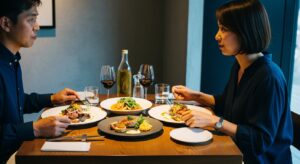
Guest Story: How a Toyota Visitor Discovered Nagoya's Rare Wagyu
 gotowp
You've flown into Nagoya for work. Your schedule is packed — factory visits, technical meetings, perhaps a presentation at a supplier's headquarters near Toyota City. Somewhere in the middle of all that, you have a lunch window. Maybe ninety minutes. Maybe less.
You open Google Maps and search "wagyu lunch Nagoya." A dozen results appear. You scroll past the hotel restaurants, the yakiniku chains, the places that look fine but not exactly memorable. And somewhere in the back of your mind, a familiar frustration surfaces:
I'm in Japan. I want to eat something I'll actually remember. But I don't know where to start.
This is the story of how one Toyota-area business visitor found exactly that — not by planning ahead, but by following a small green pin on a map into the Osu district of Nagoya.
Who This Is For
- ✅ Business travelers visiting Toyota facilities, MICE events, or industrial sites in the Nagoya area
- ✅ Anyone searching for a once-in-a-lifetime culinary experience during a Japan trip — not just "good beef," but an unforgettable story
- ✅ First-time visitors to Nagoya who aren't sure where to find authentic, hidden-gem dining beyond hotel restaurants
- ✅ Repeat Japan visitors who have tried Kobe and Matsusaka beef and are ready to discover what Aichi Prefecture has been quietly producing
- ✅ Travelers with a tight schedule who want to make every meal count
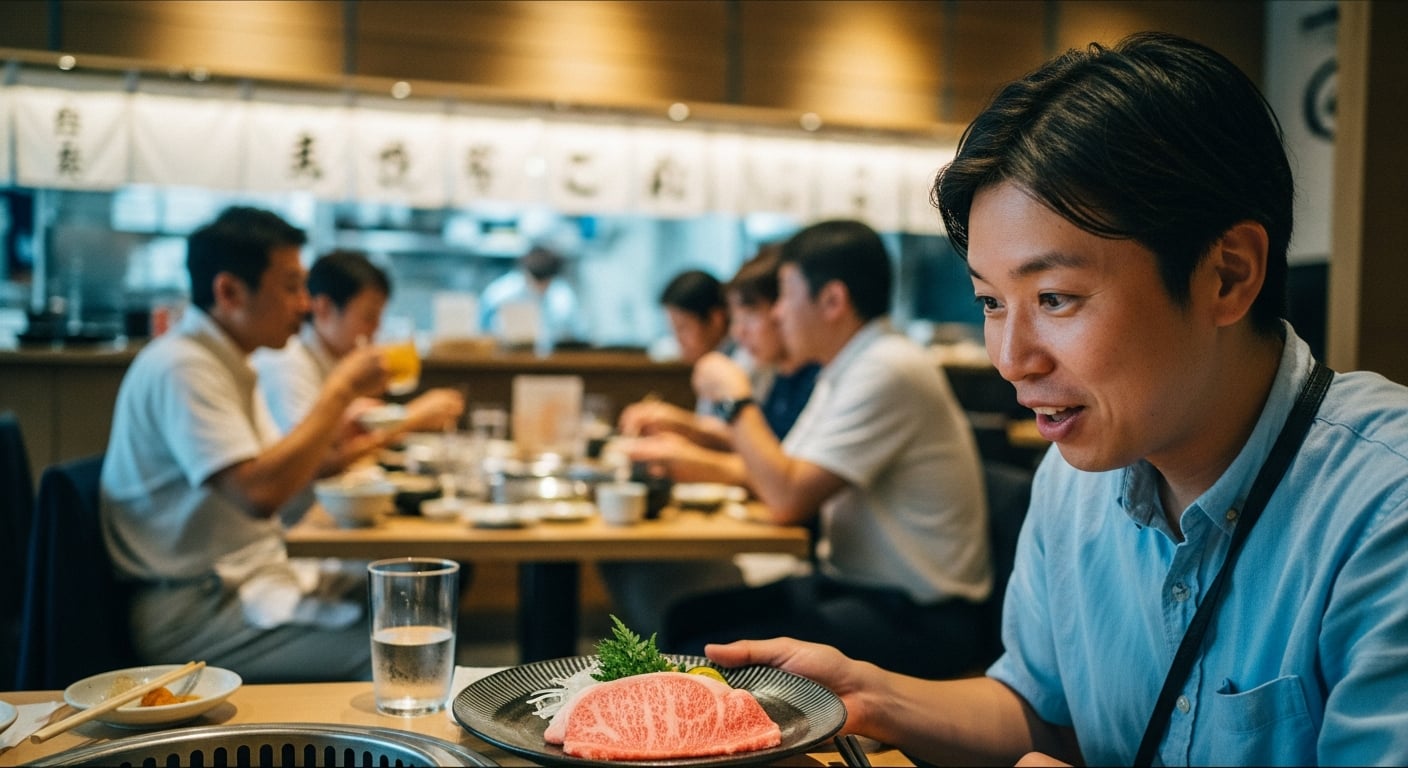
"I Almost Walked Past It Twice"
When we first opened Itadaki in April 2022, we made a mistake I still think about. We were so focused on the food — perfecting the two-stage cooking technique, sourcing the right onions from Aichi contract farms, calibrating the rice cookers to that year's harvest of Aichi no Kaori — that we underestimated how easy it was to simply miss us.
We're on the second floor of a building on a side street in Osu. The sign at street level reads 元祖レア牛丼 頂 — and for Japanese locals, that's enough. But for a foreign business traveler who landed at Chubu Centrair twelve hours ago and has never visited Nagoya before? It's a navigation puzzle they didn't sign up for.
I remember a guest — a technical consultant who had spent three days visiting a Toyota-related facility in the region — telling me afterward that he almost gave up and went to a convenience store. He'd spotted Itadaki on Google Maps, walked from Yabacho Station Exit 4, stood right in front of our building, and still wasn't certain he had the right place. He came upstairs anyway, a little uncertain, and sat down at one of our counter seats.
By the end of his lunch, he had photographed every step of the five-stage eating process and was asking whether we shipped our original 8-spice blend internationally.
That story — the almost-missed, then unforgettable — is one I've heard more times than I can count. And it taught me something important about what we're doing here.
Why "Good Beef" Is No Longer Enough
Here's something I genuinely believe after eighteen years in the food and beverage industry: the meals we remember forever are never just about taste. They're about the moment. The story. The thing you learned while eating.
Many travelers who come to Japan have already ticked the wagyu box. Kobe beef in Kobe. Matsusaka beef in a hotel restaurant in Osaka. Perhaps A5 wagyu teppanyaki somewhere on the Golden Route. These are excellent experiences — I would never diminish them. But after a certain point, "excellent beef" becomes a category, not a memory.
What we set out to create at Itadaki was something different: a dish that gave you a story worth carrying home.
The story starts with the numbers. There are approximately 500,000 wagyu cattle raised across Japan at any given time. Of those, only 300 heads per year are Horai Wagyu — raised in Okumikawa, deep in Aichi Prefecture, across just three farms. They're fed on the sake lees of Horaisen Sora, one of Aichi's finest local brews. The result is a beef with an unusually balanced profile: light, clean marbling and genuine lean meat flavor existing together in the same cut — rare in wagyu, and impossible to engineer from the outside.
We limit Horai Wagyu Rare Gyudon to 10 bowls per day. Not as a marketing device. Because that is genuinely all we can prepare with care and consistency in a single lunch service.
And the preparation itself — our proprietary two-stage cooking technique — heats the beef to over 70°C at the core, fully meeting Japan's Ministry of Health, Labour and Welfare food safety standards, while preserving a rare-style texture that surprises every first-time guest. Safe, deliberate, and unlike anything you'll encounter at any other restaurant in Japan.
✓ Key Takeaways
- Itadaki's Horai Wagyu comes from only 3 farms in Japan, with just 300 heads raised annually — genuine scarcity, not a manufactured story
- The two-stage cooking technique delivers a rare mouthfeel while fully complying with Japan's strict food safety standards — no guesswork, no concern
- With only 10 bowls of Horai Wagyu served per day, arriving early or reserving in advance is strongly recommended
What the Business Traveler Actually Experienced
Back to our Toyota-area visitor. He sat down, picked up the English menu — which explains every ingredient, its origin within Aichi Prefecture, and exactly how to eat the dish in five steps — and ordered the Shinkoccho: the standard Horai Wagyu Rare Gyudon, 100g of beef over Aichi no Kaori rice, with Nagoya Cochin egg, Atsumi Ichō-zuke pickles, and shiso leaves from Toyohashi.
He told me afterward that the five-step guide made the whole experience feel intentional rather than confusing. First, separate the Nagoya Cochin egg — white into the miso soup, yolk set atop the beef. Then appreciate the wagyu on its own before adding the yolk, then the condiments, then a final note of wasabi. Each step changes the flavor and texture of the bowl. It's a single dish that unfolds over time.
He wasn't expecting that level of structure from what he thought would be "a quick beef bowl."
"The staff were welcoming and made us feel at home even without perfect Japanese."
— Guest review
That warmth matters to us deeply. The name Itadaki is drawn from itadakimasu — the expression of gratitude spoken before every meal in Japan. It reflects something I've tried to build into the restaurant from day one: food is a gift from the farmers who raise these animals, the land that produces the rice, the artisans who craft the seasonings. Every guest who walks through our door deserves to feel that, regardless of what language they speak or where they flew in from.
How to Make This Lunch Part of Your Nagoya Visit
If you're visiting Nagoya for business — Toyota area, a MICE event, a supplier visit — the logistics of reaching Itadaki are simpler than they look on the map.
We're a 4-minute walk from Yabacho Station Exit 4 on the Meijo Subway Line. From Nagoya Station, take the Higashiyama Line to Sakae, transfer to the Meijo Line, and get off at Yabacho — roughly 10 minutes door to door. Look for the sign reading 元祖レア牛丼 頂 at street level and come up the stairs.
We serve lunch only: 11:00–15:00 on Saturdays, Sundays, Mondays, and Tuesdays (and from 9:00 on public holidays). Last order is 30 minutes before closing. We're closed Wednesday through Friday. Please check our Instagram for the monthly business calendar, as irregular closures do occur.
For Horai Wagyu specifically, I'd encourage you to reserve in advance via Tabelog Online. When booking, copy and paste 鳳来牛希望 into the notes field to request Horai Wagyu. Reservations can be completed in English. If you're arriving without a reservation, our Mikawa Beef Rare Gyudon is always available — prepared with the same two-stage technique, sourced from Aichi's Mikawa region, and equally worth your time.
Average spending is around ¥3,000 per person. We accept credit cards, IC cards, and QR code payments. All menu items are listed in English, Simplified Chinese, and Korean.
The Meal That Becomes the Story
Our Toyota-area visitor sent me a message a few weeks after his visit. He'd returned home, shown his photos to colleagues, and one of them had already looked up our Tabelog page.
"I've had great meals in Japan before," he wrote. "But this one I actually told people about."
That's what a once-in-a-lifetime culinary experience actually means. Not the most expensive meal. Not the most famous restaurant. The one that comes with a story only you can tell — because you were there, you followed the steps, you tasted something that exists nowhere else in the world.
Itadaki isn't the only good restaurant in Nagoya. But it is the only place in the world serving the Original Rare Wagyu Gyudon — a culinary concept invented here, in Osu, using ingredients that only Aichi Prefecture produces, prepared with a technique we developed ourselves over years of careful iteration.
If you have a lunch window in Nagoya — even a tight one — we'd be honored to fill it.
For our complete menu, access details, and store information, visit our official page at https://itadaki8.com/english/
To secure your Horai Wagyu bowl — limited to 10 per day — we recommend booking your seat in advance:
Reserve Your Rare Wagyu Experience
And for our latest business schedule and seasonal updates:
Check Our Monthly Schedule on Instagram
We'll see you upstairs.