Perfect Lunch After Your Toyota Museum Tour in Nagoya
 gotowp
A guest stopped by Itadaki not long ago and said something that has stayed with me. She had spent the morning at the Toyota Commemorative Museum of Industry and Technology in Nagoya — that extraordinary tribute to Japanese manufacturing precision — and arrived at our door in Osu just before noon, slightly overwhelmed in the best possible way. "I came to Nagoya for the museum," she told me, "and I'm leaving with two stories to tell."
That second story, of course, was sitting in a ceramic bowl in front of her.
I'm Masayuki Goto, founder of Itadaki. Over the past few years, I've welcomed many visitors who arrive in Nagoya specifically to see the Toyota museum, Nagoya Castle, or the Sengoku history sites — and who then spend their lunch hour wondering what to do next. This article is for those of you who want that afternoon to be just as memorable as the morning.
Who This Is For
- ✅ Visitors who have just toured the Toyota Commemorative Museum of Industry and Technology and are looking for a lunch that matches the depth of that experience
- ✅ Travelers who want a photo and a story from Nagoya that their followers will genuinely ask about
- ✅ Anyone staying in Nagoya before a Shirakawa-go or Takayama day trip the following day
- ✅ Wagyu enthusiasts who have already tried the well-known brands and want to discover what Aichi Prefecture has been quietly producing
- ✅ Repeat visitors to Japan seeking an authentic culinary discovery beyond the standard Golden Route
Before Itadaki: A Morning of Precision, An Afternoon Without a Plan
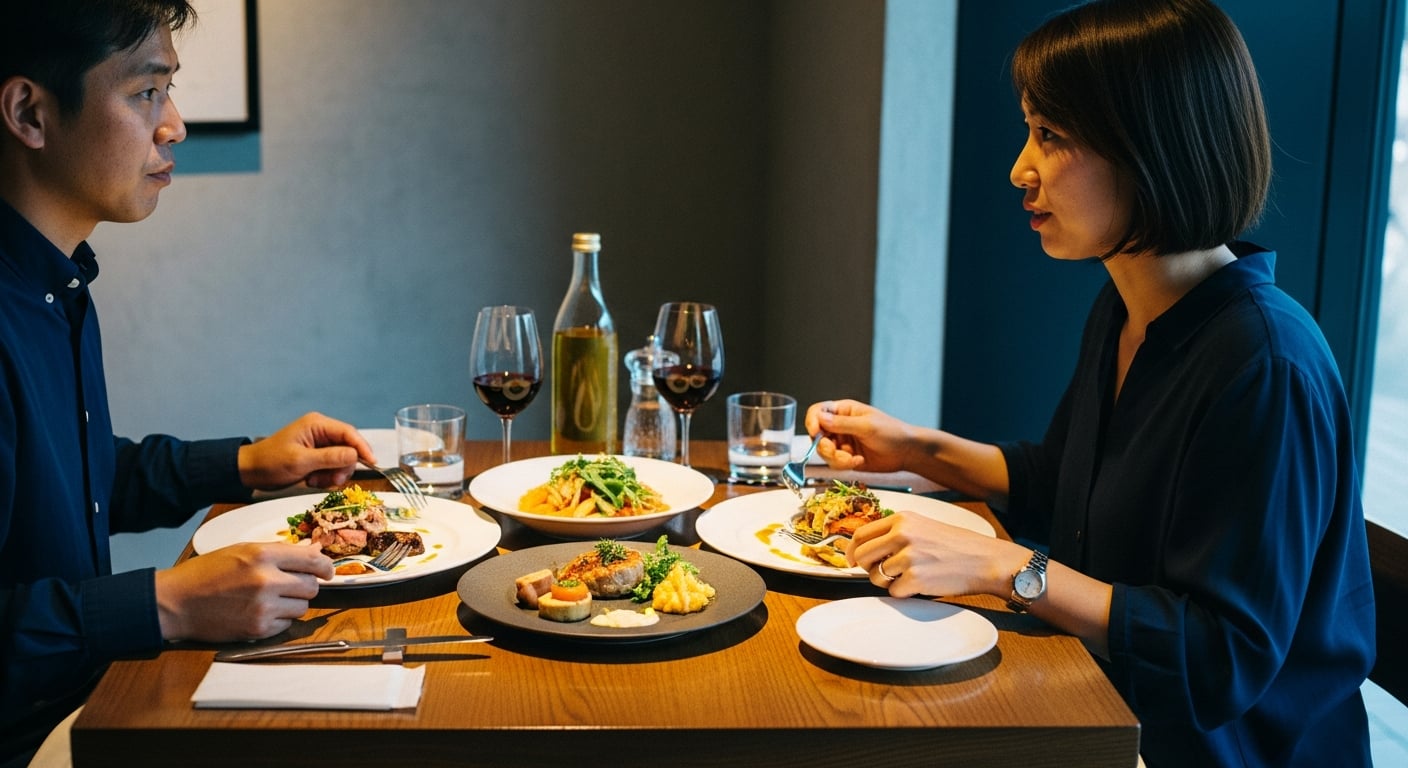
The Toyota Commemorative Museum is genuinely humbling. Room after room of looms, engines, and production-line innovation — each exhibit a reminder that extraordinary things are built through obsession with craft and an unwillingness to accept "good enough." Most visitors leave feeling inspired, slightly intellectually full, and physically hungry.
The challenge is that the museum is located in Nagoya's Nishi Ward, a little removed from the central sightseeing districts. Many visitors pull out their phones, search for nearby restaurants, and end up settling for something convenient rather than something worth remembering. They eat, they move on. The afternoon becomes functional rather than memorable.
That's the "before" I hear about most often from guests who arrive at Itadaki having almost not come. They had a morning full of stories, and lunch nearly became a footnote.
The Journey to Osu: Ten Minutes That Change the Story
From the Toyota museum area, Osu is roughly a 15-minute journey by subway — a simple hop through Nagoya's clean, easy-to-navigate metro system. Take the Higashiyama Line toward Sakae, transfer to the Meijo Line, and get off at Yabacho Station. Use Exit 4, and Itadaki is a 4-minute walk from there.
That small detour is worth making. Osu itself is unlike any other district in Nagoya — a 400-year-old shopping street that somehow contains Buddhist temples, vintage electronics shops, cosplay cafés, and some of the most interesting specialty food in the city, all within the same few blocks. Arriving here after a morning at an industrial museum feels like stepping from one kind of Japanese excellence into another.
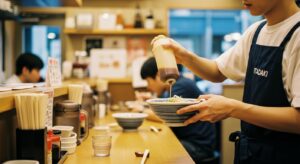
Itadaki is on the 2nd floor. Look for the sign reading 元祖レア牛丼 頂 (Ganso Rea Gyudon Itadaki) at street level and take the stairs up. Eighteen seats. Sofa seating throughout. The kind of room that feels considered rather than rushed.
After Itadaki: The Dish That Becomes a Story
Here is where the transformation happens — and it's the part I find most satisfying to witness.
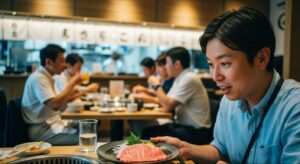
Guests arrive having already had a remarkable morning. They sit down, they read through our English menu (printed, with photos and a five-step visual guide), and then the bowl arrives. And something shifts. The visual alone does it first: marbled Horai Wagyu arranged rare-style over rice, a vivid golden Nagoya Cochin egg yolk resting on top, shiso leaves, pickled radish, a row of complimentary condiments on the side. The kind of presentation where you reach for your phone before your chopsticks.
But the story behind the bowl is what turns a good photo into genuinely shareable content.
Horai Wagyu comes from Okumikawa, deep in Aichi Prefecture. Only three farms in Japan raise it. Only 300 heads are produced each year — out of roughly 500,000 wagyu raised annually across the entire country. These cattle are fed on sake lees from Horaisen Sora, one of Aichi's most respected sake breweries. The result is a beef with a flavor profile unlike anything produced at scale: lightly marbled, with a clean finish and a depth that lingers.
We serve it using our own two-stage cooking technique — a proprietary method that brings the core temperature to over 70°C, fully meeting Japan's Ministry of Health, Labour and Welfare food safety standards, while preserving the rare-style texture that makes the dish what it is. There is nothing raw or unsafe about it. There is simply a way of cooking that most kitchens never attempt.
When your followers ask "What is that?" — and they will ask — you'll have an answer that takes more than one sentence to tell. That's the difference between a meal and a story.
"Perfect lunch during our Nagoya stay before our Shirakawa-go trip the following day."
Guest visiting from abroad, discovered via Google Maps
That review captures something I hear again and again. Itadaki fits into a Nagoya itinerary not as a standalone destination, but as the connective tissue that makes a good trip into a great one. The morning was the Toyota museum. The afternoon was Osu. The next day was Shirakawa-go. And somehow, lunch was the moment that tied it all together.
✓ Key Takeaways
- Osu is a 15-minute subway ride from the Toyota museum area — a short detour that adds depth to your Nagoya afternoon
- Horai Wagyu is produced by only 3 farms in Japan with just 300 heads annually — the story behind the bowl is as Instagram-worthy as the presentation itself
- Itadaki offers a fully translated English menu with a five-step visual guide, making the experience comfortable for international visitors without any Japanese
The Five Steps That Make It Memorable
One of the things guests comment on most — beyond the taste — is the structure of the eating experience. Our menu includes a step-by-step visual guide that walks you through the dish from first bite to last.
You begin by separating the Nagoya Cochin egg: the white goes into your miso soup, the yolk rests atop the wagyu. You taste the beef first on its own, appreciating the rare texture and the distinct character of Horai Wagyu. Then you mix in the yolk for a richer, silkier bite. Gradually, you introduce the tabletop condiments — pickled ginger from Inazawa, dried nori seaweed from Mikawa Bay, chirimen jako (dried whitebait) from Minamichita, and our original 8-spice blend — each one subtly shifting the flavor in a new direction. The final note is wasabi, sharp and clean.
Each step is worth photographing. Each step has a reason behind it. That's not something you find at most restaurants, and it's exactly the kind of detail that makes a meal worth posting — not just as a food photo, but as a sequence worth sharing.
"Instagram-worthy presentation and unforgettable taste. My followers keep asking about it."
Guest, international visitor
Planning Your Visit: What to Know Before You Go
Itadaki is open for lunch only — Tuesday, Monday, Saturday, and Sunday from 11:00 to 15:00 (last order at 14:30), and on public holidays from 09:00 to 15:00. We are closed Wednesday through Friday. Please check our Instagram for the monthly business calendar, as occasional irregular closures do apply.
Our Horai Wagyu Rare Gyudon (starting at ¥2,700 for the Shinkoccho, our standard size with 100g wagyu and 200g rice) is strictly limited to 10 bowls per day. If you have your heart set on Horai Wagyu, I'd encourage you to reserve in advance via Tabelog Online. When entering your reservation notes, copy and paste this phrase: 鳳来牛希望 — this tells us you're requesting Horai Wagyu specifically.
For guests who prefer to walk in, our Mikawa Beef Rare Gyudon (starting at ¥1,800) is always available and prepared using the same two-stage cooking technique. It is its own exceptional experience.
The restaurant seats 18 guests across counter seats and sofa-style tables — comfortable for solo diners, couples, and small groups alike. Our menu is available in English, Simplified Chinese, and Korean, and our staff welcomes visitors warmly regardless of language.
A Lunch Worth Two Stories
What strikes me about visitors who come to Nagoya for the Toyota museum is how attuned they already are to craft. They've spent a morning understanding what it means to make something exceptionally well — to obsess over the details, to refuse shortcuts, to build something that lasts. That sensibility translates directly to what we do at Itadaki.
The Horai Wagyu didn't happen by accident. The two-stage cooking technique took time to develop. The decision to source every single ingredient from Aichi Prefecture — rice, sauce, eggs, pickles, shiso leaves, miso — was a deliberate choice, not a convenience. We built something specific because we believed specificity was worth more than breadth.
When you sit down here after your morning at the museum, you're not just having lunch. You're adding a second chapter to the same story: a story about Japanese precision, applied to very different materials, arriving at something equally extraordinary.
If you'd like to secure your Horai Wagyu bowl before your visit, reservations are open now. And if you'd like to check our current schedule before making plans, our monthly calendar is always up to date on Instagram.
Reserve Your Rare Wagyu Experience
Check Our Monthly Schedule on Instagram
We look forward to welcoming you to Itadaki. For our complete menu, access details, and store information, visit our official page at https://itadaki8.com/english/