Where Should I Have Business Lunch Near Toyota Museum?
 gotowp
If your Nagoya itinerary includes a visit to the Toyota Commemorative Museum of Industry and Technology — or a technical visit to one of the many Toyota-related facilities in the area — you're probably wondering where to have a proper lunch that doesn't feel like a rushed obligation. The good news: Nagoya has a genuine answer, and it's about 10 minutes away by subway.
Who This Is For
- ✅ Business travelers on Toyota-related visits or MICE events in Nagoya
- ✅ First-time visitors to Nagoya curious about eating rare-style wagyu safely
- ✅ Travelers who want a memorable, story-worthy lunch between professional engagements
- ✅ Anyone who has heard about "rare wagyu gyudon" and wondered whether it's actually safe to eat
- ✅ Visitors planning to explore the Osu or Sakae district after their museum or factory visit
What Kind of Lunch Experience Does Nagoya Actually Offer?
Nagoya has its own distinct food culture — one that most business travelers either miss entirely or only scratch the surface of. Beyond the well-known dishes like miso katsu and kishimen noodles, Aichi Prefecture quietly produces some of Japan's rarest and most carefully raised wagyu beef. One restaurant in the Osu district, about 10 minutes by subway from the Toyota Museum area, has built its entire concept around this: Itadaki, the originator of Rare Wagyu Gyudon.
Itadaki is a lunch-only specialty restaurant founded in April 2022 by Masayuki Goto — a food professional with 18 years of industry experience. Every ingredient on the menu is sourced from Aichi Prefecture, including beef from farms that most people outside Japan have never heard of. It's not a place that tries to do everything. It does one thing, and it does it with precision.
For a business traveler, this is exactly the kind of place worth knowing about. Efficient. Focused. Genuinely extraordinary.
Is Rare Wagyu Actually Safe to Eat? Isn't Raw Beef Dangerous?
This is the question that stops most Western visitors in their tracks — and it's a completely fair one to ask.
In the United States and across much of Europe, public health authorities advise against consuming undercooked beef due to the risk of E. coli, salmonella, and other bacterial contamination. That caution is real, and if you're arriving in Nagoya from New York, London, Sydney, or Toronto, your instinct to pause at the words "rare wagyu" is entirely rational.
Here's what's different about Itadaki.
The restaurant uses a proprietary two-stage cooking technique developed under the direction of founder Masayuki Goto, who holds a Certified Food Sanitation Supervisor qualification issued by Japan's Ministry of Health, Labour and Welfare. This technique heats the beef to over 70°C at the core — the threshold required by Japan's strict national food safety standards. The process is not a shortcut or a workaround. It's a carefully engineered method that fully complies with Japanese regulatory requirements while preserving a texture that reads as rare to the palate.
In other words: the sensation is rare. The safety is not a compromise.
This distinction matters enormously for anyone approaching the dish with food safety in mind. Itadaki isn't asking you to take a risk. It's inviting you into a cooking technique that simply doesn't exist anywhere else — one that took years to develop and has been recognized by eight major Japanese television programs, including NHK, Japan's national public broadcaster.
The beef itself also plays a role here. Itadaki sources exclusively from Aichi Prefecture farms — including Horai Wagyu, produced by only three farms in Japan with just 300 heads raised annually, and Mikawa Beef, raised on a carefully managed diet with lactic acid bacteria gut management. Both are raised under rigorous quality control. This isn't commodity beef. It's traceable, small-production wagyu from producers Goto has built direct relationships with — partly inspired by a desire to support local farmers who struggled during the COVID-19 pandemic.
What Exactly Is on the Menu, and How Should I Order?
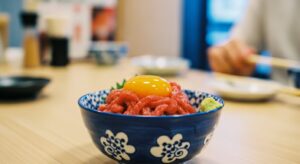
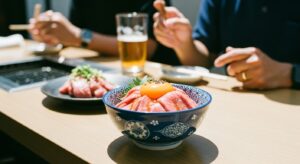
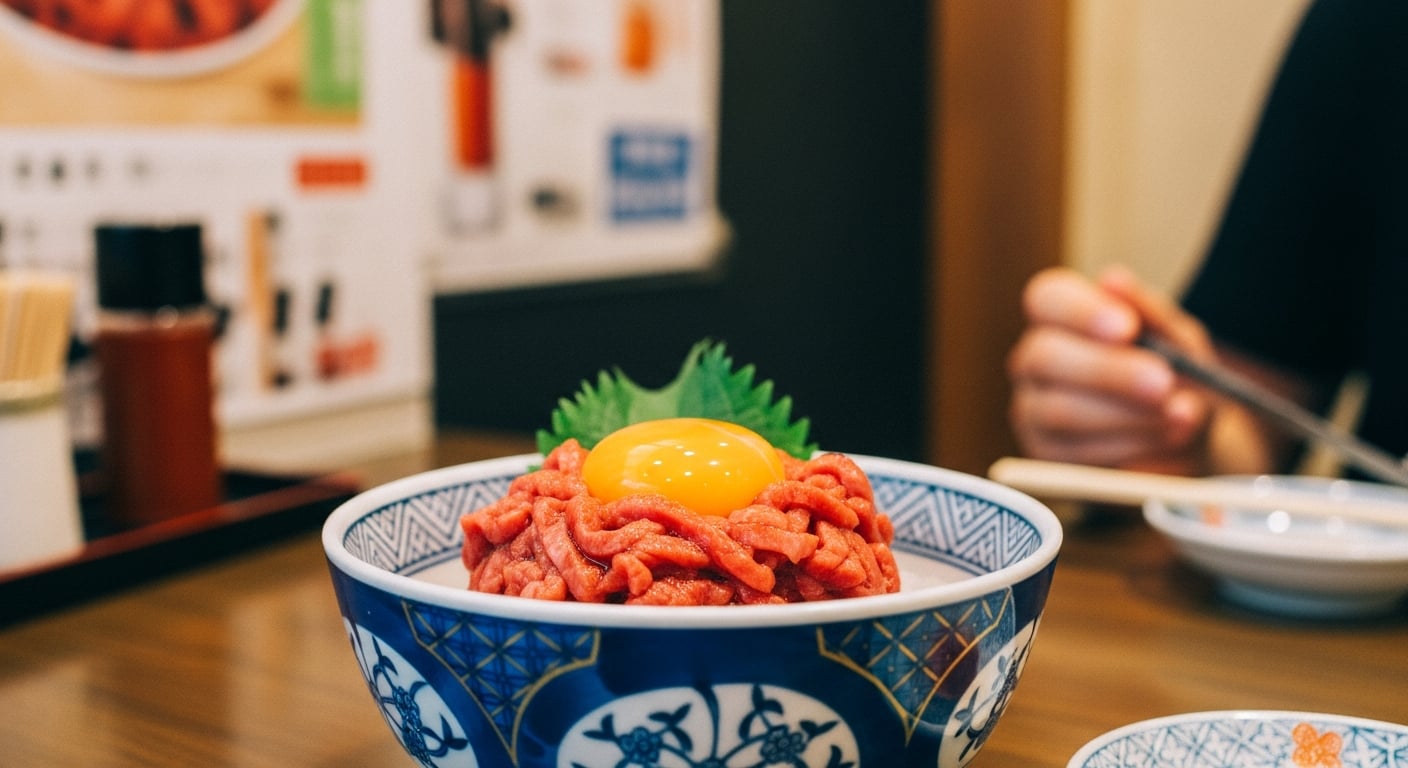
The menu at Itadaki is straightforward: the centerpiece is the Rare Wagyu Gyudon, available in two main versions. The Horai Wagyu version (from ¥2,700) is strictly limited to 10 bowls per day, so if that's your target, a reservation via Tabelog Online is strongly recommended — you can paste 鳳来牛希望 into the notes field to request it specifically. The Mikawa Beef version (from ¥1,800) is always available for walk-in guests and prepared using the same two-stage cooking technique.
The dish arrives with a raw Nagoya Cochin egg, pickled vegetables from Atsumi Peninsula, shiso leaves from Toyohashi, and a miso soup made with Hatcho miso from Okazaki. The menu includes a five-step visual guide — in English, Simplified Chinese, and Korean — that walks you through how to separate the egg yolk, when to mix, and how to build the flavor as you eat. No Japanese required.
One guest put it simply:
"The English menu with clear serving instructions made the experience stress-free."
— Guest review
For a business lunch between a morning factory tour and an afternoon meeting, that ease of experience is no small thing.
✓ Key Takeaways
- Itadaki's rare wagyu is cooked to over 70°C at the core using a proprietary two-stage technique — fully compliant with Japan's national food safety standards. The "rare" experience is in the texture, not the risk.
- Both the Horai Wagyu and Mikawa Beef versions are available, with the Horai Wagyu limited to 10 bowls daily — advance reservation is recommended.
- The multilingual menu with a 5-step visual guide means no Japanese is needed to enjoy the full experience.
How Far Is Itadaki from the Toyota Museum, and How Do I Get There?
Itadaki is located in Osu, Naka-ku — a vibrant district in central Nagoya known for its mix of traditional temples and contemporary subculture. From the Toyota Commemorative Museum of Industry and Technology (closest station: Sako or Norita on the Meijo Subway Line), the journey takes approximately 15–20 minutes by subway, depending on your exact starting point.
The most straightforward route from central Nagoya: take the Meijo Line to Yabacho Station and use Exit 4. Itadaki is a 4-minute walk from there. The restaurant is on the 2nd floor — look for the sign reading 元祖レア牛丼 頂 at street level and take the stairs up.
From Nagoya Station, the journey is about 10 minutes: Higashiyama Line to Sakae, transfer to the Meijo Line, one stop to Yabacho. It's also within walking distance from Sakae, Kamimaezu, and Osu Kannon Stations, making it easy to combine with a stroll through Osu Kannon Temple or the Osu Shopping Street before or after your visit.
There are 18 seats in total, including five counter seats well-suited for solo diners — useful if you're on your own between engagements. The restaurant is open Tuesday, Monday, Saturday, and Sunday from 11:00 to 15:00 (last order 14:30), with holiday hours starting at 9:00. No dinner service is offered.
Is This the Kind of Place Worth Telling Colleagues About?
Honestly? Yes — and not because of the price or the marketing, but because the story behind the dish is genuinely worth sharing.
Horai Wagyu is produced by only three farms in Japan. Out of approximately 500,000 wagyu raised annually across the country, only 300 are Horai Wagyu. The cattle are fed on sake lees from Horaisen Sora, a respected Aichi brewery — which contributes to their distinctive flavor profile, combining light marbling with a clean, lean beef character unusual in premium wagyu. When Goto conceived Itadaki, he wasn't trying to create a luxury restaurant in the conventional sense. He was asking a simple question: why doesn't the gyudon — Japan's most humble beef bowl — have a premium version? Every other donburi does.
That question, asked during a difficult pandemic period when local farmers needed support, became a restaurant. And that restaurant became the originator of an entirely new culinary category in Japan.
"I've had Kobe beef and Matsusaka beef, but Horai Wagyu at Itadaki was on another level."
— Guest review
For a business lunch, the combination of an efficient format (lunch-only, à la carte, no lengthy set menus), genuine culinary depth, and a story you'll remember makes Itadaki a natural choice when you want something beyond the ordinary.
Practical Summary: What Should I Do Before I Go?
A few things worth knowing before you visit:
- Itadaki is open on Saturdays, Sundays, Mondays, and Tuesdays only (11:00–15:00). Wednesdays, Thursdays, and Fridays are closed. Holiday hours begin at 9:00.
- Irregular closures occur — check the monthly business calendar on Instagram before your visit.
- Horai Wagyu (10 bowls daily) can sell out during peak lunch hours. If it's on your list, reserve in advance and add 鳳来牛希望 to the notes field on Tabelog.
- No dedicated parking — public transportation is recommended. Coin parking is available nearby if needed.
- The restaurant is non-smoking throughout, with sofa seating at all table seats.
If you're in Nagoya for a Toyota-related visit, a MICE event, or simply passing through Central Japan, a lunch at Itadaki is the kind of experience that earns its place in the itinerary — not because it's famous, but because it's the real thing.
For our complete menu, access details, and store information, visit our official page at https://itadaki8.com/english/
To secure your Horai Wagyu bowl before it sells out, we'd love to welcome you — Reserve Your Rare Wagyu Experience via Tabelog Online.
And if you'd like to confirm we're open on the day you're planning to visit, Check Our Monthly Schedule on Instagram before you head out.