Behind the Scenes: The 400-Year History of Osu Shopping Street
 gotowp
A guest stopped me recently after finishing their bowl and said something that stayed with me: "I discovered Itadaki through Google Maps and it became the best meal of our Japan trip." They weren't just talking about the food. They were talking about stumbling onto something they hadn't expected — a street, a neighborhood, a layer of Japan that their itinerary hadn't planned for.
That moment reminded me why I chose Osu as the home for Itadaki. This district has been surprising people for over 400 years. The discovery feeling isn't a marketing trick — it's written into the streets themselves.
So today, rather than talking about what's on the plate, I want to walk you through the neighborhood that holds the plate. Because if you're the kind of traveler who wants a story worth sharing — not just a photo — Osu gives you both.
Who This Is For
- ✅ Travelers who want their Japan trip content to go beyond the usual Tokyo and Kyoto highlights
- ✅ Anyone visiting Nagoya and wondering what makes Osu worth a full half-day
- ✅ Repeat visitors to Japan looking for a neighborhood with genuine historical depth and modern energy
- ✅ Food and culture enthusiasts who want to understand the story behind a place before they arrive
- ✅ Instagram-minded travelers seeking visually rich, story-worthy locations that most visitors haven't found yet
Four Centuries in One Walk
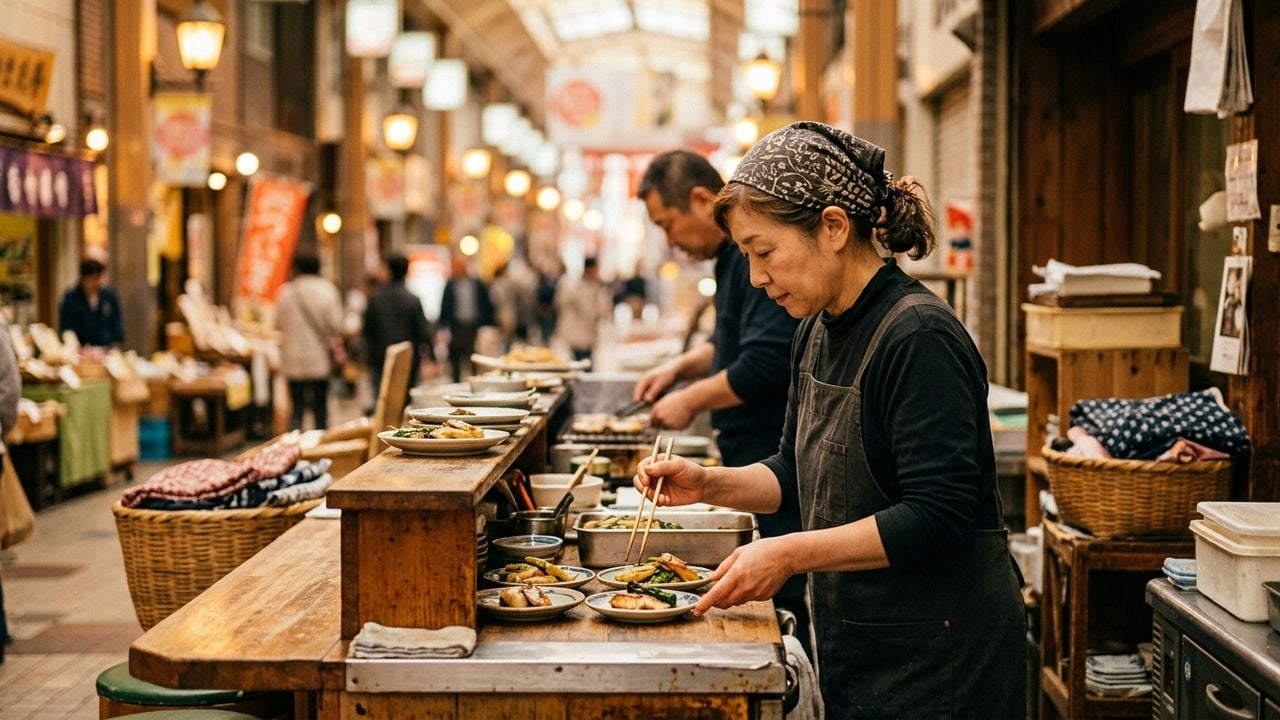
Osu's history begins not as a shopping street but as a temple town. Osu Kannon Temple — one of Central Japan's most important Buddhist sites — was relocated to this area in the early Edo period, and the surrounding streets gradually filled with merchants, craftspeople, and pilgrims. For more than 400 years, commerce and devotion have coexisted here in a way that's rare even by Japanese standards.
What makes Osu different from Kyoto's Nishiki Market or Tokyo's Asakusa is this: it never became a museum. The Edo-era bones of the district are still visible in the covered arcade structure and the placement of the temples, but everything else has layered on top organically. Vintage electronics sit next to hand-rolled incense. Maid cafés face centuries-old stone lanterns. The 1,200 shops that line Osu Shopping Street today are the latest chapter in a story that has been rewriting itself continuously since the 1600s.
For a traveler who wants something to talk about, that layering is the content. A photo from Osu doesn't need a filter — it already contains four centuries of visual tension, and that tension is what makes people stop scrolling.
You're getting a sense of Osu's layers — the temple history, the subculture energy, the 400 years that make it visually unlike anywhere else in Japan. But Itadaki's opening days shift monthly, and nothing is more frustrating than arriving on a Wednesday to find us closed. Our monthly business calendar is posted to Instagram before each month begins, so you can lock in your visit around the exact days we're open.
What the Street Looks Like When You're Actually There
The covered arcades are the spine of Osu. Stretching for several blocks and branching into side alleys, they protect shoppers from Nagoya's occasional autumn rain — and in October, the light filtering through the arcade roof has a particular quality that photographers notice immediately.
At the northern end of the main arcade, Osu Kannon Temple anchors the scene. The pigeons, the incense smoke, the red lanterns — it reads as classically Japanese, and it photographs exactly as beautifully as you'd expect. But five minutes south, the atmosphere shifts completely. Retro game shops, hand-stitched cosplay supply stores, Taiwanese bubble tea counters, and basement venues hosting local bands. The street changes mood with every block.
That range is what makes Osu uniquely shareable. A single visit gives you multiple visual stories: temple atmosphere, subculture energy, street food, traditional crafts. You're not photographing one moment — you're photographing a neighborhood's entire identity compressed into an afternoon.
If you want to understand more about what makes this district Nagoya's most iconic, this deeper look at Osu Shopping Street's character and history covers the cultural layers in more detail.
The Osu Lunch Question — and How We Think About It
After a morning in Osu — Osu Kannon, the arcades, the side streets — the question becomes where to eat. And it's a real question, because the street has hundreds of options. I've spent years in this neighborhood, and my honest answer is that the best Osu lunches are the ones with a story attached to them.
That's partly what Itadaki was designed to be. Not the most convenient option, not the fastest, but the one you remember. The rare wagyu gyudon we serve uses Horai Wagyu — a Japanese black wagyu from Okumikawa, Aichi, produced by only 3 farms with just 300 heads raised annually. That scarcity isn't marketing language; it's the actual supply chain. When you order it, you're eating something that most wagyu restaurants in Japan have never served.
The story of Horai Wagyu connects directly to the broader story of Aichi Prefecture's ingredients — the same agricultural richness that has fed Nagoya's merchant culture for centuries. Every bowl we serve is built entirely from Aichi-sourced ingredients: the rice, the sauce base, the miso, the egg, the pickles. That's the "everything from Aichi" principle, and it's what gives the dish a narrative that holds up when someone back home asks, "Wait, what exactly did you eat?"
For the craft behind that preparation, this article on our rare wagyu cooking technique explains the two-stage process in detail.
✓ Key Takeaways
- Osu's 400-year history creates natural visual storytelling across a single afternoon — temple architecture, subculture shops, and covered arcade light all photograph differently and tell different stories.
- The neighborhood's layered identity (Edo-era temple town + modern subculture hub) is what makes it stand out from more polished tourist districts, and that authenticity is exactly what repeat Japan visitors are seeking.
- A lunch that carries its own narrative — the origin, the ingredient scarcity, the cooking method — extends the story of your Osu visit beyond the photographs.
The Horai Wagyu section landed differently than you expected, didn't it — 300 heads across 3 farms is the kind of number that makes the bowl feel genuinely rare, not just described that way. That rarity is also why we limit it to 10 bowls a day, and why it sells out on busy Osu mornings. Reserving your bowl via Tabelog before you arrive is the straightforward way to make sure the story you want to tell actually happens.
How the Story Travels Home
Here's what I notice from guests who come through Itadaki after a morning in Osu: the ones who leave with the best stories are the ones who understood why before they arrived. Not just "this place is famous" but "this neighborhood has been continuously alive for 400 years, and here's what that actually looks like."
That understanding changes how you photograph. You're not just capturing a shot of the temple gate — you're capturing the juxtaposition of the incense smoke and the anime shop sign two doors down, because you know that tension is the point. You're not just posting a food photo — you're sharing a bowl of beef from 300 cattle and a rice grown in Aichi's fields, and you know the numbers behind it.
"I discovered Itadaki through Google Maps and it became the best meal of our Japan trip."
— Guest visitor
That comment tells me something important. The discovery moment — finding something unexpected through a search, then walking into an experience that exceeds what any photo had suggested — is the emotional core of what travelers are chasing. Osu is built for that kind of discovery. Its 400 years of continuous reinvention means there's always something the guidebooks haven't caught up to yet.
If you're planning your time in the Osu area and want ideas for structuring your visit around both the street and a proper lunch, this guide to lunch spots on Osu Shopping Street gives a practical look at how to fit everything in.
Planning Your Osu Visit in October
October is one of the best months to explore Osu. The summer heat has passed, the autumn light is clear and warm, and the district is in full operation after the summer festival season. It's also worth noting that mid-October 2026 falls during the Asian Para Games, which means Nagoya is hosting international visitors from across the region — and Osu, as always, welcomes everyone.
A practical note on timing: Itadaki is open for lunch service only, on Saturdays, Sundays, Mondays, Tuesdays, and public holidays (11:00–15:00, with last order 30 minutes before closing). We are closed Wednesday through Friday. Our Horai Wagyu is limited to 10 bowls per day, and it does sell out — so if that's specifically what you're coming for, a reservation via Tabelog in advance is the reliable approach.
We're a 4-minute walk from Yabacho Station Exit 4 on the Meijo Subway Line, and also within walking distance from Sakae, Kamimaezu, and Osu Kannon stations. From Nagoya Station, the journey is roughly 10 minutes by subway.
For our complete menu, access details, and store information, visit our official page at https://itadaki8.com/english/.
Osu has been offering discovery experiences for four centuries. The street keeps changing; the spirit of finding something unexpected never does. I hope your visit adds one more good chapter to that ongoing story.
You've just read through 400 years of Osu, the ingredient story behind the bowl, and the kind of discovery moment that turns a lunch into the meal people mention for years after the trip. The next step is making sure you actually get a seat. Tabelog reservations take a few minutes, and they're the only way to guarantee the Horai Wagyu is waiting for you when you arrive.