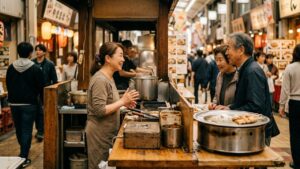
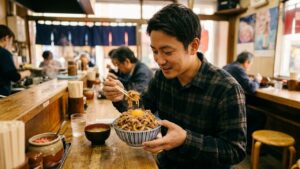
Where Should I Eat Lunch on Osu Shopping Street Nagoya?
 gotowp
The short answer: if you're walking Osu Shopping Street and want a lunch you'll be talking about long after you leave Japan, head to Itadaki on the second floor of 4-1-20 Osu. It's a four-minute walk from Yabacho Station, and it's the only place in the world serving what we call the Original Rare Wagyu Gyudon — a beef bowl unlike anything you've tried before. But if your first reaction to "rare wagyu beef bowl" is a flicker of hesitation about food safety, this article is written specifically for you.
Who This Is For
- ✅ Visitors exploring Osu Shopping Street who want a genuinely memorable lunch, not just a convenient one
- ✅ Travelers who've heard about "rare wagyu" in Japan but are uncertain whether it's safe to eat
- ✅ First-time visitors to Nagoya curious about what makes Aichi Prefecture's food culture distinct
- ✅ Anyone who has tried Kobe or Matsusaka beef and wants to discover what else Japan's wagyu world has to offer
- ✅ Solo travelers, couples, or small groups looking for a relaxed, welcoming lunch environment with multilingual support
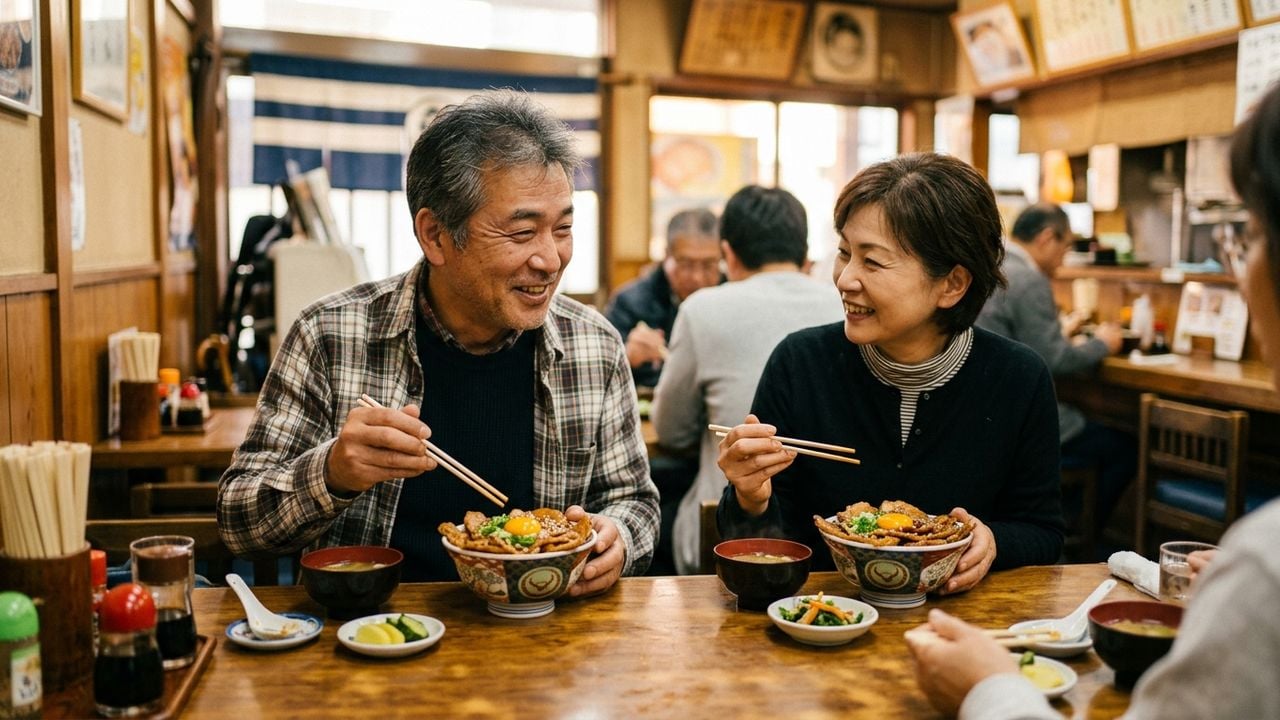
Is Rare Wagyu Actually Safe to Eat?
Yes — and the key is understanding what "rare" means at Itadaki, because it's not the same as what you might picture at home.
In the United States, the UK, and much of Europe, public health guidance warns against eating undercooked beef, citing risks from E. coli and salmonella. That advice makes complete sense in those contexts. But Itadaki's rare wagyu is a different story, because the "rare" texture you experience at the table is the result of a proprietary two-stage cooking technique — not raw preparation.
Here's what that means in practice: the beef is heated to above 70°C at its core during preparation. That threshold fully satisfies Japan's food safety standards as set by the Ministry of Health, Labour and Welfare. The technique was developed specifically by Itadaki's founder, Masayuki Goto — a Certified Food Sanitation Supervisor — to deliver the sensation of rare beef while ensuring the dish meets regulatory requirements at every stage. The outcome is something that feels genuinely rare in texture and flavour, but is prepared with the same rigour you'd expect from a licensed, inspected Japanese restaurant.
So when you sit down and see the beautifully arranged beef atop the bowl, you're not looking at raw meat. You're looking at the result of 18 years of food industry experience and a technique that took serious development to perfect.
The food safety question is answered — but you're probably now wondering whether Itadaki will actually be open on the day you're visiting Osu. Because the schedule runs only four days a week with occasional irregular closures, the monthly calendar on Instagram is the most reliable way to confirm before you commit your lunch plans. It takes less than a minute to check.
What Exactly Goes Into the Bowl — and Why Does It Matter?
The ingredient story at Itadaki is just as important as the cooking technique, and it's one of the things that separates this from any other gyudon you'll encounter in Japan.
Every single ingredient comes from Aichi Prefecture. The rice is "Aichi no Kaori," a premium Aichi-grown variety. The miso soup is made with Hatcho miso from Okazaki City — one of Japan's most distinguished miso-producing regions. The pickles are traditional Atsumi Ichō-zuke from the Atsumi Peninsula. Even the egg sitting atop the bowl is from Yamada Poultry Farm's Nagoya Cochin hens, a breed that has its own centuries-long history in this region.
The beef itself comes from two sources. Mikawa Beef, raised in Aichi's Mikawa region and always available on the menu, uses the uchimomo lean cut — balanced and clean in flavour. And then there's Horai Wagyu, the ultra-rare Kuroge Wagyu raised in Okumikawa, Aichi, by only three farms, with just 300 heads produced annually across the entire country. These cattle are fed on sake lees from Horaisen Sora — a well-regarded local premium sake — which contributes to a flavour profile that's genuinely unlike other wagyu brands.
To put that scarcity in perspective: Japan raises approximately 500,000 wagyu cattle in any given year. Horai Wagyu accounts for around 300 of them. It's available at Itadaki in a strictly limited daily quantity of 10 bowls.
✓ Key Takeaways
- Itadaki's rare wagyu is cooked to above 70°C at the core using a proprietary two-stage technique — it fully meets Japan's Ministry of Health, Labour and Welfare food safety standards.
- Every ingredient is sourced from Aichi Prefecture, creating a cohesive "taste of Aichi" experience in a single bowl.
- Horai Wagyu is limited to 10 bowls daily — the scarcity is genuine, not a marketing device.
You now know the two-stage cooking technique and the 70°C core temperature — but Horai Wagyu is capped at 10 bowls a day, and September is a busy season in Nagoya. Securing your bowl in advance through Tabelog means you won't arrive to find it sold out before midday. Reservations are made online — no phone call required.
What Will the Experience Actually Feel Like — Especially If I Don't Speak Japanese?
This is where Itadaki has put real thought into welcoming visitors who aren't familiar with Japan's food culture. The restaurant offers printed menus in English, Simplified Chinese, and Korean. More usefully, there's a step-by-step photographic guide — five stages — that walks you through exactly how to eat the dish to get the most out of it.
The five steps unfold like this: you first separate the raw Nagoya Cochin egg, dropping the white into your miso soup and placing the yolk atop the beef. You taste the wagyu in its purest form first, appreciating the rare texture before anything else changes it. Then you break the yolk into the beef for a richer, silkier bite. From there, you explore the complimentary condiments on the table — pickled ginger from Kimura Farm in Inazawa City, chopped seaweed from Mikawa Bay, chirimen jako (dried whitebait from Minamichita), and Itadaki's own original 8-spice blend. You finish with wasabi for a clean, refreshing close.
One of our guests summed it up well:
"The English menu with clear serving instructions made the experience stress-free."
That's exactly the intention. A dish this carefully constructed deserves to be enjoyed with confidence, not confusion. The guide exists so that whether you're visiting from London, Seoul, Sydney, or São Paulo, you can follow the experience the way it was designed — without needing to ask questions or feel uncertain.
The seating itself also contributes to that ease. Itadaki has 18 seats total, all with sofa-style comfort. Five counter seats work well for solo visitors. There's a five-person sofa table that suits groups and families, and smaller two- and four-person tables for couples and duos. It's a calm, unhurried setting — the kind of place where you actually slow down over lunch rather than rushing through it.
How Do I Get There from Osu Kannon Temple or the Shopping Street?
Itadaki is located on the second floor of 4-1-20 Osu in Naka-ku, Nagoya — a four-minute walk from Yabacho Station Exit 4 on the Meijo Subway Line. If you're already exploring what makes Osu Shopping Street Nagoya's most iconic district, you're essentially already in the neighbourhood.
Osu Kannon Temple is roughly a five-minute walk. Hisaya-odori Garden Flarie — a free-admission urban garden with themed sections including a European-style Harmony Garden and a Crystal Garden greenhouse — is a short three-minute walk from Yabacho Station and frequently appears in major English-language travel guides. If you've been strolling there on a September morning before lunch, Itadaki is a natural next stop.
From Nagoya Station, the journey is straightforward: take the Higashiyama Line to Sakae, transfer to the Meijo Line, and get off at Yabacho. Total time: around 10 minutes.
There's no dedicated parking, but coin parking lots are easy to find within a one-to-three minute walk if you're arriving by car.
Do I Need to Reserve in Advance, and What Are the Hours?
Itadaki operates on a lunch-only schedule: 11:00 to 15:00 on Saturdays, Sundays, Mondays, and Tuesdays (last order at 14:30). On public holidays, the restaurant opens earlier at 09:00. There is no dinner service.
September 20th, 2026 — a Sunday — falls within the regular operating schedule, so Itadaki will be open from 11:00 to 15:00.
Walk-ins are welcome, but if your plan specifically includes Horai Wagyu — the ultra-rare 10-bowl daily option — a reservation via Tabelog is strongly recommended. During busier periods, those 10 bowls can sell out before midday. The Mikawa Beef gyudon is always available without that limitation, starting from ¥1,800 for the standard Fumoto size.
Because Itadaki's schedule occasionally includes irregular closures, it's worth checking the monthly business calendar on Instagram before your visit, especially when travel plans are hard to rearrange. The Instagram handle is @itadaki_gyudon.08.
Is This the Right Lunch Stop for Me — or Should I Look Elsewhere?
Itadaki is not trying to be everything to everyone. It doesn't offer vegetarian, vegan, or Halal-certified options. There's no dinner service, no delivery, and no take-out — the rare preparation is designed for immediate dine-in. If those are non-negotiable requirements for your group, you'll want to plan accordingly.
But if you're a traveler who values genuine craft over brand recognition, who wants to eat something in Nagoya that simply does not exist anywhere else on earth, and who feels reassured knowing the food safety question has a clear and honest answer — this is worth going out of your way for.
Itadaki has been featured on eight major Japanese TV programs including NHK, and the concept of "Rare Wagyu Gyudon" originated here in April 2022, when founder Masayuki Goto opened the restaurant in Osu. The name comes from "itadakimasu" — the Japanese expression of gratitude spoken before a meal. It reflects something genuine about how this restaurant approaches food: as a gift from the farmers who raise it and the land that sustains them.
That's the kind of lunch Osu Shopping Street has to offer — if you know where to look.
For our complete menu, access details, and store information, visit our official page at https://itadaki8.com/english/
You've read about the two-stage technique, the 300-head annual supply, and the five-step eating guide designed so the experience unfolds exactly as it should. The next step is simply securing your seat before those 10 daily Horai Wagyu bowls are gone. Reserve directly through Tabelog — it's the only way to guarantee availability.