What Makes Osu Shopping Street Nagoya's Most Iconic District?
 gotowp
You've pulled up Google Maps, typed in "Osu Shopping Street," and started walking — only to find yourself at the entrance of a covered arcade with no clear sense of what's inside, which direction to head, or how long you'll be wandering. If that sounds familiar, you're not alone. Osu is one of Nagoya's most beloved neighborhoods, but for first-time visitors, it can feel like a labyrinth without a map legend.
This guide answers the most common questions travelers ask before visiting Osu — including how the district fits into a broader Nagoya itinerary, what makes it genuinely unlike anywhere else in Japan, and how to navigate it without getting lost on the way to lunch.
Who This Is For
- ✅ First-time visitors to Nagoya wondering what Osu Shopping Street is actually like
- ✅ Travelers trying to figure out how to get to Osu — and specifically how to find restaurants on the 2nd floor of its buildings
- ✅ Repeat Japan travelers looking for an authentic Nagoya neighborhood beyond the tourist checklist
- ✅ Anyone planning a lunch stop in Osu before or after Shirakawa-go, Takayama, or other Central Japan destinations
- ✅ Visitors who want to understand what makes Osu feel different from Asakusa, Dotonbori, or Kyoto's Nishiki Market
What Is Osu Shopping Street, and Why Is It Called Nagoya's Most Iconic District?
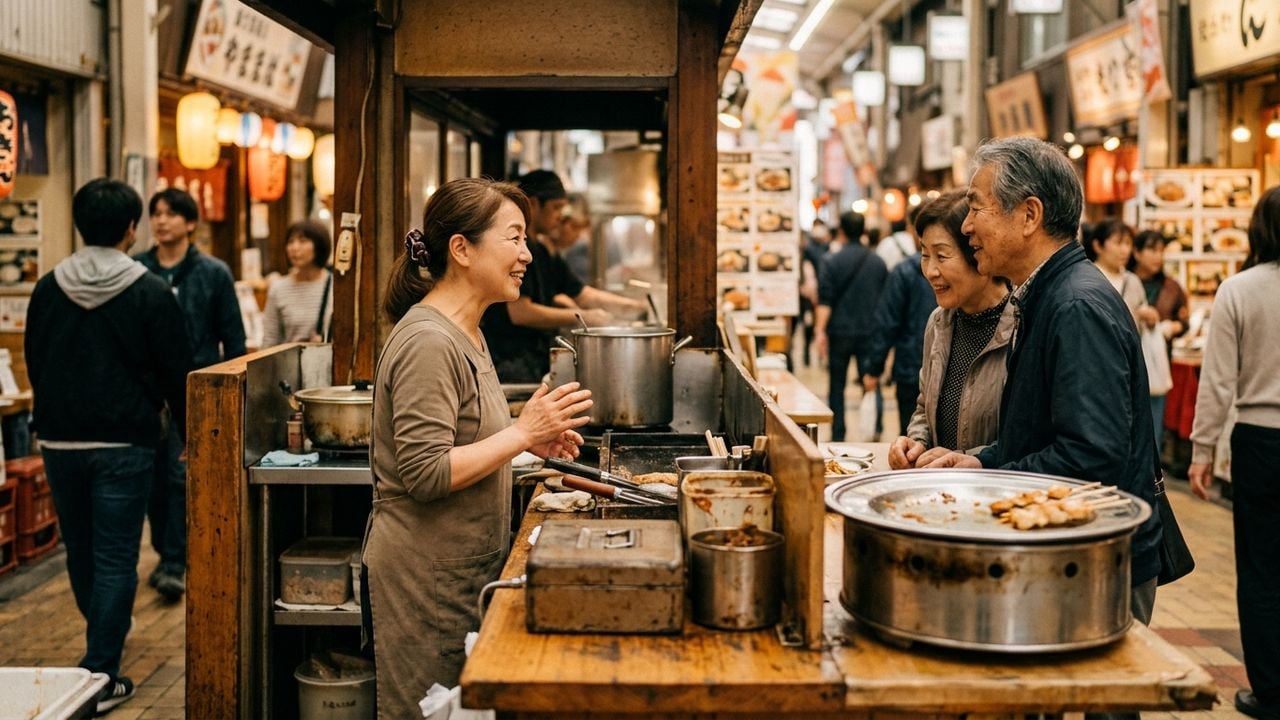
Osu Shopping Street is Nagoya's answer to the question: what happens when 400 years of merchant culture, Buddhist temple life, subculture fandom, and street food all share the same few city blocks?
The district stretches across a network of covered arcades totaling more than 1,200 shops. It is anchored at one end by Osu Kannon Temple — one of Central Japan's most important Buddhist sites — and extends outward in several directions through shops selling everything from vintage electronics and anime figurines to handmade accessories, traditional crafts, and international cuisine. It is the largest of Nagoya's traditional shopping streets, and unlike many preserved historical districts in Japan, it is entirely alive: busy on weekdays, electric on weekends.
What sets Osu apart from similar districts elsewhere in Japan is the coexistence of things that shouldn't logically belong together. A Buddhist temple courtyard leads directly into a street lined with maid cafés. A 300-year-old neighborhood history sits next to one of Japan's largest concentrations of cosplay-friendly shops. Osu is also the main stage for the World Cosplay Summit, one of the city's most internationally recognized annual events — which draws participants and fans from dozens of countries each year.
Trip.com's official Nagoya travel guide lists Osu as a "Day 1 must-visit spot" for international tourists, and for good reason. It offers the kind of unscripted, layered discovery that repeat Japan travelers specifically seek out when they're ready to move beyond the golden route.
Osu's covered arcades can shift week to week — shops close, pop-up events appear, and Itadaki's Horai Wagyu sells out on some days without warning. Our monthly business calendar is posted with exact open days so you can plan your Osu visit around an actual confirmed lunch stop. Takes about 30 seconds to check.
How Is Osu Different From Other Famous Japanese Shopping Districts?
Most famous Japanese shopping districts have a clear identity: Akihabara is electronics and anime; Nishiki Market is food; Asakusa is tourism and temples. Osu refuses that kind of categorization.
The district has its subculture side — Nagoya residents often call it "Nagoya's Akihabara" — but it also has a multicultural food scene that reflects the city's quietly international character. Taiwanese and Chinese restaurants sit alongside specialty coffee shops, traditional Japanese sweets stalls, and izakayas that have been open for decades. And threading through all of it is the rhythm of a neighborhood that actual Nagoya residents visit regularly, not just tourists.
That lived-in quality is part of what makes finding a restaurant in Osu feel so different from, say, visiting a food hall in a department store. The best places are often on the second floor of unmarked buildings, above street-level shops, reachable only by a staircase you'd walk past without a second glance. Which brings us to the navigation question.
✓ Key Takeaways
- Osu Shopping Street spans 1,200+ shops across a network of covered arcades, anchored by Osu Kannon Temple and shaped by 400 years of merchant history.
- Its distinctive character comes from the coexistence of Buddhist temple culture, subculture fandom, international food, and genuine local daily life — all in the same few blocks.
- The best restaurants in Osu are often on upper floors of buildings, invisible from street level — making navigation more deliberate than in other districts.
You now know Itadaki is on the 2nd floor, 4 minutes from Yabacho Exit 4 — but the Horai Wagyu is capped at 10 bowls a day, and showing up without a reservation means real risk of missing it. Securing your bowl before you travel to Osu is the one step that turns a planned lunch into a guaranteed one. Reservation is handled entirely online via Tabelog.
How Do I Actually Get to Osu — and Why Do People Get Lost?
Getting to Osu is straightforward. Getting to a specific address inside Osu is where many visitors run into trouble.
The easiest approach from Nagoya Station: take the Higashiyama Line to Sakae Station, transfer to the Meijo Subway Line, and ride one stop to Yabacho Station. Total travel time is approximately 10 minutes. From Yabacho Station Exit 4, you're a 4-minute walk from the heart of the district. Osu is also within walking distance from Sakae Station, Kamimaezu Station, and Osu Kannon Station — so depending on where you start, you have several entry points.
The confusion begins once you're inside. The covered arcade has no grid logic. Side streets branch off at irregular angles. Building numbers don't follow a pattern that feels intuitive to visitors from outside Japan. And many of the most interesting destinations — restaurants, specialty shops, galleries — occupy upper floors with nothing at street level to signal that they exist.
Google Maps helps, but it has known imprecision in the Osu arcade area. The satellite view and walking directions can send you to the right block without getting you to the right entrance. The practical workaround: identify a visible landmark near your destination before you leave, and use that rather than the pin alone.
For a neighborhood guide to Osu that weaves together sightseeing and dining, this Osu district food tour itinerary for visitors during Asian Games offers a well-structured walk through the area.
What Should I Eat in Osu — and How Do I Find the Right Place?
Osu has an unusually wide range of food options for a shopping district its size. Street food is accessible along the main arcade. But the more memorable meals tend to happen when you step off the main path and go up a flight of stairs.
One example is Itadaki — the originator of Rare Wagyu Gyudon — located on the 2nd floor at 4-1-20 Osu, a 4-minute walk from Yabacho Station Exit 4. At street level, look for the sign that reads "元祖レア牛丼 頂" (pronounced "Ganso Rea Gyudon Itadaki"). Take the stairs up to the second floor. If you walk past without noticing, you're not doing anything wrong — this is exactly what happens to most first-time visitors. The landmark to orient yourself: Osu Kannon Temple to the north, the main Osu Shopping Street arcade entrance nearby.
The restaurant sources every ingredient from Aichi Prefecture — from the ultra-rare Horai Wagyu (only 300 heads raised annually across 3 farms in Japan) to the rice, eggs, pickles, and even the white soy sauce used in the signature sauce. It's a lunch-only operation, open on Saturdays, Sundays, Mondays, and Tuesdays, 11:00–15:00. The Horai Wagyu option is limited to 10 bowls per day, so a reservation via Tabelog is strongly recommended if that's what you're aiming for.
"Perfect lunch during our Nagoya stay before our Shirakawa-go trip the following day."
Guest visiting Nagoya en route to Shirakawa-go
That kind of timing — a proper lunch in Osu before heading north to Shirakawa-go or Takayama the next morning — is one of the most common ways travelers fit Nagoya into a broader Central Japan itinerary. Osu makes a natural base for that kind of day, with a morning at Osu Kannon Temple, lunch somewhere worth the effort to find, and an afternoon of wandering before the next leg of the trip. For more on how other visitors have built their Nagoya days around the Osu area, this guide for guests staying near Osu covers the logistics in useful detail.
Is Osu Worth a Full Day, or Just a Few Hours?
That depends on what draws you. A first-time visitor can see the main arcade, visit Osu Kannon Temple, and have a proper lunch in about three to four hours. A repeat visitor who wants to explore the side streets, find the vintage shops tucked into the back arcades, and discover which cafés are worth a second visit could spend an entire day without running out of ground to cover.
September in Nagoya brings warm weather and the kind of foot traffic that gives Osu its best energy. The district is lively without the peak summer heat, and major events — including the 2026 Asian Games, held in Nagoya this autumn — bring an international dimension to the neighborhood that makes even familiar streets feel different. If you're in Nagoya during this period, Osu rewards a slower pace rather than a checklist approach.
One nearby stop worth adding before or after your time in the arcade: Hisaya-odori Garden Flarie, a free-admission urban garden just 3 minutes from Yabacho Station. It's featured in major English travel guides and makes a calm counterpoint to the energy of the shopping street. The contrast — from the quiet of the garden to the texture and noise of Osu — captures something true about Nagoya: it holds very different experiences within a short walk of each other.
For our complete menu, access details, and store information, visit our official page at https://itadaki8.com/english/
You've mapped out Yabacho Exit 4, identified the 「元祖レア牛丼 頂」 sign at street level, and know exactly which staircase to take — now the one thing left is locking in your bowl before someone else does. Horai Wagyu is 10 bowls a day, and Osu fills up fast on weekends. Reserve your seat now through Tabelog.