The Complete English Guide to Osu District Dining
 gotowp
It's early October in Nagoya, and the city is humming. The 2026 Asian Games have just wrapped up, the crowds are still buzzing through Osu Shopping Street, and the autumn air has finally arrived — cool enough to make a bowl of something warm feel exactly right. If you've found yourself wandering through Osu's covered arcades, passing paper lanterns and anime storefronts, you've probably also felt that familiar traveler's hesitation: I want to eat somewhere local, but what if I can't read the menu?
That anxiety is real, and it's one of the most common things I hear from visitors who eventually make their way to Itadaki. So today, I want to address it directly — not with vague reassurance, but with a practical, honest guide to navigating Osu district dining as an English speaker. Think of this as the guide I wish someone had handed you before you arrived.
Who This Is For
- ✅ Foreign visitors exploring Osu district who are worried about language barriers at local restaurants
- ✅ Travelers who want an authentic Nagoya dining experience but aren't sure how to order without Japanese
- ✅ Anyone who has ever chosen a chain restaurant out of linguistic caution and later regretted missing the real thing
- ✅ First-time visitors to Osu who want to know what to expect before sitting down at a specialty restaurant
- ✅ Wagyu enthusiasts curious about trying rare-style beef but unsure how to navigate the dish without guidance
1. The Language Barrier Fear Is Real — But It Doesn't Have to Stop You
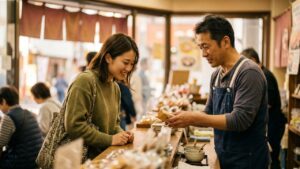
Let's be honest about what actually happens when a foreign visitor stands outside a restaurant in Osu. You peer through the door. The sign is in Japanese. The chalkboard menu is in Japanese. Someone calls out irasshaimase from behind the counter, and you suddenly feel like you've walked into a scene you didn't rehearse for. So you step back, find the nearest place with an English sign, and spend the rest of the afternoon wondering what you missed.
This pattern is incredibly common — and completely understandable. But it's also the reason so many repeat Japan visitors tell me their second trip was so much better than their first. They knew where to look for restaurants that had done the work to welcome international guests. Osu, for all its vibrant chaos, has a growing number of spots that genuinely cater to non-Japanese speakers. The key is knowing which ones, and knowing what to expect when you walk in.
When I opened Itadaki in Osu back in 2022, one of the first things I committed to was making sure that a visitor who had never been to Japan before could sit down, understand the menu completely, and feel confident ordering — without needing a single word of Japanese. That wasn't an afterthought. It was part of the concept from day one.
You're weighing up whether Itadaki is actually open on the day you're planning to visit — and the operating calendar is one of the things that trips up even well-prepared travelers. Our monthly business schedule is posted on Instagram, so you can confirm the exact dates before building your itinerary around lunch here. Takes under a minute to check.
2. What to Actually Look for When Choosing a Restaurant in Osu
Here's a practical ranking of what to prioritize when you're choosing where to eat in Osu district, especially if English support matters to you.
① A printed multilingual menu with photos and prices
This is the single most important thing. A menu with photos removes almost all ambiguity — you can point, confirm, and order without any shared language. Prices printed clearly mean no surprises at the register. At Itadaki, our printed menu is available in English, Simplified Chinese, and Korean, and every dish includes a photo, the price (tax included), and a clear description of the ingredients. You'll know exactly what you're ordering before you say a word.
② A visual guide explaining how to eat the dish
This one matters more than people expect. Some Japanese dishes — particularly something as specific as a rare wagyu gyudon — have a right way to be enjoyed. At Itadaki, the menu includes a five-step visual guide called "How to Enjoy Rare Gyudon." It walks you through everything: how to separate the Nagoya Cochin egg (white into the miso soup, yolk onto the beef), how to eat the wagyu first on its own to appreciate its natural flavor, when to mix in the yolk, and how to use the complimentary condiments on the table. No guesswork, no awkward moments — just the full experience, exactly as it was designed.
③ Welcoming staff who don't require you to speak Japanese
You don't need a restaurant where every staff member is fluent in English. What you need is staff who are genuinely comfortable with international guests — who won't panic if you point at the menu, who will smile and confirm your order patiently, and who will make you feel at home. Translation apps work well in this kind of relaxed environment, and at Itadaki, you're welcome to use yours freely. We won't rush you.
④ Online presence in English, including access and hours
Before you even step out the door, look for restaurants that have published their hours, access information, and menu in English online. In Osu, there are more details about the district than even locals sometimes know — including which restaurants have made the effort to communicate clearly with international visitors. Itadaki's official English page covers everything from how to get here from Nagoya Station to what each menu item contains and how much it costs.
⑤ Clear reservation options that don't require Japanese phone calls
If a restaurant takes reservations — and for popular spots, reservations matter — look for online booking options that don't require you to call in Japanese. Itadaki accepts reservations through Tabelog's online reservation system, which is straightforward to use even without Japanese language skills.
✓ Key Takeaways
- A printed multilingual menu with photos and prices removes nearly all ordering anxiety — look for this before sitting down.
- Visual step-by-step guides for how to eat a dish are genuinely useful for unfamiliar Japanese specialties like rare wagyu gyudon.
- You don't need Japanese-fluent staff — you need staff who are comfortable and patient with international guests. Translation apps fill the rest.
You now know that the five-step guide and the multilingual menu handle the ordering — the one thing left is making sure the Horai Wagyu bowl is still available when you arrive. Limited to 10 bowls a day, it sells out during peak hours, and a Tabelog reservation is the only way to hold your spot. The reservation form is available in English.
3. Navigating Allergens and Dietary Questions Without Japanese
This is the question that causes the most stress for visitors with food allergies, and it deserves a direct answer.
At Itadaki, the allergen information for our dishes is published clearly in English. Here's what you need to know in advance:
- Soy: present in our soy sauce, miso paste, and Atsumi Ichō-zuke pickles
- Wheat: present in our soy sauce
- Egg: the Nagoya Cochin egg comes with all gyudon dishes, but can be removed for −¥150 if needed
- Sesame: present in the complimentary chirimen (dried whitebait) topping on the table — please avoid this condiment if you have a sesame allergy. Our original 8-spice blend does not contain sesame.
Itadaki is a wagyu specialty restaurant, so full vegetarian, vegan, or Halal options are not available. If you have severe allergies, I'd encourage you to note them when making your reservation through Tabelog, so our team can be aware in advance. We can't guarantee against cross-contamination in our small kitchen environment, and I want to be honest about that.
For visitors with lighter dietary preferences — or families with children — the Fumoto (Mikawa Beef, 100g, ¥1,800) is often a good starting point. It's the most approachable entry point into the rare wagyu gyudon experience.
4. The Five-Step Experience — Why It Matters That You Know This Before You Arrive
When guests come to Itadaki for the first time, what often surprises them isn't just the taste of the wagyu — it's that there's a deliberate sequence to how the bowl is meant to be eaten. This isn't pretension. It's because the dish was designed so that each step reveals something different about the ingredients.
Here's how it works, and you'll find this in the menu in English when you arrive:
- Separate the egg. Pour the egg white gently into the miso soup, and place the golden yolk directly on top of the beef.
- Taste the wagyu first, on its own. Before mixing anything, try the beef with a small bite of rice. This is where you experience the rare texture and the natural flavor of the Horai Wagyu — or Mikawa Beef, depending on what you've ordered.
- Mix the yolk into the beef. The golden yolk coats the wagyu and rice, adding richness and a silky texture that completely transforms the dish.
- Explore the condiments. The table has complimentary pickled ginger, dried nori seaweed, chirimen jako, and Itadaki's original 8-spice blend. Add them gradually and discover new flavor combinations.
- Finish with wasabi. A small amount at the end acts as a palate cleanser and brightens the final bites.
Every one of these steps is illustrated in the menu. You don't need to memorize them before you arrive — but knowing the structure beforehand means you can focus on enjoying the experience rather than figuring out the logistics mid-meal.
"The rare wagyu was unlike anything I've ever tasted — a life-changing culinary experience."
Guest review via Google
That response is one I hear in different forms often. What stays with me, though, is the follow-up comment many guests add: that the five-step guide made the meal feel like more than just eating. It gave the experience a shape — a beginning, middle, and end — that they could carry with them long after the bowl was finished.
5. Practical Access and Timing: What English-Speaking Visitors Need to Know
Itadaki is located on the 2nd floor at 4-1-20 Osu, Naka-ku, Nagoya — a four-minute walk from Yabacho Station Exit 4 on the Meijo Subway Line. From Nagoya Station, the journey takes roughly 10 minutes by subway: take the Higashiyama Line to Sakae, transfer to the Meijo Line, and exit at Yabacho.
We serve lunch only: 11:00–15:00 on Monday, Tuesday, Saturday, and Sunday, and 09:00–15:00 on public holidays. Last order is 30 minutes before closing. Wednesday, Thursday, and Friday are closed. There are occasional irregular closures — the most reliable way to confirm our schedule is to check our monthly business calendar on Instagram before you visit.
One important note for visitors interested in the Horai Wagyu: we limit this to 10 bowls per day, and it does sell out during peak hours. If you're specifically planning to try Horai Wagyu — produced by only 3 farms in Japan with just 300 heads raised annually — a reservation via Tabelog is the safest way to secure your bowl.
If you're planning a broader Nagoya itinerary, Itadaki pairs naturally with a morning visit to Osu Kannon Temple or the free-admission Hisaya-odori Garden Flarie (three minutes from Yabacho Station), making for a complete half-day in the area without rushing. Our complete Nagoya travel guide with Itadaki as a lunch stop has more suggestions if you're building your itinerary from scratch.
And if you're visiting Osu for the shopping street, the subculture shops, or events in the district, this guide to Osu district covers details that even regulars sometimes overlook — including the best timing for visiting on a weekday versus a weekend.
Closing Thought: The Meal You Almost Didn't Have
The language barrier in Japanese restaurants is real, but for the restaurants that have genuinely prepared for international visitors, it's also solvable — often within the first thirty seconds of sitting down. A menu in your language, a visual guide that shows you exactly what to do, and staff who are glad you're there: that's all it takes to transform an anxious hesitation into the meal you'll be telling your friends about for years.
Osu is worth exploring — not despite its local character, but because of it. The best experiences here are the ones where you didn't default to the familiar, and instead trusted that someone on the other side of that door had made it easy for you to arrive.
For our complete menu, access details, and store information, visit our official page at https://itadaki8.com/english/
You came to Osu for something you couldn't find anywhere else — and the meal that matches that intention is waiting, with a menu in your language and a five-step guide so nothing is left to chance. Horai Wagyu is capped at 10 bowls a day; reserving in advance is how you make sure October 7th lunch is the highlight of your Nagoya stay.