7 Reasons Solo Travelers Love Nagoya's Food Scene
 gotowp
You have been planning this Japan trip for months. The Shinkansen ticket is booked, the hotel is sorted, and your itinerary is packed with temples, castles, and street food. But somewhere between the excitement and the research, a nagging question keeps surfacing: Is eating rare wagyu actually safe? My country's food authority would never allow that.
Or maybe it is simpler than that. You are traveling solo, and you are not entirely sure whether a sit-down Japanese restaurant is going to feel awkward — whether the menu will be in English, whether the staff will make you feel welcome, or whether ordering will feel like an exam you did not study for.
These are real concerns. And if they have been quietly nudging Nagoya off your shortlist, this article is for you.
Who This Is For
- ✅ Solo travelers who want a memorable, unhurried lunch without the pressure of a group table
- ✅ Food lovers from Western countries who are curious about rare-style wagyu but want to understand the food safety facts first
- ✅ Visitors exploring Osu district this October — whether after the Asian Games events or simply enjoying Nagoya's autumn atmosphere
- ✅ Anyone who has already tried Kobe or Matsusaka beef and is wondering what Japan's next hidden wagyu story might be
- ✅ Travelers who want their lunch to be genuinely Instagram-worthy and genuinely unforgettable

1. Nagoya's Food Scene Is Built for the Curious Solo Diner
October in Nagoya is one of the quietest and most pleasant months to explore. The summer heat has passed, the crowds of Golden Week are a distant memory, and the city settles into a comfortable, walkable rhythm. For solo travelers, this is the sweet spot.
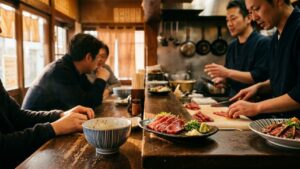
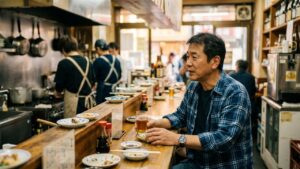
Nagoya's food culture has always rewarded individual exploration. Counter seats are common, lunch menus are clearly structured, and the city's compact subway system means you can move between Osu, Sakae, and the castle district without feeling like you are running a marathon. Unlike Tokyo's relentless pace or Kyoto's scripted tourist trail, Nagoya feels like a city that lets you set your own tempo — and eat on your own terms.
If you are curious about how Nagoya fits into a broader Japan food itinerary, this guide on why wagyu fans are adding Nagoya to their bucket list gives a useful overview of what the city offers that Tokyo and Osaka simply cannot replicate.
The food safety question about rare wagyu is one that keeps coming up — and the answer deserves more than a single paragraph. Our monthly business calendar and any irregular closures for October are posted directly on our official Instagram, so you can plan your visit with accurate, up-to-date information before committing to a day.
2. The Real Question: Is Rare Wagyu Safe to Eat?
Let us answer this directly, because it is the question that stops many Western visitors from booking.
In the United States, the UK, Australia, and much of Europe, public health authorities advise against consuming undercooked beef — for good reason. E. coli and salmonella risks associated with raw or near-raw beef are well documented, and most travelers carry that caution with them when they travel.
So when they see 「レアわぎゅう牛丼」 — rare wagyu gyudon — on a Japanese restaurant menu, the instinct is: wait, is this actually raw?
Here is what is important to understand. At Itadaki, the beef is not served raw. Our signature dish is prepared using a proprietary two-stage cooking technique developed by founder Masayuki Goto, which heats the beef to over 70°C at the core. That threshold fully meets Japan's Ministry of Health, Labour and Welfare food safety standards — the same rigorous regulatory framework that governs Japan's entire food service industry.
What the technique preserves is the texture — a tender, almost silky mouthfeel that feels like a rare preparation but is not one by any food safety definition. It is a genuine technical achievement, developed over years of refinement, and it is why Itadaki has been recognized as the originator of the 「Rare Wagyu Gyudon」 culinary concept by eight major Japanese television programs, including NHK.
Goto himself holds a Certified Food Sanitation Supervisor qualification from Japan's Ministry of Health, Labour and Welfare, and the restaurant operates under a Licensed Restaurant Operator permit from the Aichi Prefecture Public Health Center. The safety is not incidental — it is foundational to everything Itadaki does.
3. The Beef Itself: Why Horai Wagyu Is a Different Conversation
Beyond the cooking technique, the source of the beef matters enormously.
Itadaki sources from two Aichi Prefecture wagyu producers: Mikawa Beef, which is always available, and Horai Wagyu — limited to just 10 bowls every day. Horai Wagyu is raised in Okumikawa, in the mountains of Aichi, across only three farms in Japan. Just 300 heads are produced annually. For context: Japan raises approximately 500,000 wagyu cattle per year. Horai Wagyu represents 300 of them.
What makes these cattle distinctive is their feed. Horai Wagyu are raised on the lees of Horaisen Sora, a renowned premium sake from the same mountain region. This creates a beef with an unusual balance — lighter marbling than Kobe, but with a clean, layered flavor that stands on its own without rich fat to carry it.
Goto's direct sourcing partnership with these farms began during the COVID-19 pandemic, when small Aichi producers were struggling with unsold harvests. Itadaki was conceived, in part, as a permanent solution to that problem: a restaurant built entirely on farm-to-table relationships with Aichi Prefecture producers — beef, rice, eggs, sauce base, pickles, and even the beverages on the menu.
✓ Key Takeaways
- Itadaki's rare-style wagyu is cooked to over 70°C at the core — fully meeting Japan's food safety standards. The 「rare」 refers to texture, not temperature.
- Horai Wagyu is produced by only 3 farms in Japan, with just 300 heads annually — making it one of Japan's most genuinely scarce wagyu breeds, not a marketing claim.
- Every ingredient at Itadaki — beef, rice, eggs, sauce, pickles — comes from Aichi Prefecture, creating a coherent 「taste of Aichi」 experience in a single bowl.
Now that you know the two-stage cooking technique fully meets Japan's food safety standards, the practical next step is making sure the Horai Wagyu bowl is actually waiting for you — not sold out. Only 10 bowls are available each day, and October Sundays fill quickly. Reservation through Tabelog takes just a few minutes and secures your bowl in advance.
4. Solo Dining Here Is Genuinely Comfortable
Itadaki has 18 seats in total, including 5 counter seats that are ideal for solo diners. The atmosphere is calm rather than rushed — lunch service runs from 11:00 to 15:00 (last order 30 minutes before closing), so there is no pressure to clear the table quickly.
The menu is available in English, Simplified Chinese, and Korean, and includes a photographic five-step guide that walks you through how to enjoy the dish — separate the Nagoya Cochin egg white into the miso soup, rest the yolk atop the beef, taste the wagyu first in its purest form, then gradually layer in the condiments on the table. It is a designed eating journey, not a rushed bowl of rice.
Staff have welcomed solo diners, couples, families, and visitors in cosplay from the nearby Osu district with equal warmth. You do not need to speak Japanese. You do not need to be a wagyu expert. The dish — and the five-step guide — does the explaining for you.
「Instagram-worthy presentation and unforgettable taste. My followers keep asking about it.」
A visitor who discovered Itadaki during their Nagoya stay
That reaction is not unusual. The visual presentation — vibrant shiso leaves, a golden Nagoya Cochin yolk resting on the beef, traditional Japanese ceramic serving ware — makes the dish genuinely photogenic. But it is the story behind the bowl that gives people something real to share: the 300-head-per-year figure, the sake lees feed, the two-stage cooking technique. That combination of visual and narrative is why guests tell their friends, and why those friends eventually find their way to Osu.
5. October in Osu: The Right Time to Explore
Itadaki sits in the Osu district of Naka-ku, Nagoya — one of the city's most layered and interesting neighborhoods. October brings a comfortable cool to the streets, making it one of the better months to walk the 1,200-shop Osu Shopping Street, stop at Osu Kannon Temple, and wander without a fixed agenda.
Three minutes from Yabacho Station (the same station as Itadaki) is Hisaya-odori Garden Flarie, a free-admission urban garden with themed sections including a European-style Harmony Garden and a Crystal Garden greenhouse. It is the kind of quiet, beautiful stop that pairs naturally with a long lunch — arrive, walk the garden, then head to Itadaki for the Shinkoccho (the standard-size Horai Wagyu bowl, 100g beef, 200g rice, ¥2,700 tax included, limited to 10 bowls per day).
If you are visiting Nagoya this October as part of a broader itinerary that includes Gifu or the mountains, this Osu district food guide for sightseeing visitors outlines how to structure a day that covers both the neighborhood and a proper lunch without feeling rushed.
6. The Practical Details Solo Travelers Actually Need
A few things worth knowing before you go:
Access: Itadaki is on the 2nd floor at 4-1-20 Osu, Naka-ku — a 4-minute walk from Yabacho Station Exit 4 on the Meijo Subway Line. From Nagoya Station, take the Higashiyama Line to Sakae, transfer to the Meijo Line, and get off at Yabacho. Total journey: approximately 10 minutes.
Open days: Saturday, Sunday, Monday, and Tuesday, 11:00–15:00. Closed Wednesday through Friday. On public holidays: 09:00–15:00. October 4 (Sunday) is a regular business day — Itadaki will be open from 11:00.
Reservations: Walk-ins are welcome, but the Horai Wagyu is limited to 10 bowls per day and can sell out during peak hours. Reservation via Tabelog is recommended if you want to secure it. The monthly business calendar — including any irregular closures — is posted on the official Instagram.
Payment: Credit cards, Apple Pay, and Google Pay are all accepted.
7. A Culinary Discovery Worth Telling People About
There is a specific kind of meal that solo travelers remember long after the trip ends — not necessarily the most expensive one, or the most famous one, but the one that surprised them. The one where the story behind the dish was as interesting as the dish itself.
Itadaki was built precisely for that kind of encounter. Goto's philosophy — reflected in the restaurant's name, which comes from itadakimasu, Japan's pre-meal expression of gratitude — is that every ingredient in the bowl deserves respect: the farmers who raised the cattle, the rice growers, the egg producer, the miso makers of Okazaki. That philosophy shapes everything from the sourcing decisions to the way the five-step eating guide is written.
You do not need to arrive knowing all of this. But most guests leave knowing it — and that is exactly the point.
For our complete menu, access details, and store information, visit our official page at https://itadaki8.com/english/
You came here wondering whether rare wagyu was actually safe to eat — and the answer is yes, with a technique and a food safety standard behind it that no other gyudon restaurant offers. The Horai Wagyu bowl is limited to 10 per day, and the best way to make sure October 4 becomes the lunch you tell people about is to reserve your seat now on Tabelog.