How Do I Eat Rare Wagyu Bowl the Right Way at Itadaki?
 gotowp
You've found what looks like an incredible wagyu restaurant in Nagoya — the kind of place you wouldn't want to miss. But then the doubt creeps in: Will I be able to order without Japanese? What if I don't know how to eat the dish? What if I ask a question and no one understands me? That hesitation is real, and it stops a lot of visitors from walking through the door of some of the most memorable restaurants in Japan.
At Itadaki in Osu, Nagoya, we designed the entire guest experience with that exact worry in mind. Here's what you actually need to know before you arrive — step by step, language barrier and all.
Who This Is For
- ✅ International visitors worried about ordering at a Japanese specialty restaurant without speaking Japanese
- ✅ First-time visitors to Itadaki who want to know exactly what to expect when they sit down
- ✅ Travelers curious about the 5-step eating guide and how it works in practice
- ✅ Anyone wondering whether a translation app is enough, or whether a printed English menu is actually available
- ✅ Visitors who want to know how to ask about allergens or special requests without causing confusion
Is There an English Menu at Itadaki?
Yes — and it goes well beyond a basic translation. Itadaki's printed menu is available in English, Simplified Chinese, and Korean, and it was designed specifically so that a visitor with zero Japanese can walk in, sit down, and order with complete confidence.
Each item on the menu comes with a clear photo, the price (tax included), and a description of the main ingredients. You don't need to guess what "Shinkoccho" means or wonder what comes with the bowl — the menu tells you. If you'd like to add a side dish, adjust the rice portion, or remove the egg due to an allergy, all of that is laid out clearly in English so you can simply point at the page and communicate your choice without any Japanese at all.
We designed it this way because we believe language should never be the reason someone misses out on a genuine Nagoya culinary experience. Our staff is welcoming to international visitors, and translation apps work perfectly well in the restaurant if a more specific conversation comes up.
You now know the eating guide exists — but whether the Horai Wagyu bowls are still available on the day you plan to visit is a different question. Our monthly business calendar (including irregular closures) is updated regularly on Instagram, so you can check before committing your lunch plans. Takes less than a minute to look up.
What Is the 5-Step Eating Guide, and Why Does It Matter?
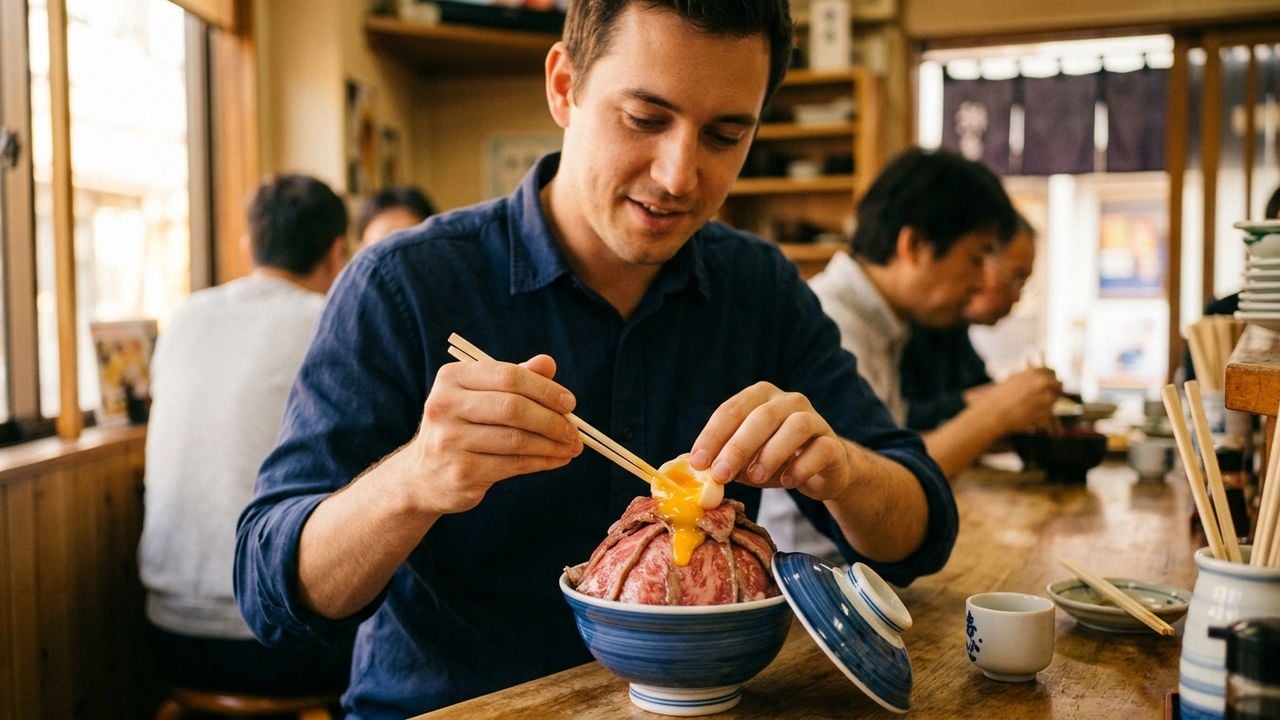
Rare wagyu gyudon is not something most visitors have encountered before. Even guests who have eaten plenty of wagyu across Japan — Kobe, Matsusaka, Omi — find themselves pausing when the bowl arrives at Itadaki. The dish has a raw egg resting on top of the beef, a row of small condiment jars on the table, and a specific logic to how everything fits together. Without guidance, it can feel overwhelming.
That's why our printed menu includes a visual step-by-step section titled How to Enjoy Rare Gyudon. It walks you through five deliberate stages:
- Separate the egg. Slide the egg white into the miso soup — it adds a soft, silky texture to the broth. Place the golden yolk directly on top of the beef.
- Taste the wagyu first, on its own. Before mixing anything, take a bite of the rare-style beef with rice and let the natural flavor of Horai Wagyu speak for itself. This is the moment the dish is designed around.
- Break the yolk and mix it in. The rich Nagoya Cochin egg yolk coats the wagyu and rice, shifting the flavor into something richer and more layered.
- Add the tabletop condiments. Pickled ginger, chopped seaweed from Mikawa Bay, chirimen jako (dried whitebait), and Itadaki's original 8-spice blend are all there to explore. Add them gradually — each changes the character of the bowl.
- Finish with wasabi. A small amount of Itadaki's original wasabi at the end resets the palate and leaves a clean, refreshing note.
Every one of these steps is illustrated in the English menu with photos. You don't need to memorize anything in advance. The guide is right there on the table.
✓ Key Takeaways
- Itadaki's fully printed menu is available in English, Simplified Chinese, and Korean — no Japanese required to order.
- The menu includes a visual 5-step guide for exactly how to eat rare wagyu gyudon, so you'll never be left guessing.
- Translation apps are equally welcome in the restaurant, and staff are warm and patient with international guests.
The 5-step guide takes the guesswork out of eating the bowl — but the Horai Wagyu itself is limited to 10 bowls a day, and it does sell out during peak hours. Securing your seat in advance means you won't arrive to find it's already gone. Reservation is made through Tabelog online.
How Do I Ask About Allergens or Special Requests?
This is one of the most common concerns we hear from international visitors, and it's worth being direct about. Here's what we can tell you honestly:
The most common allergens in our dishes are soy (in the soy sauce, miso, and Atsumi Ichō-zuke pickles), wheat (also in the soy sauce), and egg (the Nagoya Cochin egg, which can be removed at −¥150 per bowl). The tabletop chirimen (dried whitebait) topping contains sesame — if you have a sesame allergy, please simply avoid that particular condiment. Our original 8-spice blend does not contain sesame.
For guests with severe allergies, we recommend noting this when making a reservation via Tabelog, so our team can be aware before you arrive. Because Itadaki operates in a small kitchen environment, cross-contamination cannot be fully guaranteed — we want you to have that information clearly so you can make the right decision for your needs.
Itadaki is a wagyu specialty restaurant, so full vegetarian, vegan, or Halal options are not available. If you have questions beyond what the menu covers, a translation app works well at the counter, and our staff will do their best to respond helpfully.
"The English menu with clear serving instructions made the experience stress-free."
— A visitor to Itadaki, Osu, Nagoya
What Happens When I Actually Sit Down?
When you arrive at Itadaki on the 2nd floor of a building on Osu's main street (a 4-minute walk from Yabacho Station Exit 4 on the Meijo Subway Line), you'll find 18 seats spread across comfortable sofa-style tables and a counter. The atmosphere is unhurried — this is a lunch-only restaurant, open Tuesday and Monday, Saturday and Sunday, and on public holidays, so there's no evening rush here.
You'll be handed the multilingual menu as soon as you're seated. Take your time with it. Point at what you'd like, and the staff will confirm your order. If you want to add a side dish — the Teppen wagyu plate (50g, ¥800) is worth it if you'd like to taste the same Horai Wagyu prepared with a different cutting and searing approach — you can indicate that by pointing at the relevant item on the menu.
When the bowl arrives, open the menu to the eating guide section and follow it at your own pace. There's no pressure to rush. The sofa seating is genuinely comfortable, the condiment jars are easy to identify from the photos, and the miso soup is already portioned for the egg white.
One practical note: if you want to try the Horai Wagyu version (limited to 10 bowls per day), it's worth making a reservation in advance via Tabelog. The story of why Horai Wagyu is limited to just 10 bowls a day goes deeper than most visitors expect — only 300 heads are raised annually across three farms in Japan, fed on sake lees from the renowned local sake Horaisen Sora. During peak hours, these bowls can sell out before lunchtime ends.
For guests visiting Nagoya as part of a broader trip — perhaps stopping in the city before heading to Shirakawa-go or Takayama the following day, or spending a morning at Hisaya-odori Garden Flarie (just a 3-minute walk from Yabacho Station) — Itadaki fits naturally into a relaxed sightseeing lunch. If you're curious about how the gyudon concept came to exist in the first place, the complete story behind Itadaki's founding is worth reading before your visit.
Do I Need Japanese to Have a Great Experience at Itadaki?
No. That's the straightforward answer. The multilingual menu, the visual eating guide, the clearly priced à la carte options, and the welcoming approach of our team are all there precisely so that language is never the deciding factor between a visitor having a memorable experience or settling for something familiar.
What does matter is arriving with a little curiosity and a willingness to follow the five steps. The dish unfolds differently from what most visitors expect — it's not something you pour soy sauce over and eat quickly. It has a pace to it, a sequence, and a reason behind each stage. The eating guide in the English menu gives you all of that context without needing to ask a single question in Japanese.
Itadaki is open for lunch only (11:00–15:00 on Monday, Tuesday, Saturday, and Sunday; 9:00–15:00 on public holidays). Last order is 30 minutes before closing, and irregular closures can apply — the monthly business calendar is posted on our official Instagram. If your schedule is flexible enough to plan around, a reservation makes the experience noticeably smoother, particularly for Horai Wagyu.
For our complete menu, access details, and store information, visit our official page at https://itadaki8.com/english/.
You've seen how the multilingual menu and 5-step guide are designed to make this experience fully accessible without any Japanese — the next step is actually sitting down at that sofa table with the bowl in front of you. Reservations for the Horai Wagyu (10 bowls per day) are accepted via Tabelog, and it takes only a moment to book.