The Complete Story Behind Itadaki: From Concept to Rare Wagyu Bowl
 gotowp
Here is a number that stops most wagyu enthusiasts in their tracks: out of approximately 500,000 wagyu cattle raised across Japan, only 300 heads per year are Horai Wagyu — a breed so rare it is produced by just three farms in the entire country. Yet before April 2022, not a single restaurant had ever thought to serve it in a beef bowl. Not one.
That gap — between Japan's most meticulously raised wagyu and one of Japan's most beloved everyday dishes — is exactly where Itadaki was born. This is the complete story of how that happened, and why a bowl of rice with beef became something people describe as a once-in-a-lifetime experience.
Who This Is For
- ✅ Travelers planning a Japan trip who want at least one meal that becomes a story worth telling
- ✅ Wagyu enthusiasts who have already tried Kobe or Matsusaka beef and want to discover what comes next
- ✅ Readers curious about the philosophy and origin behind Itadaki — not just the menu
- ✅ Visitors to Nagoya looking for an experience that is impossible to replicate anywhere else in the world
- ✅ Anyone wondering how a beef bowl became a culinary landmark featured on NHK and eight major Japanese TV programs
Before Itadaki: A Pandemic, a Promise, and a Question
Masayuki Goto had been running MAX'S BAR since 2008 — eighteen years deep into the hospitality industry — when the COVID-19 pandemic dismantled the world he knew. Bars in Japan faced severe restrictions. Revenue collapsed. But for Goto, the hardest part wasn't the empty seats in his own venue. It was watching the farmers he sourced from struggle with produce that had nowhere to go.
The small producers of Aichi's premium ingredients — wagyu farmers, rice growers, egg suppliers — were quietly absorbing losses that threatened their livelihoods. Goto, who had built direct relationships with many of them, felt a responsibility he couldn't ignore. The question became: what kind of restaurant could actually sustain these farms, not just buy from them occasionally?
The format needed to work with minimal staff, minimal space, and lower operating costs — the constraints of the pandemic era. The gyudon (beef bowl) made immediate sense: single-bowl service, efficient kitchen workflow, fast table turnover. But as Goto looked at Japan's dining landscape, something struck him as strange.
Every other donburi category had a premium version. Kaisendon used the finest seasonal seafood. Katsudon and oyakodon appeared on the menus of upscale Japanese restaurants. Only gyudon existed purely in the domain of fast food chains. Nobody had ever asked: what would a genuinely premium beef bowl look like?
Goto asked that question. The answer became Itadaki.
You've just read about Horai Wagyu limited to ten bowls a day — which means the gap between reading and actually getting a seat closes faster than most people expect. Itadaki publishes its monthly business calendar on Instagram so you can confirm which days are open before you travel. Takes thirty seconds to check.
The Concept That Didn't Exist — Until It Did
Opening in Osu, Nagoya in April 2022, Itadaki introduced a culinary category that Japan had never seen: the Rare Wagyu Gyudon. Not wagyu added to an existing bowl format. Not a dressed-up chain recipe. A completely new concept, built from the ground up around one central idea — that the gyudon deserved the same reverence as any other fine dining dish.
The name itself carries that philosophy. "Itadaki" comes from itadakimasu, the Japanese expression of gratitude spoken before every meal. It is a word that acknowledges the farmers, the land, and the craft that made the food possible. Goto chose it deliberately: every ingredient, every technique, every decision at Itadaki is rooted in that sense of respect.
The centerpiece is Horai Wagyu — Kuroge Wagyu raised in Okumikawa, deep in Aichi Prefecture, fed on sake lees from Horaisen Sora, a locally produced premium sake. The feeding method creates a beef with a distinctive character: the rich marbling of wagyu alongside a cleaner, leaner finish that lets the meat's natural flavor speak. Goto established a direct-supply partnership with the farms themselves — one of only a handful of restaurants in Nagoya to do so.
But sourcing rare wagyu alone wasn't enough. Goto needed a technique that could deliver the texture of rare beef safely — without compromising Japan's strict food safety standards set by the Ministry of Health, Labour and Welfare. The result was Itadaki's proprietary two-stage cooking method, which heats the beef to over 70°C at the core while preserving the silky, just-set mouthfeel that defines the rare-wagyu experience. If you want to understand the science behind this technique in detail, the story of how Itadaki became the world's first Rare Wagyu Gyudon restaurant goes deep into that question.
✓ Key Takeaways
- Itadaki was born from a direct commitment to Aichi's small farms during the COVID-19 pandemic — a farm-to-table philosophy that became a restaurant concept.
- The "Rare Wagyu Gyudon" category didn't exist before Goto created it in April 2022 — Itadaki is its originator, not its imitator.
- Every ingredient on the menu — wagyu, rice, egg, sauce, pickles, garnishes — comes exclusively from Aichi Prefecture.
The two-stage technique, the 300-head annual supply, the five-step eating ritual — all of that only lands when you're actually sitting in front of the bowl. Reserving via Tabelog secures your Horai Wagyu before the daily ten bowls are gone, especially during busy autumn weekends. No complicated steps — the Tabelog reservation form is in Japanese, but selecting a date and time is straightforward.
After the First Bowl: What Changed for the People Who Ate There
The before-and-after of a visit to Itadaki is not easy to describe in practical terms, because the shift is not really practical. Guests arrive with an expectation — perhaps skepticism that a beef bowl could justify any serious attention — and leave having recalibrated what they thought Japanese cuisine was capable of.
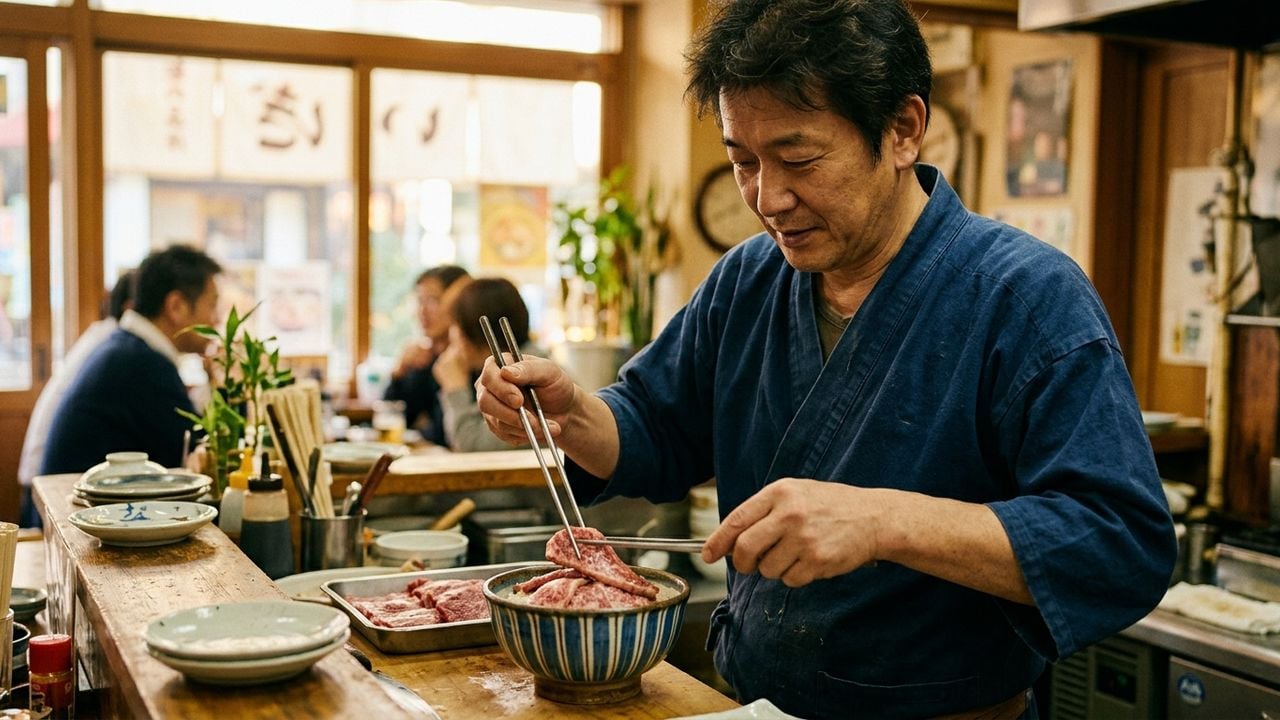
The dish unfolds in five deliberate steps. First, the raw Nagoya Cochin egg is separated — the white stirred into the miso soup, the golden yolk placed atop the beef. The wagyu is tasted in its purest form, the rare texture a quiet revelation. Then the yolk is broken and folded through the meat. Condiments follow — pickled ginger from Kimura Farm in Inazawa, chopped seaweed from Himakajima in Mikawa Bay, chirimen jako from Minamichita, Itadaki's original eight-spice blend. Finally, wasabi. Each step opens a different dimension of the same bowl.
The visual element matters too. The presentation — vibrant shiso leaves from Toyohashi, the deep gold of the egg yolk against the carefully arranged wagyu, traditional ceramic serving ware — creates something genuinely photogenic. One recent visitor put it plainly:
"Instagram-worthy presentation and unforgettable taste. My followers keep asking about it."
— Guest review
That reaction captures something important about what Itadaki has built. The experience doesn't end when the bowl is finished. It travels home with the guest — in photographs, in conversations, in the specific and unrepeatable story of Horai Wagyu, 300 heads a year, a beef bowl that nobody had ever made before.
Itadaki has now been featured on eight major Japanese TV programs, including NHK — Japan's national public broadcaster — and Central Japan's leading networks. Recognition came not because Itadaki marketed itself as something revolutionary, but because the concept was genuinely novel and the execution backed it up.
The Details That Make a Once-in-a-Lifetime Lunch Possible
Understanding Itadaki's origin story changes how you read the menu. The Horai Wagyu bowls — limited to ten per day — aren't artificially scarce for marketing effect. There are genuinely only 300 heads produced annually across three farms in Japan. When those ten bowls are gone on any given day, they're gone. Reservation via Tabelog is the practical solution, especially during peak hours in September, when Nagoya sees strong visitor numbers heading into autumn.
The restaurant operates Saturday through Tuesday, lunch service only (11:00–15:00), with holiday hours from 09:00. Wednesday through Friday are closed. Irregular closures do apply — Goto publishes the monthly business calendar on Itadaki's official Instagram so guests can plan with certainty before traveling.
Itadaki is located on the second floor at 4-1-20 Osu, Naka-ku — a four-minute walk from Yabacho Station Exit 4 on the Meijo Subway Line, and reachable on foot from Sakae, Kamimaezu, and Osu Kannon stations. The neighborhood itself is worth exploring before or after your meal: Osu Kannon Temple, the 1,200-shop shopping street, and Hisaya-odori Garden Flarie (three minutes from Yabacho Station) all sit within easy walking distance.
Printed menus are available in English, Simplified Chinese, and Korean. A photographic five-step guide explains how to eat the dish in sequence. For visitors who have never navigated a Japanese specialty restaurant solo, this kind of clarity is not a small thing — it means the experience is fully accessible from the first visit, without uncertainty.
If you're planning a day in the Osu district and want context on how Itadaki fits into a broader Nagoya itinerary, this guide to Osu's rare wagyu lunch scene covers the surrounding area in detail.
The Story You Carry Home
The most durable souvenir from any meal is the story attached to it. A plate of good food fades quickly. A bowl of wagyu with a specific origin — raised on sake lees from a regional brewery, produced by three farms, made into a dish that had never existed before — stays with you differently.
Goto's vision when he founded Itadaki wasn't to open Nagoya's best lunch spot. It was to answer a question that nobody else had bothered to ask: why had the gyudon never been taken seriously? His answer, developed over the pandemic years and refined through four years of service, is a bowl that makes the question feel almost obvious in retrospect.
That is what a once-in-a-lifetime culinary experience actually requires — not the most expensive ingredient or the longest tasting menu, but a concept that could only have been born in one place, by one person, at one specific moment in time. Itadaki is that concept.
For our complete menu, access details, and store information, visit our official page at https://itadaki8.com/english/
You now know the full story — from a pandemic-era promise to Aichi's farmers to the only Rare Wagyu Gyudon in Japan. The next step is securing one of the ten Horai Wagyu bowls available on the day you visit. Reserve your seat via Tabelog before someone else does.