Behind the Scenes: The Craft Behind Rare Wagyu Preparation
 gotowp
You're scrolling through your Japan itinerary and you pause. You've already lined up Fushimi Inari in Kyoto, teamLab in Tokyo, and Dotonbori in Osaka — all beautiful, all well-documented. But somewhere in the back of your mind is a quiet question: Is there something I haven't seen yet? Something my followers haven't seen a hundred times before?
That feeling brought a lot of our guests through the door at Itadaki. And what they found — both on the plate and in the story behind it — became the kind of travel moment that outlasts the trip itself.
I'm Masayuki Goto, founder of Itadaki in Osu, Nagoya. I opened this restaurant in April 2022 with a simple conviction: that a beef bowl could be a once-in-a-lifetime culinary experience. Today, I want to take you behind the counter and show you what actually goes into each bowl — not the technique explained in a vacuum, but the full texture of craft, ingredient, and intention that makes this dish worth sharing.
Who This Is For
- ✅ Travelers who want their Japan food story to be genuinely different from the posts they've already seen
- ✅ Visitors curious about what makes Horai Wagyu so rare — and how it ends up in a beef bowl in Osu
- ✅ Anyone who has wondered what a restaurant founder actually thinks about while building a new culinary concept
- ✅ Foodies who appreciate the difference between a dish that looks good and a dish that has something to say
- ✅ Guests heading to or from Shirakawa-go, Takayama, or exploring Nagoya's Osu district and looking for a lunch that earns its place in the itinerary
Why a Beef Bowl? The Question That Started Everything
When I was thinking through what to build after the pandemic upended MAX'S BAR, I kept returning to one observation that nobody in the food industry seemed to talk about. Think about Japan's iconic donburi dishes — katsudon, oyakodon, kaisendon. Each of them has a premium version. A high-end katsudon using kurobuta pork. A kaisendon built entirely on premium sashimi. But gyudon? Everyone knew it as fast food from a chain. There was no elevated version. No one had tried.
That gap felt less like a problem and more like an open door.
At the same time, I was watching farmers I'd sourced from for years — small producers of Aichi's finest ingredients — struggle with unsold stock during the pandemic. Premium local wagyu going unserved. Eggs from rare Nagoya Cochin chickens with nowhere to go. I didn't want to simply help them once; I wanted to build something that would keep supporting them long-term. A restaurant that made their ingredients the story, not just the ingredient list.
That's what became Itadaki. The name itself comes from itadakimasu — the phrase Japanese people say before eating, a quiet expression of gratitude to farmers, land, and craft. It's our philosophy in a single word.
If you want the full origin story, I've written about the complete journey from concept to rare wagyu bowl — from the pandemic turning point through to opening day in Osu.
If you're working out which days Itadaki is open before building your Nagoya itinerary, business hours follow a scheduled calendar that changes monthly. Our Instagram shows the current month's confirmed open days — including any irregular closures — so you can plan around a Horai Wagyu bowl with confidence. Takes about thirty seconds to check.
The Ingredient That Makes the Story Instagram-Proof
Before anything else, the starting point is the beef itself — and this is where the story gets genuinely unusual.
Horai Wagyu is raised in the Okumikawa mountains of Aichi Prefecture. Only three farms in Japan produce it. Total annual production: approximately 300 heads. To put that in context, Japan raises roughly 500,000 wagyu cattle each year. Horai Wagyu represents a fraction of a fraction.
What makes this particular wagyu distinctive isn't just scarcity. It's the feeding method. The cattle are raised on sake lees from Horaisen Sora — one of Aichi's most celebrated sake breweries — which gives the beef a flavor profile unlike anything in the standard wagyu catalog. It's not about heavy marbling. It's about the balance between fat and lean, a kind of clarity in the flavor that surprises even guests who have tried Kobe or Matsusaka before.
One guest put it simply: "I've had Kobe beef and Matsusaka beef, but Horai Wagyu at Itadaki was on another level." That's not marketing. That's a flavor experience that's earned, starting from how the animal was raised.
Because availability is genuinely limited — we serve Horai Wagyu in a maximum of 10 bowls per day — the ingredient carries its own narrative weight. When you tell your friends back home that you ate something produced by only 3 farms in all of Japan, that's not a number you need to explain. It explains itself.
What "Rare" Actually Means — and Why It Matters for Your Story
Here's where a lot of visitors have questions, and I think it's worth being direct.
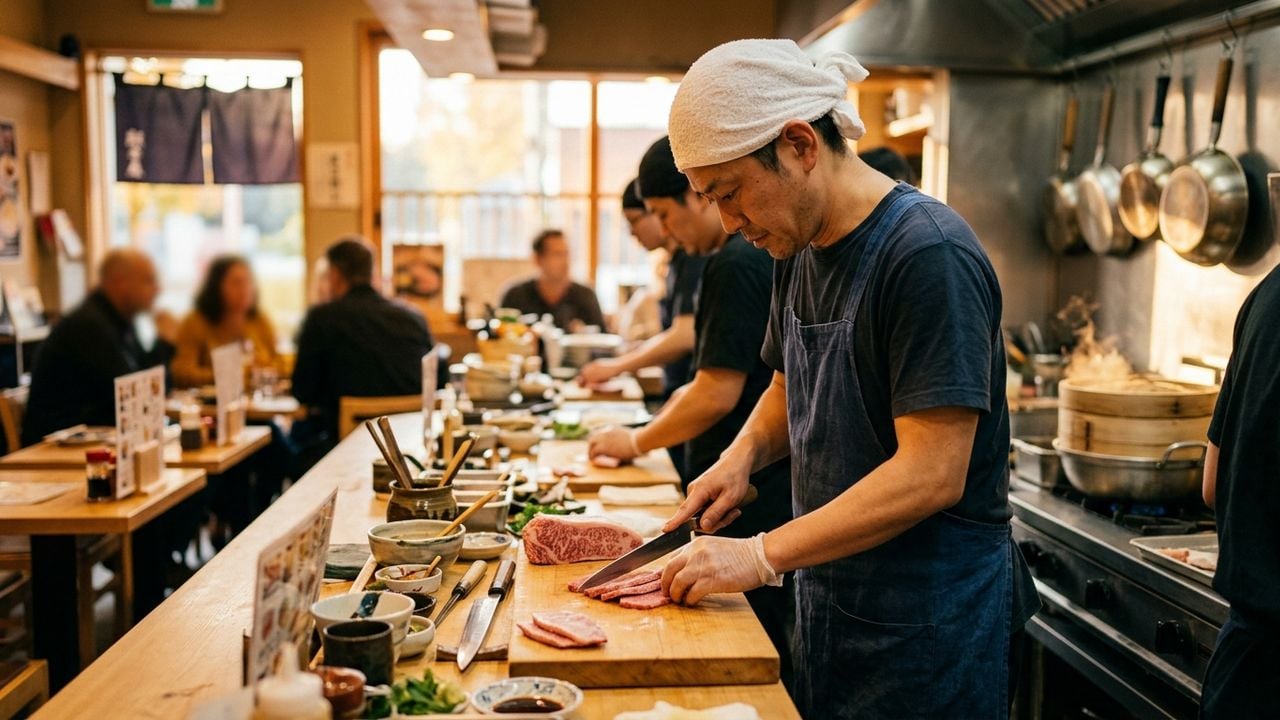
Serving beef in a rare-style preparation in a restaurant in Japan requires meeting strict food safety standards set by the Ministry of Health, Labour and Welfare. These are not suggestions — they are enforceable regulations, and for good reason. As a Certified Food Sanitation Supervisor, I take this seriously. The signature texture of Itadaki's gyudon is not achieved by serving undercooked beef. It's achieved through a proprietary two-stage cooking method that brings the core temperature of the beef above 70°C — fully meeting Japan's safety requirements — while preserving a texture that reads, to the palate, as rare.
That technical achievement took real development time. It's difficult to replicate, and it's one of the things that defines Itadaki as a concept rather than just a restaurant. If you're curious about how the technique works in detail, I've written about the science behind safe rare wagyu preparation — including how we built the process from scratch.
For the purposes of your travel story: you can eat this dish comfortably and confidently, and then describe it to your followers as a "rare-style wagyu gyudon" — because that's exactly what it is.
✓ Key Takeaways
- Horai Wagyu is produced by only 3 farms in Japan — roughly 300 heads per year out of 500,000 total — and its distinctive flavor comes from a sake lees feeding method unique to Aichi's Okumikawa mountains.
- The "rare" texture at Itadaki is the result of a proprietary two-stage cooking technique that fully meets Japan's food safety standards — not a compromise on safety.
- Every single ingredient at Itadaki, from the rice to the egg to the pickles, comes from Aichi Prefecture — creating a coherent story of place, not just a collection of premium parts.
You've just read that Horai Wagyu is limited to 10 bowls per day — and that it does sell out during peak hours. Knowing the story is one thing; actually getting the bowl is another. A Tabelog reservation locks in your spot before you arrive in Osu, so the only thing left to do is show up and eat.
The Bowl as a Whole: What Your Followers Will Actually See
A dish can have an extraordinary story and still arrive at the table looking ordinary. Itadaki's gyudon is not that.
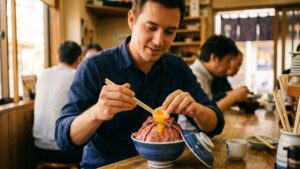
The presentation arrives in a traditional Japanese ceramic bowl. The rare wagyu is arranged across the rice, naturally marbled, with a raw Nagoya Cochin egg yolk resting on top — golden, still whole, waiting to be broken. Shiso leaves add a sweep of green. The contrast of colors — the deep brown of the beef, the amber yolk, the white of the rice beneath, the purple-green shiso — photographs the way food photographs when no one has tried to make it photogenic. It just is.
The five-step eating guide that comes with every bowl adds another layer to the story you can tell. You start by separating the egg: white into the miso soup, yolk onto the beef. You eat the wagyu first, in its purest form, before adding anything. Then you introduce the yolk, then the condiments — pickled ginger from Inazawa, dried seaweed from Mikawa Bay, chirimen jako from Minamichita. The final step is wasabi. Each stage is a new experience within the same bowl.
Guests consistently find that this structure gives them something to narrate — not just something to photograph. As one visitor noted: "The five-step eating guide made the dish even more enjoyable and memorable."
"The staff were welcoming and made us feel at home even without perfect Japanese."
— A guest at Itadaki, Osu, Nagoya
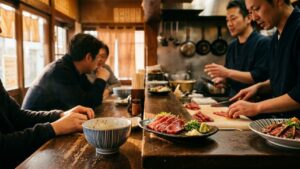
That comment means a lot to me, because creating a comfortable environment for international guests — people navigating a language they may not speak, in a city they may not know — is something we work at deliberately. Printed menus in English, Simplified Chinese, and Korean. A photographic eating guide. Staff who will gesture and smile their way through any question. Authenticity doesn't require fluency on either side of the counter.
Goto's Recommended Spots in Nagoya — Where Craft Lives Outside the Kitchen
Because this restaurant exists in Osu, and because Osu is a district with genuine character, I want to share a few places that have shaped my sense of what good craft looks like — in and out of food.
Shikemichi (四間道) — This preserved Edo-period merchant district near Nagoya Station is one of the city's most quietly spectacular corners. Three-hundred-year-old warehouses, cobblestone streets, and the rooftop shrines called Yanegami-sama that exist nowhere else in Japan. If you walk through Shikemichi, you start to understand why Nagoya's craftspeople — in pottery, sake, lacquerware — have the sensibility they do. The hidden cafés and restaurants inside restored merchant buildings have that same quality: unhurried, considered, specific to this place. I find myself thinking about Shikemichi when I think about what it means to build something with a sense of time and place.
IG Arena (Aichi International Arena) — On the other end of the spectrum, this is Nagoya's newest and most ambitious venue, designed by architect Kengo Kuma and opened in July 2025. I'm a basketball fan, so watching the Nagoya Diamond Dolphins play here has been something I've looked forward to since the project was announced. With the 2026 Asian Games confirmed here for basketball and judo events, the arena has quickly become the energy center of the city. The contrast between Shikemichi and IG Arena captures something real about Nagoya — it holds both the ancient and the forward-facing without forcing them to compete.
Both of these places, in different ways, are what Itadaki is trying to be: rooted in Aichi, honest about craft, and genuinely worth going out of your way to find.
For full details on our menu, access from Nagoya Station and the Osu area, and what to expect when you visit, the best place to start is our official English page at itadaki8.com/english/.
And if you're planning your visit around a specific date, a look behind the scenes at a typical day at Itadaki gives you a real sense of the rhythm of the place — including when Horai Wagyu tends to sell out.
Horai Wagyu is limited to 10 bowls per day. If you'd like to secure one, a reservation through Tabelog is the most reliable way to make sure it's waiting for you.
You came here looking for a Japan food story worth telling — and Horai Wagyu, produced by 3 farms, 300 heads a year, fed on sake lees in the Okumikawa mountains, is exactly that kind of story. The dish exists. The seat is available. The next step is securing it before the 10 daily Horai Wagyu bowls are spoken for.