7 Reasons Wagyu Fans Add Nagoya to Their Bucket List
 gotowp
You've done your research. You've read about Kobe beef, tasted Matsusaka, maybe even tracked down Omi. And then someone mentions "rare wagyu gyudon in Nagoya" — and your first reaction is hesitation. Rare? Like, undercooked? Is that actually safe?
I get it. That exact hesitation is what almost kept us from becoming what Itadaki is today — and it's a story worth telling honestly.
When I first started developing the concept that would become Itadaki back in 2021, I ran into a wall that had nothing to do with finding the right beef or perfecting the rice. The wall was trust. Even among Japanese diners, the idea of a "rare" beef bowl raised eyebrows. Outside Japan, among the Western visitors I hoped to welcome someday, I knew the reaction would be stronger. In the US and Europe, food safety guidelines explicitly discourage undercooked beef — and for good reason. E. coli, salmonella, the risks are real and the guidelines exist to protect people.
So I had two choices: abandon the "rare" concept and make something safer but ordinary, or solve the safety problem so completely that the question of risk would never need to be asked again. I chose the second path. It took months of testing, collaboration with our food safety team, and ultimately the development of what we now call our two-stage cooking technique. That process — the struggle to get it right — is woven into every bowl we serve.
This article is for wagyu enthusiasts who are genuinely curious about Nagoya, but who need to understand the "why" and "how" before they can feel comfortable saying yes. Here are 7 reasons serious wagyu fans are now adding Nagoya — and specifically Itadaki — to their bucket list.
Who This Is For
- ✅ Wagyu enthusiasts who have tried Kobe and Matsusaka and want to discover what comes next
- ✅ Travelers who have heard about "rare wagyu" but aren't sure if it's safe to eat
- ✅ Repeat visitors to Japan looking for an authentic experience beyond Tokyo and Kyoto
- ✅ Foodies who care deeply about sourcing, craft, and the story behind a dish
- ✅ Anyone planning a Nagoya stop and wondering whether the food scene is worth the detour
1. The Safety Question Has a Real, Verifiable Answer
Let's address this first, because everything else depends on it. Itadaki's rare wagyu is not raw beef. It is not served at an unsafe temperature. The two-stage cooking technique we developed heats the beef to over 70°C at the core — the threshold required by Japan's Ministry of Health, Labour and Welfare to ensure complete bacterial elimination. This is not a workaround or a loophole. It is full compliance with Japan's strictest national food safety standard.
What the technique achieves is a controlled texture: the exterior develops a light sear while the interior retains a silky, tender quality that feels rare to the palate without ever being microbiologically unsafe. Think of it as precision cooking taken to an extreme. The result is a sensation that has no equivalent anywhere else — not in a steakhouse, not in a sushi restaurant, not in any other gyudon you've ever eaten.
I hold a Certified Food Sanitation Supervisor qualification from Japan's Ministry of Health, Labour and Welfare, and Itadaki operates under a licensed restaurant permit from the Aichi Prefecture Public Health Center. The food safety framework is not background detail — it is the technical foundation that makes the entire experience possible.
You now know the two-stage technique heats the beef to over 70°C at the core — but whether Horai Wagyu will be available on the specific day you're planning to visit is a separate question entirely. Our monthly operating calendar, including any irregular closures around the Asian Games period, is posted there first. Takes less than a minute to check.
2. The Beef Itself Is Unlike Any Wagyu You've Encountered Before
Horai Wagyu is produced in the Okumikawa mountain region of Aichi Prefecture. Only 3 farms raise it. Only 300 heads are produced annually across all of Japan — out of approximately 500,000 wagyu cattle raised nationwide. Those numbers alone make it extraordinary. But what truly sets it apart is the feeding method: the cattle are raised on sake lees from Horaisen Sora, a premium local sake from the same region. The result is a beef with an unusually balanced character — present marbling, but with a clean lean-meat flavor that heavier marbled wagyu rarely delivers.
Itadaki is one of the very few restaurants in Nagoya with a direct sourcing partnership with these farms. We limit Horai Wagyu to 10 bowls per day — not as a marketing device, but because that is genuinely what responsible, fresh-daily sourcing at this scale looks like. If you've already explored the well-known wagyu brands, Horai is the discovery that changes your mental map of Japanese beef. If you want to explore why serious wagyu travelers now consider Itadaki a once-in-a-lifetime destination, the story of Horai is where it starts.
3. Nagoya Is Now a Destination in Its Own Right for Serious Food Travelers
For years, Nagoya was treated as a transit point on the Golden Route — a brief stop between Tokyo and Kyoto, if acknowledged at all. That is changing, and changing fast. Repeat visitors to Japan, particularly those who have already done the classic circuit multiple times, are discovering that Aichi Prefecture holds a depth of food culture that most tourists have never encountered. Hatcho miso from Okazaki. White soy sauce from Hekinan. Nagoya Cochin eggs raised by small poultry farms. These are not obscure ingredients — they are the foundations of a regional culinary identity that rivals anything in Japan's more famous food cities.
Itadaki exists specifically to put that identity into a single bowl. Every ingredient — rice, sauce base, egg, pickles, garnishes — comes from Aichi Prefecture. That level of regional coherence is rare even in Japan's fine dining world. The fact that it arrives as a gyudon, the most humble format in Japanese cuisine, is the point. Reinventing the ordinary without disrespecting it is harder than it sounds.
✓ Key Takeaways
- Itadaki's two-stage cooking technique heats beef to over 70°C at the core, fully meeting Japan's national food safety standards — the "rare" texture is a technical achievement, not a safety risk.
- Horai Wagyu is produced by only 3 farms in Japan with 300 heads annually; Itadaki sources directly from those farms and limits service to 10 bowls per day.
- Every ingredient at Itadaki comes from Aichi Prefecture — creating a fully cohesive regional food experience that serious food travelers are increasingly seeking out.
The five-step guide and the Horai sourcing story are compelling on the page — but the 10-bowl daily limit means the gap between "I want to try this" and "I actually got a bowl" comes down to timing. Reservations are handled through Tabelog online, and securing yours before arrival is the one practical step this article can't do for you.
4. The Dish Is Designed to Be Understood — Including by First-Timers
One of the early struggles I faced when developing Itadaki was realizing that the experience I was creating would be unfamiliar to most guests — not just foreign visitors, but many Japanese diners too. A rare-style beef bowl, served with a raw Nagoya Cochin egg, accompanied by white soy sauce, sake-lees-fed wagyu, and a table of Aichi condiments... without guidance, even a knowledgeable food lover might not know where to begin.
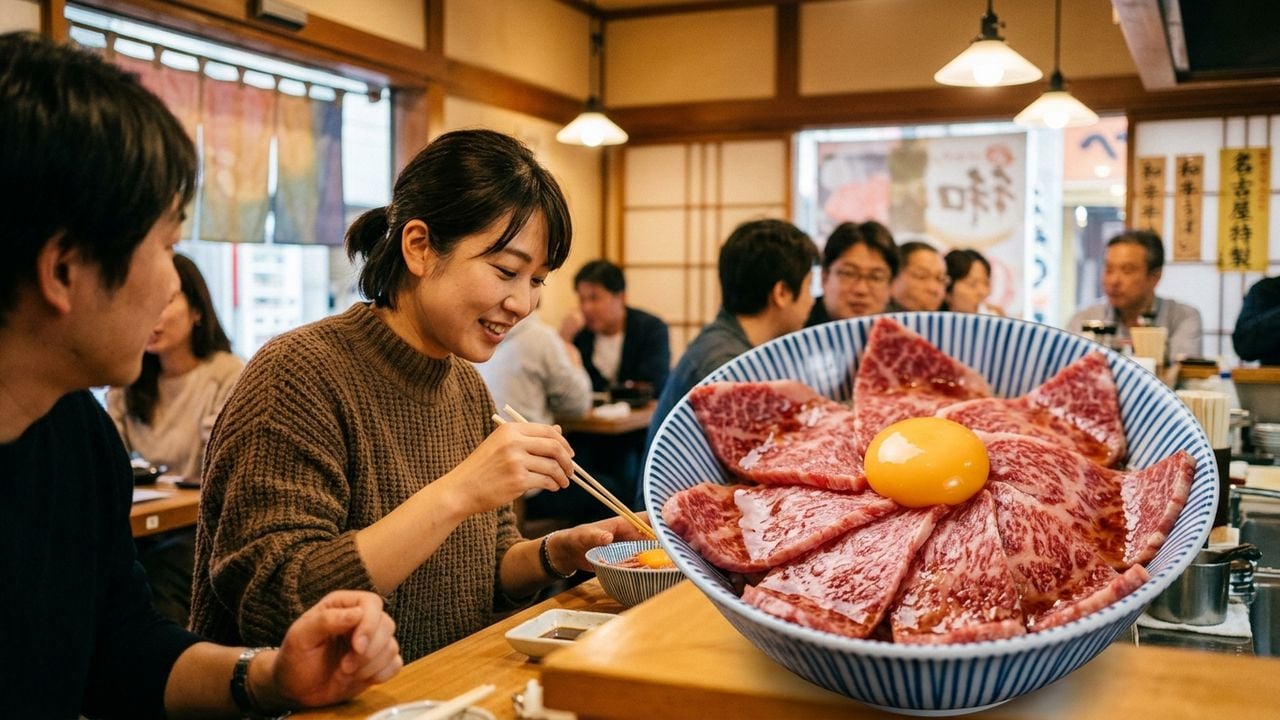
So we built a five-step guide into the dining experience itself. Step one: separate the egg — white into the miso soup, yolk onto the beef. Step two: taste the wagyu alone first, without anything else, to appreciate the texture and flavor of the Horai beef on its own terms. Step three: mix the golden yolk in. Step four: explore the condiments — pickled ginger, dried seaweed from Mikawa Bay, chirimen jako, the original 8-spice blend. Step five: finish with wasabi for a clean final note. Each step changes the bowl, and by the end, guests have had what feels like multiple distinct dishes from a single serving.
Printed menus are available in English, Simplified Chinese, and Korean. The five-step guide is visual and language-independent. International guests consistently mention that the clarity of the experience — knowing exactly what they're eating and why — made them feel genuinely welcomed rather than simply accommodated.
"The rare wagyu was unlike anything I've ever tasted — a life-changing culinary experience."
— Guest review
5. The Location Makes It Easy to Combine With Everything Else in Nagoya
Itadaki is located on the second floor of a building in Osu — four minutes on foot from Yabacho Station Exit 4 on the Meijo Subway Line, and within walking distance of Osu Kannon Temple, the Osu Shopping Street, and Hisaya-odori Garden Flarie. If you're spending time in the Sakae or Osu district — whether for sightseeing, exploring the shopping streets, or simply taking in the neighborhood — lunch at Itadaki fits naturally into the day without requiring a separate trip.
For travelers using Nagoya as a base for day trips to Shirakawa-go or Takayama, the timing works especially well: lunch in Osu before or after the journey, rather than trying to find something notable in transit. From Nagoya Station, Yabacho is roughly 10 minutes by subway — one transfer at Sakae, no complexity. It's the kind of access that makes a special lunch feel planned without feeling like an effort.
With the 2026 Asian Games bringing significant international attention to Nagoya this autumn, the city is in the process of introducing itself to a much wider global audience. For wagyu fans who want to discover the city before it becomes a standard itinerary stop, now is exactly the right moment. You can read more about how international visitors during major Nagoya events are discovering rare wagyu for the first time.
6. The Story Behind the Bowl Is One You'll Actually Want to Tell
During the COVID-19 pandemic, I watched small Aichi producers — the farmers, the poultry growers, the onion growers — absorb the impact of a collapsed food service industry. Restaurants closed or reduced operations. Premium local ingredients went unsold. I had been running MAX'S BAR since 2008, and I knew these producers personally. The idea for Itadaki came directly from that situation: build something that could support them structurally, long-term, through genuine demand rather than goodwill.
The name Itadaki comes from "itadakimasu" — the Japanese expression of gratitude spoken before meals. It reflects a simple but sincere belief: that food is a gift from the people who grow it, raise it, and prepare it, and that deserves acknowledgment at every step. When guests sit down and hear that their Horai Wagyu came from one of three farms in Japan, that the sake lees from a mountain brewery shaped the flavor of their beef, that the egg was laid by Nagoya Cochin hens raised by a single family farm — that's not marketing. That's just what the bowl actually is.
Itadaki has been featured on eight major Japanese television programs, including NHK, Chukyo TV, CBC, Nagoya TV, and Tokai TV — recognized as the originator of the "Rare Wagyu Gyudon" concept. The coverage reflects something real: there was no category for what we created in 2022. There is now.
7. It's the Kind of Meal You Only Get Here
Katsudon has its premium versions. Oyakodon has its premium versions. Kaisendon — seafood rice bowls — has long been elevated into a fine dining experience at restaurants throughout Japan. But until Itadaki opened in April 2022, gyudon had no equivalent. It was Japan's most beloved everyday food, and it had no high-end form. That gap existed for a reason: to do it properly requires both the right ingredients and a cooking method that doesn't exist anywhere else. The Horai Wagyu can't be sourced by most restaurants. The two-stage technique is ours. The 100% Aichi sourcing commitment rules out shortcuts.
That combination of genuine scarcity and technical difficulty is what makes the experience irreproducible. Guests who have eaten Kobe beef at famous Kobe restaurants, Matsusaka beef at Mie steakhouses, and high-end wagyu across Japan consistently describe the Horai Wagyu at Itadaki as something categorically different — not better in a competitive sense, but different in a way that expands rather than replaces their understanding of Japanese beef. If you want to understand what that difference feels like in practice, this perspective from history-focused travelers who made Itadaki their Nagoya lunch stop captures it well.
Planning Your Visit
Itadaki is open for lunch only — 11:00 to 15:00, with last order at 14:30 — on Saturdays, Sundays, Mondays, and Tuesdays. On public holidays, we open earlier at 9:00. Wednesdays, Thursdays, and Fridays are non-operating days. Because our schedule can include irregular closures, please check our official Instagram for the monthly business calendar before planning your visit.
Horai Wagyu is limited to 10 bowls per day and can sell out during peak hours. If you specifically want to try the Horai, a reservation via Tabelog is strongly recommended. Mikawa Beef — our other signature offering — is always available without reservation concerns.
We accept credit cards, Apple Pay, and Google Pay. Menus are available in English, Simplified Chinese, and Korean. No Japanese is required to have a complete experience.
For our complete menu, access details, and store information, visit our official page at https://itadaki8.com/english/.
Seven reasons in, and the one that matters most is still the simplest: Horai Wagyu is 300 heads a year across 3 farms in Japan, and we serve 10 bowls a day. If this is the kind of meal you've been building toward on your wagyu journey, the next step is locking in your seat before someone else does.