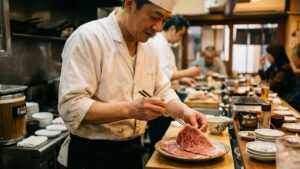
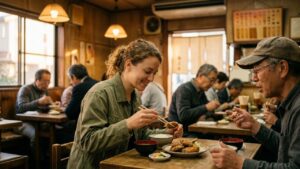
How Japan's Wagyu Tourism Scene Grew Beyond Kobe and Matsusaka
 gotowp
A guest messaged me through Instagram last month — she had visited Itadaki during her Nagoya trip back in spring, and she wrote: "My followers keep asking about the bowl in my photo. I've had to explain it three times this week." That message stayed with me for days.
It made me think about how much the landscape of wagyu travel in Japan has shifted. Kobe beef and Matsusaka beef still draw visitors from around the world — and rightfully so. But something has changed in the way travelers approach food experiences in Japan. The question is no longer only "where can I eat the most famous wagyu?" It's becoming: "where can I find the wagyu that nobody else has found yet?"
That shift is visible in the questions I get from guests, in the conversations I have with travelers who pass through Osu, and in the way social media has quietly rewired what counts as a memorable food experience abroad.
Who This Is For
- ✅ Travelers who have already tried Kobe or Matsusaka beef and want to discover what Japan's wagyu scene looks like beyond the famous names
- ✅ Anyone planning a Japan trip and looking for a food story worth telling — not just eating well, but having something genuinely intriguing to share
- ✅ Repeat visitors to Japan exploring Central Japan and Aichi Prefecture for authentic, off-the-beaten-path experiences
- ✅ Wagyu enthusiasts curious about how regional beef culture is reshaping Japanese food tourism
- ✅ Travelers passing through Nagoya before or after Shirakawa-go, Takayama, or Gifu who want to make the most of their time here
How Wagyu Tourism Quietly Moved from Brand Recognition to Story
For a long time, wagyu tourism in Japan followed a predictable path. You visited Kobe, you ate Kobe beef. You visited Kyoto or Ise, you made a detour for Matsusaka. These experiences were — and still are — exceptional. The beef is extraordinary. But the narrative around them had become, in some ways, almost too familiar. Travelers knew what to expect before they arrived.
What began changing around the early 2020s was a different kind of traveler arriving in Japan. Visitors who had already done the Golden Route. People returning for the third or fourth time, specifically hunting for something they hadn't experienced before. They weren't chasing brand names. They were chasing stories — ingredients with origins, techniques with reasoning behind them, meals that felt like genuine discoveries rather than confirmed reservations at a famous restaurant.
This is the moment when regional wagyu — the kind produced in small volumes on specific farms for specific reasons — started drawing serious attention. The journey from Kobe and Matsusaka toward discovering Japan's rarer wagyu varieties is something many food travelers are only beginning to take.
Aichi Prefecture sits at the center of this shift in a way that most visitors haven't yet realized.
You're starting to understand why regional wagyu stories travel further than brand names alone — but knowing which days Itadaki is actually open before you build your itinerary around it matters just as much. Our monthly business calendar is posted there so you can plan around our operating days. One quick look saves a wasted trip.
The Ingredients Behind the Story: What Makes Aichi Wagyu Different
When I started developing the concept behind Itadaki, I wasn't thinking primarily about flavor profiles or marbling grades. I was thinking about farmers. Specifically, I was thinking about the small producers in Aichi who had struggled during the pandemic — people raising extraordinary ingredients with almost no audience to sell to.
That process of sourcing led me to a way of thinking about ingredients that has stayed with me since: the best food stories aren't invented. They grow out of place, practice, and relationships.
Take Horai Wagyu. This is a Japanese black wagyu (Kuroge Wagyu) raised in the Okumikawa region of Aichi Prefecture — mountain country, far from the tourist trail. Only three farms in Japan produce it. The annual production: approximately 300 heads. To put that in context, Japan raises around 500,000 wagyu annually. Horai Wagyu represents a fraction of a fraction of that total.
What makes these cattle different isn't just their scarcity. It's the feeding method. The farmers incorporate sake lees — the residue from brewing "Horaisen Sora," one of Aichi's most respected premium sake labels — into the cattle's diet. This imparts a subtle, distinctive character to the beef: a balance between light marbling and lean, clean flavor that is genuinely unlike anything produced elsewhere.
That's not a marketing angle. That's an agricultural reality specific to three farms in one region of one prefecture in Japan. The facts behind Horai Wagyu's rarity speak for themselves — and that's exactly what makes it worth talking about.
Alongside Horai Wagyu, Itadaki sources Mikawa Beef from Aichi's Mikawa region — cattle raised on okara feed with careful gut management using lactic acid bacteria. Every other ingredient on the table follows the same principle: Aichi no Kaori rice grown in Aichi Prefecture, Hatcho miso from Okazaki City, Nagoya Cochin eggs from Yamada Poultry Farm, shiso leaves from Toyohashi, pickled radish from the Atsumi Peninsula, and ginger from Kimura Farm in Inazawa. The white soy sauce base for our "magic sauce" comes from Hekinan City.
When every single element on the table has a specific origin within one prefecture, the dish stops being just a meal. It becomes a map of a place.
✓ Key Takeaways
- Japan's wagyu tourism has expanded significantly as repeat visitors seek regional, story-driven experiences beyond famous brands like Kobe and Matsusaka.
- Horai Wagyu — produced by only 3 farms in Aichi, with approximately 300 heads per year — represents exactly the kind of genuine rarity that defines this new era of wagyu discovery.
- Sourcing every ingredient from a single prefecture creates a coherent food story that travelers can genuinely share, not just consume.
Horai Wagyu is limited to 10 bowls a day — and the guests who message me afterward saying they almost missed it are the ones who walked in without a reservation. Securing your bowl ahead of time is the one step that turns this from a "maybe" into a confirmed highlight of your Nagoya day. Tabelog online reservation takes just a few minutes.
Why the Story Is What Travels — Not Just the Taste
Here's something I've noticed over the years, both from running Itadaki and from my own travels abroad: the food experiences that stay with you longest are rarely the most expensive ones. They're the ones with the most specific stories attached.
You can taste excellent wagyu in many places. But when you know that the beef in front of you comes from a herd of 300 cattle — raised in Okumikawa's mountain air, fed on sake lees from a brewery that's been making premium sake for generations — the eating changes. The flavor doesn't change. The context does. And context is what you carry home.
This is the dynamic behind what I think of as the new wagyu tourism: it's not about eating the most famous beef. It's about encountering an ingredient whose story you can genuinely pass on.
"Instagram-worthy presentation and unforgettable taste. My followers keep asking about it."
— Guest review
That review captures exactly what I mean. The photo drew the questions. But the questions opened a conversation — about Horai Wagyu, about Aichi, about a way of preparing beef that most people have never encountered. The photo was a door into a story. And that story, not the image itself, is what made the experience stick.
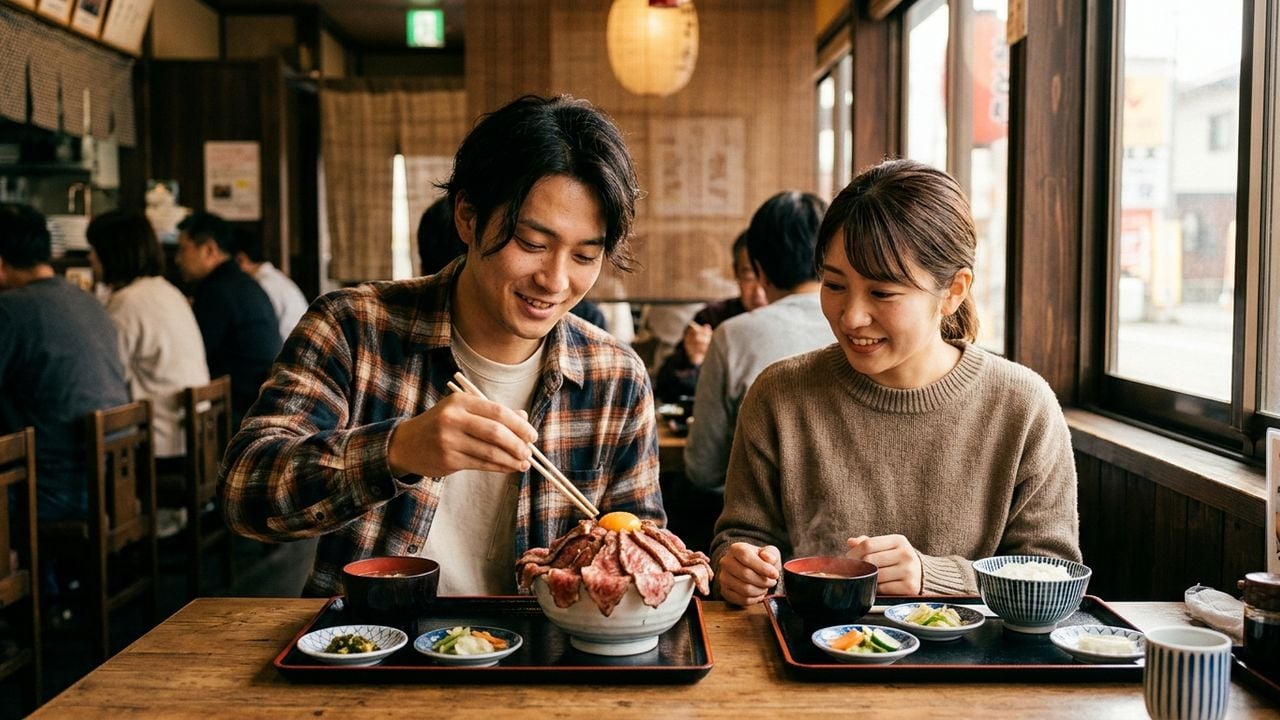
The visual element matters, of course. The presentation of the Rare Wagyu Gyudon — marbled beef arranged over rice in a traditional ceramic bowl, a golden Nagoya Cochin egg yolk resting on top, shiso leaves catching the light alongside the pale-pink wagyu — is striking in a way that photographs honestly. But what makes the image resonate with an audience is the caption: "500,000 wagyu in Japan. Only 300 heads of this one. Fed on sake lees from a mountain brewery. Cooked rare, served in Nagoya."
That's a story in four lines. And it's entirely true.
What This Means for How You Plan Your Japan Itinerary
If you're building a Japan itinerary right now — especially one that includes Nagoya before or after Shirakawa-go, Takayama, or a trip through Gifu — the practical implication of everything above is this: the food experiences worth centering your plans around are often the ones that don't appear on the first page of search results.
Nagoya is one of Japan's most underappreciated food cities. It sits at the geographic heart of Japan, functions as the gateway to Central Japan's mountain regions, and hosts a food culture that is emphatically its own — Hatcho miso, Nagoya Cochin, Aichi-grown rice varieties, sake breweries producing nationally respected labels. Yet most travel itineraries treat it as a one-day stop between Kyoto and Tokyo.
The travelers who find Itadaki — usually through a search, a recommendation, or a photo they couldn't stop thinking about — often describe the same thing afterward: that this was the lunch they didn't expect to be the highlight of their trip. Not because it was the most ornate experience, but because it was the most specific one. What makes a wagyu experience worth the journey to Japan comes down to exactly that kind of specificity.
Itadaki is open for lunch on Saturdays, Sundays, Mondays, and Tuesdays (11:00–15:00), with last order at 14:30. On public holidays, we open from 9:00. Horai Wagyu is limited to 10 bowls per day — during peak periods, it often sells out before noon. Reservation via Tabelog is strongly recommended if you want to secure the Horai Wagyu experience.
We're a four-minute walk from Yabacho Station Exit 4 on the Meijo Subway Line, and our menus are available in English, Simplified Chinese, and Korean — with a five-step guide to enjoying the dish included at every table.
For our complete menu, access details, and store information, visit our official page at https://itadaki8.com/english/
The Shift Has Already Happened — The Question Is What You Do with It
Japan's wagyu tourism scene didn't suddenly abandon Kobe and Matsusaka. Those experiences remain extraordinary. What changed is the appetite of the traveler — more curious, more interested in provenance, more aware that the most shareable food stories are the ones that surprised them.
Horai Wagyu, Mikawa Beef, Aichi no Kaori rice, white soy sauce from Hekinan — these aren't alternatives to Japan's famous food brands. They're a different chapter of the same story. A chapter that most visitors to Japan haven't read yet.
If that's the chapter you're looking for, Nagoya — and specifically Osu — is a very good place to start.
The story behind 300 heads of Horai Wagyu fed on sake lees from an Aichi mountain brewery is exactly the kind of travel narrative your followers will keep asking about — but only if you actually get a seat. With just 10 Horai Wagyu bowls available each day, a reservation is what stands between you and the bowl that becomes the caption everyone remembers. Reserve your place now through Tabelog.