5 Facts That Prove How Rare Horai Wagyu Really Is
 gotowp
Late September in Nagoya carries a particular kind of energy. The Asian Games are underway, Osu is buzzing with visitors from across the region, and the city feels more international than ever. If you're here right now — whether you came for the Games, for the history, or simply because Nagoya finally made it onto your itinerary — there's a good chance you're navigating menus, train lines, and unfamiliar street signs in a language you don't speak.
That moment of hesitation in front of a restaurant — will I be able to order? Will anyone understand me? What exactly am I eating? — is something almost every traveler knows. And it's exactly the reason why many foreign visitors end up at the nearest international chain rather than the local place they really wanted to try.
This article is for anyone who's been curious about Horai Wagyu — perhaps the most obscure name in Japan's wagyu world — but wasn't sure whether they'd actually be able to enjoy it comfortably at an authentic local restaurant in Nagoya. We'll cover five facts that explain just how rare this beef truly is, and show you why the language barrier at Itadaki is genuinely not the obstacle you might expect.
Who This Is For
- ✅ Travelers who have already tried Kobe or Matsusaka beef and are wondering what else Japan's wagyu world has to offer
- ✅ Visitors in Nagoya during the 2026 Asian Games period who want a memorable lunch beyond the tournament venues
- ✅ Anyone who feels nervous about dining at a local Japanese specialty restaurant without speaking Japanese
- ✅ Food lovers who want to understand the story behind a dish before they eat it
- ✅ International travelers seeking an authentic Nagoya experience they can actually navigate confidently
Fact 1: Only 300 Heads Are Raised Each Year — Across All of Japan
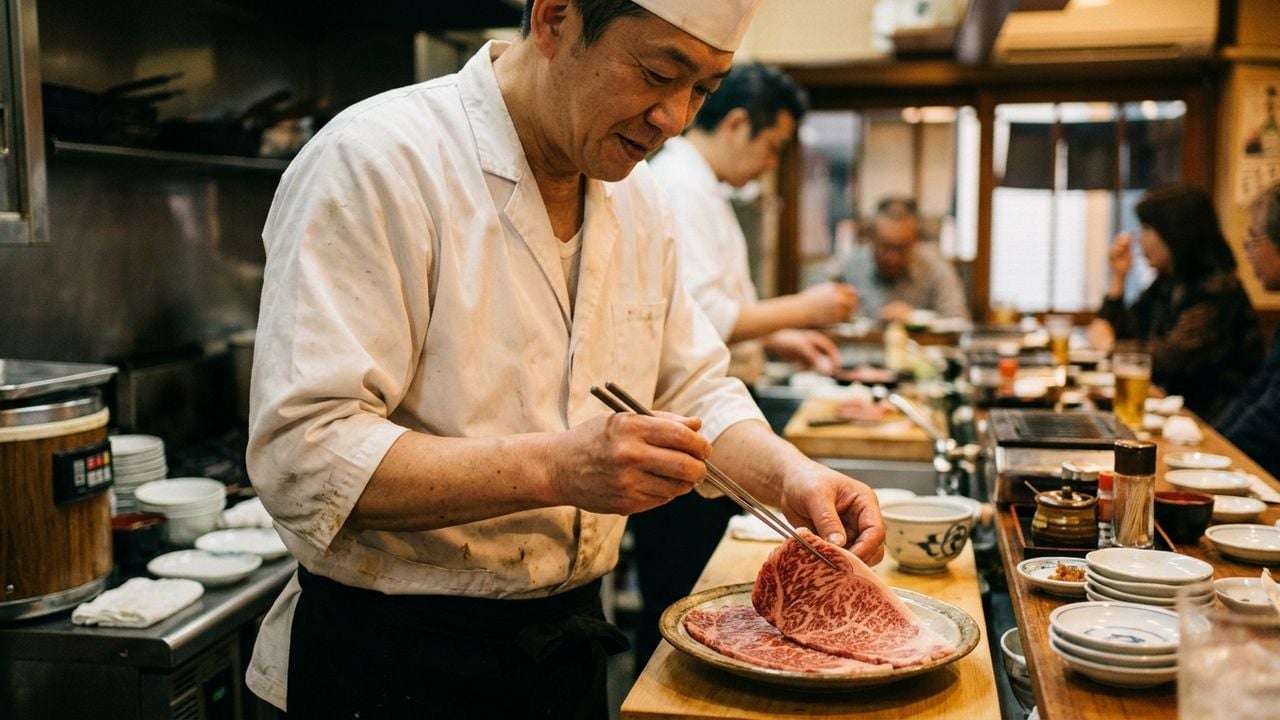
Japan raises approximately 500,000 wagyu cattle annually. Of those, Horai Wagyu accounts for just 300 heads — produced by only three farms in the entire country, all located in the Okumikawa region of Aichi Prefecture. That's not a regional rarity. That's a national one.
To put it another way: for every Horai Wagyu raised, there are roughly 1,600 other wagyu produced in Japan. It is, by volume, one of the scarcest Japanese beef breeds available anywhere. And yet, outside of Aichi, almost no one has heard of it — which is precisely what makes discovering it feel like a genuine find rather than a tourist attraction.
If you want to understand what makes Horai Wagyu different from other Japanese wagyu breeds, the short answer is this: it's the combination of extreme scarcity, a hyper-local feeding method, and a flavor profile that surprises even experienced wagyu enthusiasts.
The 10-bowl daily limit for Horai Wagyu is real — and during the Asian Games period, those bowls are going faster than usual. Itadaki's monthly business calendar tells you exactly which days are open before you make plans around a visit. Takes a moment to check on Instagram.
Fact 2: The Cattle Are Fed on Sake Lees from One of Aichi's Most Celebrated Breweries
The feeding method for Horai Wagyu isn't a minor detail — it's central to why the beef tastes the way it does. The cattle are raised on sake lees from Horaisen Sora, a premium sake produced in Okumikawa. The fermentation by-products from the brewing process are incorporated into the cattle's feed, influencing the fat composition and the final flavor of the meat in ways that are genuinely difficult to replicate elsewhere.
This is what one of our guests meant when they told us: "I've had Kobe beef and Matsusaka beef, but Horai Wagyu at Itadaki was on another level." The marbling is lighter than Kobe, but the flavor is more complex — a cleaner finish with a depth that comes from the sake lees, not just from fat content alone.
「I've had Kobe beef and Matsusaka beef, but Horai Wagyu at Itadaki was on another level.」
A guest from overseas, visiting Nagoya as part of their Japan trip
This is a wagyu that rewards curiosity. It isn't trying to out-marble Kobe or out-brand Matsusaka. It's doing something quieter and more particular — and that's exactly what makes it worth seeking out.
Fact 3: It's Available in Nagoya at Only a Handful of Restaurants — and Limited to 10 Bowls a Day at Itadaki
Because annual production is so limited, Horai Wagyu rarely appears on restaurant menus in central Nagoya. At Itadaki — which holds a direct-supply partnership with the farms in Okumikawa — it's offered as the Shinkoccho, a rare wagyu gyudon strictly limited to 10 bowls per day.
That limit isn't a marketing tactic. It reflects the actual supply. During peak periods like the Asian Games season, those 10 bowls can sell out before noon. If Horai Wagyu is the reason you're coming, reserving your bowl via Tabelog in advance is genuinely the safest approach — not just a suggestion.
✓ Key Takeaways
- Horai Wagyu is produced by just 3 farms and only 300 heads annually — making it one of Japan's rarest wagyu breeds by volume
- Its distinctive flavor comes partly from sake lees feed, creating a profile that surprises guests who've previously only tried Kobe or Matsusaka
- At Itadaki, it's capped at 10 bowls per day — and during busy periods, it sells out early
You now know the Horai Wagyu limit is 10 bowls per day — and that late September is one of Nagoya's busiest lunch periods. Securing your bowl before you arrive means the meal you've planned around is actually waiting for you. Reservation is handled through Tabelog online.
Fact 4: "Rare" Doesn't Mean Raw — the Cooking Method Is the Innovation
This is where many international visitors have questions — and it's worth addressing directly. When Itadaki describes its gyudon as "rare-style," guests sometimes assume they're being served raw beef. That's not quite accurate.
Founder Masayuki Goto developed a proprietary two-stage cooking technique that heats the beef to over 70°C at the core — fully meeting Japan's Ministry of Health, Labour and Welfare food safety standards — while preserving the silky, tender texture that the word "rare" is meant to evoke. This technique is what makes Itadaki's dish genuinely original: it achieves a sensory experience that feels rare, without any compromise on safety.
It's also part of why Itadaki has been recognized as the originator of the Rare Wagyu Gyudon concept — not just by guests, but by eight major Japanese TV programs including NHK. The technique is difficult to replicate, and it represents Goto-san's core contribution to Japanese culinary innovation.
For guests with food safety concerns, this is the honest answer: the rare texture is the result of a controlled cooking process, not an absence of cooking. The English menu explains this clearly, and staff are prepared to walk you through it if needed.
Fact 5: You Can Enjoy Every Detail — Even Without Speaking Japanese
Here's the practical truth that often gets overlooked: the language barrier at Itadaki is genuinely manageable — in fact, it's been designed that way from the beginning.
The printed menu is available in English, Simplified Chinese, and Korean. Every dish includes a photo, a price, and a clear description of the ingredients. There are no ambiguous descriptions to navigate, no need to ask what something contains — it's all there on the page. You can point and order with complete confidence.
The menu also includes a five-step visual guide called "How to Enjoy Rare Gyudon" — showing exactly how to separate the Nagoya Cochin egg (the white goes into the miso soup, the yolk sits atop the beef), how to mix ingredients at each stage, which condiments to add and when, and how to finish with wasabi for a clean final note. It's not just a guide — it's a way of making the meal more enjoyable, turning an unfamiliar dish into a deliberate, multi-stage experience.
One guest summed it up simply: "The English menu with clear serving instructions made the experience stress-free."
Translation apps work comfortably in the space if you want to ask something more specific. And while Itadaki's staff may not all be fluent English speakers, they are genuinely welcoming to international guests — the kind of warmth that communicates clearly even across a language gap.
The restaurant is a compact space: 18 seats, all sofa-style seating, with counter spots ideal for solo visitors and table configurations that work well for couples and small groups. It's a calm, unhurried environment — exactly the kind of place where you can take your time with a dish that deserves it. The behind-the-scenes rhythm of a day at Itadaki reflects just how much care goes into making each visit feel considered rather than rushed.
Planning Your Visit During the Asian Games Season
If you're in Nagoya in late September 2026, timing matters. Itadaki is open for lunch only — Monday, Tuesday, Saturday, Sunday, and public holidays, from 11:00 to 15:00 (last order at 14:30). Wednesday, Thursday, and Friday are closed. The restaurant is a four-minute walk from Yabacho Station Exit 4 on the Meijo Subway Line — easily reachable from central Nagoya in around 10 minutes.
Osu itself is worth building time around. After lunch, Osu Kannon Temple is a five-minute walk, and Hisaya-odori Garden Flarie — a free-admission urban garden — is just three minutes from Yabacho Station. It's a neighborhood that rewards slow exploration, especially during a Games visit when you might want a break from the main event venues.
For the complete menu, access details, and everything else you'll need to plan your visit, the official English page at itadaki8.com/english/ has all the information in one place.
Horai Wagyu is rare enough that most visitors to Japan — even those who consider themselves serious wagyu enthusiasts — have never encountered it. If you're already in Nagoya, or making your way through Central Japan this autumn, this is a straightforward opportunity to taste something genuinely uncommon. The dish is ready to explain itself. All you need to do is show up.
The English menu, the five-step guide, the sofa seating — everything described here is ready for you on the day. The one thing that isn't guaranteed without action is the Horai Wagyu itself. Reserve your rare wagyu experience now so that 10-bowl limit doesn't become a problem.