Asian Games Nagoya 2026: Osu Kannon Sightseeing + Local Wagyu Experience
 gotowp
You've been to Kyoto twice. You've had Kobe beef. You know how to navigate the Tokyo subway without looking at the map. So when the Asian Games brought you to Nagoya in September 2026, you weren't looking for the obvious. You were looking for the place — the kind of spot that doesn't show up on the first page of a travel blog, that a local foodie would tell you about only if you asked the right question.
If that sounds familiar, you're not alone. And Osu — the neighborhood where Itadaki quietly opened its doors in 2022 — might be exactly where that search ends.
Who This Is For
- ✅ Repeat visitors to Japan who have already done the Golden Route and are ready to go deeper
- ✅ Asian Games 2026 attendees looking for a memorable Nagoya lunch beyond stadium food
- ✅ Wagyu enthusiasts who want to discover a rare Japanese beef brand most travelers have never heard of
- ✅ Travelers spending a morning at Osu Kannon and wondering where to eat afterward
- ✅ Anyone who wants a story worth telling — not just a meal worth posting
A Morning in Osu: More Than a Temple Visit
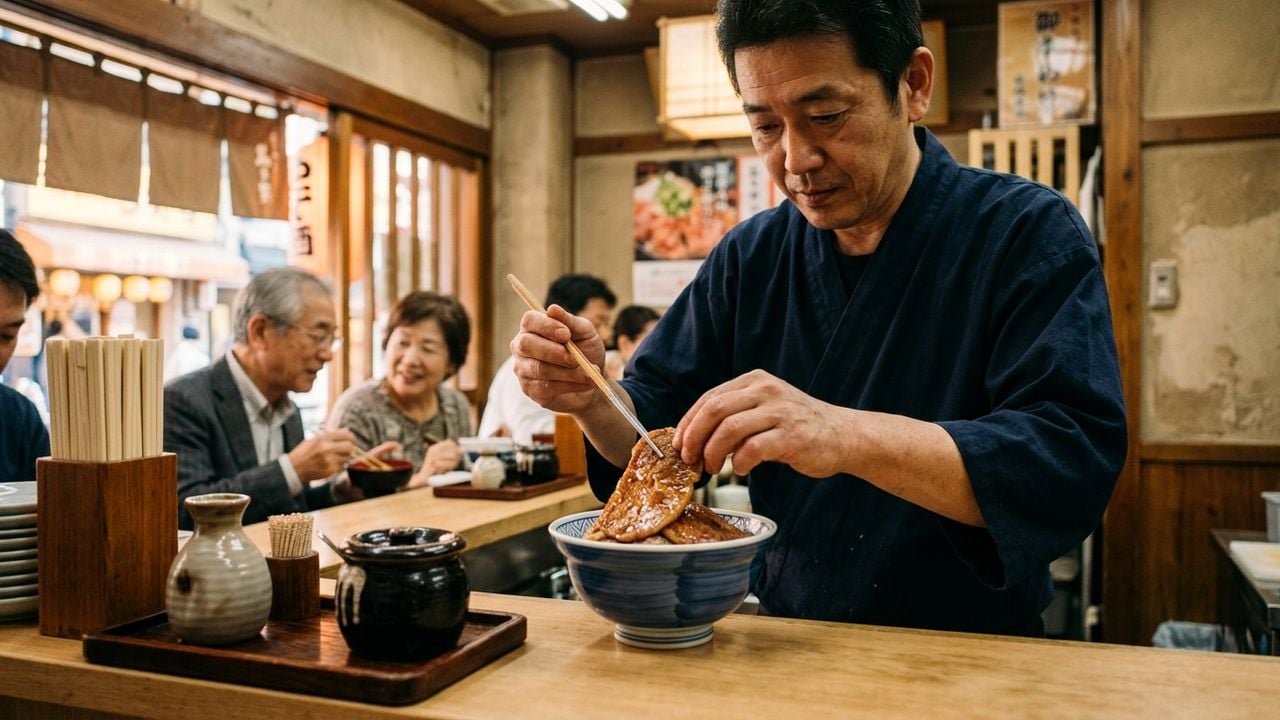
Osu Kannon Temple draws visitors every day. The main hall, the stone lanterns, the pigeons circling the courtyard — it's photogenic, atmospheric, and genuinely worth the visit. But the guests who remember Osu most vividly aren't the ones who stopped at the temple and turned back. They're the ones who kept walking.
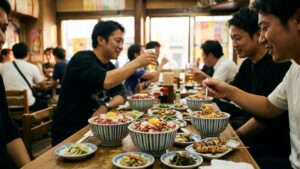
The Osu Shopping Street stretches out from the temple in all directions — 1,200 shops, more than 400 years of history, and a neighborhood energy that somehow blends Buddhist tradition with vintage electronics, maid cafés, and some of the most interesting specialty food in Nagoya. This is Osu as locals know it: layered, surprising, and genuinely fun to explore.
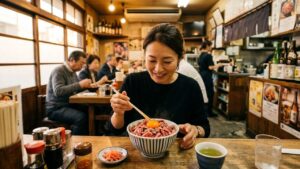
Itadaki sits in this neighborhood, on the second floor of a building along the street. It doesn't announce itself loudly. There's no mascot, no queue-management rope out front. What it does have is a concept that no other restaurant in Japan offers: the Original Rare Wagyu Gyudon — a beef bowl built entirely from Aichi Prefecture ingredients, prepared using a proprietary two-stage cooking technique that delivers a rare-style texture while fully meeting Japan's food safety standards.
The gyudon, Japan's classic everyday beef bowl, had always been fast food. Founder Masayuki Goto looked at that and asked a simple question: why? Katsudon, oyakodon, kaisendon — all of them have elevated versions. Only gyudon had been left behind. That question became Itadaki.
If you're building your Osu morning around Osu Kannon and want to time your arrival at Itadaki well, the monthly business calendar is the one thing you'll want to confirm first — especially during Asian Games season when Nagoya is busier than usual. Our official Instagram posts the schedule each month so you can plan before you book. Takes about 30 seconds to check.
What Guests Who Found It Are Saying
We hear this kind of feedback regularly, but one comment has stayed with us:
"The rare wagyu was unlike anything I've ever tasted — a life-changing culinary experience."
Guest review
That's a significant thing to say about a beef bowl. But it makes sense when you understand what's actually in it.
The Horai Wagyu — available in our signature Shinkoccho bowl at ¥2,700 — is produced by only 3 farms in all of Japan, with just 300 heads raised annually. For context, Japan produces roughly 500,000 wagyu cattle per year. Horai Wagyu accounts for 300 of them. The cattle are raised in Okumikawa, deep in Aichi's interior, and fed on the lees of Horaisen Sora, a premium local sake. This gives the beef a flavor profile that's genuinely unlike other wagyu — lighter marbling, a cleaner finish, and a delicacy that reveals itself slowly.
We limit Horai Wagyu to 10 bowls per day. That's not marketing. It's simply the reality of working with beef this rare.
Another guest who had made their way through many of Japan's well-known wagyu brands put it this way:
"I've had Kobe beef and Matsusaka beef, but Horai Wagyu at Itadaki was on another level."
Guest review
For a repeat Japan traveler, this is exactly the kind of discovery that makes a trip feel new again.
✓ Key Takeaways
- Osu is one of Nagoya's most character-rich neighborhoods — ideal for a morning of temple visits, street exploration, and specialty dining, especially during Asian Games 2026
- Itadaki invented the Rare Wagyu Gyudon concept, sourcing every ingredient exclusively from Aichi Prefecture — including Horai Wagyu, produced by just 3 farms at 300 heads per year
- The experience has resonated most strongly with repeat Japan visitors who want discoveries, not just destinations
Horai Wagyu is limited to 10 bowls a day, and September in Nagoya during the Asian Games is not the moment to assume a walk-in will work out. If the Horai Wagyu bowl is what you're coming for, securing your seat in advance is the only way to guarantee it's there when you arrive. Reservation is available online through Tabelog.
The Story Behind Every Bowl — and Why It Matters
Goto didn't set out to open a wagyu restaurant. During the COVID-19 pandemic, the small Aichi farmers he had long sourced from — premium producers with nowhere to sell — were struggling. He felt a responsibility to do something. What emerged was a farm-to-table concept built around those exact producers: Horai Wagyu farms, Yamada Poultry Farm's Nagoya Cochin eggs, Kimura Farm's pickled ginger from Inazawa, white soy sauce from Hekinan, shiso from Toyohashi, rice grown in Aichi. The name Itadaki comes from itadakimasu — the expression of gratitude Japanese speakers say before every meal. It reflects a belief that food is a gift from the people who grow and raise it.
That philosophy shapes the dish itself. The five-step eating guide — available in English, Simplified Chinese, and Korean — walks guests through separating the Nagoya Cochin egg (white into the miso soup, yolk over the beef), tasting the wagyu first in its purest form, then layering in the complimentary condiments: pickled ginger, chopped seaweed from Mikawa Bay, chirimen jako, the original 8-spice blend, wasabi. Each step changes the flavor. Most guests don't expect a beef bowl to have a journey. This one does.
For Asian Games visitors exploring Nagoya between events, this is the kind of lunch that becomes the story you tell at dinner. If you're curious how other Asian Games visitors have planned their Nagoya days around both sightseeing and dining, this guide to eating near Asian Games venues in Nagoya offers some useful context on how to combine the two.
Practical Details for Your Visit
Itadaki is a 4-minute walk from Yabacho Station Exit 4 on the Meijo Subway Line — the same station that puts you within walking distance of Hisaya-odori Garden Flarie, a free-admission urban garden that's quietly become one of Nagoya's most beautiful photo spots. From Nagoya Station, it's roughly 10 minutes by subway (Higashiyama Line to Sakae, transfer to Meijo Line, off at Yabacho). Osu Kannon Station and Kamimaezu Station are also within comfortable walking distance.
Itadaki operates on scheduled business days only: Saturday, Sunday, Monday, and Tuesday, from 11:00 to 15:00 (last order at 14:30). On public holidays, doors open at 9:00. There is no dinner service. Irregular closures do happen — the monthly business calendar is posted on our official Instagram, which is worth checking before you plan your visit.
Because Horai Wagyu is limited to 10 bowls per day and Asian Games season brings visitors to Nagoya from across Asia and beyond, reservations through Tabelog are strongly recommended. If you'd like to understand how the 10-bowl limit works in practice — and when it tends to sell out — this piece on the Horai Wagyu experience goes into more detail.
The restaurant has 18 seats across a mix of counter seating and sofa-style tables, with printed menus available in English. The five-step eating guide is illustrated and designed so that no Japanese is needed to enjoy the dish fully.
The Kind of Discovery You Come Back to Japan For
The Asian Games bring something unusual to Nagoya this September — a city that many international visitors have passed through without stopping is now, for a few weeks, a destination in its own right. And the travelers who will remember Nagoya most clearly aren't necessarily the ones who saw the most venues or checked off the most sights. They're the ones who found the neighborhood, walked into a restaurant they'd never heard of, and sat down to a bowl of beef that turned out to be unlike anything they'd tasted before.
Osu is that neighborhood. Itadaki is that restaurant. The Horai Wagyu is, with some planning and a reservation, waiting for you.
For our complete menu, access details, and store information, visit our official page at https://itadaki8.com/english/
You've read about the 300-head-per-year wagyu, the farm origins, the five-step eating journey — now the only thing left is to actually sit down to it. With Asian Games visitors filling Nagoya's lunch spots this September, the 10-bowl daily limit on Horai Wagyu makes a reservation the straightforward next step. Tabelog online booking takes just a few minutes.