Only 10 Bowls a Day: Nagoya's Exclusive Horai Wagyu Beef Experience for Asian Games Visitors
 gotowp
I'll be honest with you — the question I get asked most often during Asian Games week isn't about our menu or our location. It's this: "Is rare wagyu actually safe to eat?"
I'm Masayuki Goto, founder of Itadaki here in Osu, Nagoya. I've been in the food and beverage industry for 18 years, and when I opened this place in 2022, I knew that question was coming. I had spent years traveling internationally — eating at restaurants across different countries, discovering how deeply food safety culture shapes what people are willing to put in their mouths. A guest from London or Los Angeles hears "rare beef bowl" and their first instinct, naturally, is caution. That's not ignorance — it's a completely rational response based on what their own health authorities have told them for years.
So before I tell you anything about what's on the plate, I want to address that question head-on. Because if you're visiting Nagoya during the Asian Games and you've seen Itadaki mentioned somewhere, you deserve a straight answer — not marketing language.
Who This Is For
- ✅ Visitors to Nagoya for the 2026 Asian Games who want to try wagyu but feel uncertain about rare-style beef preparation
- ✅ Western travelers accustomed to well-done beef who are curious whether rare wagyu is genuinely safe by international standards
- ✅ Wagyu enthusiasts who have tried Kobe or Matsusaka beef and want to understand what makes Horai Wagyu different
- ✅ Anyone who has heard about "Rare Wagyu Gyudon" and wants to know exactly what that means before reserving
- ✅ Travelers planning lunch in the Osu or Sakae area during Asian Games week and weighing their options
Why "Rare" Wagyu Made Me Nervous Too — At First
One of my favorite things to do outside the restaurant is travel and eat. When I visit a city I've never been to, I go straight to local restaurants — not the tourist spots, but the places where the story behind the food is inseparable from the dish itself. Over the years, eating raw or near-raw preparations in countries where I didn't speak the language taught me something important: context matters more than appearance. What looks risky without context becomes completely understandable once you know the method behind it.
That experience shaped how I built Itadaki's entire approach to rare wagyu preparation. When I was developing the concept during the pandemic — watching the small Aichi farms I sourced from struggle with unsold harvests — I knew that whatever I created had to be honest. The food had to be genuinely safe. Not "safe enough." Fully, verifiably safe by Japan's own standards.
So here's what we actually do, explained plainly.
You now know the safety standard and the story — but Asian Games week means our Horai Wagyu sells out faster than any other time of year. Our monthly Instagram calendar shows which days still have availability, including this week's schedule. Takes less than a minute to check.
The Two-Stage Cooking Technique: What It Is and Why It Matters
At Itadaki, we use a proprietary two-stage cooking technique that heats the beef to over 70°C at the core. That number is not arbitrary — it is the threshold set by Japan's Ministry of Health, Labour and Welfare for safe beef preparation. Our method fully meets those standards.
What makes this technically difficult — and why no other gyudon restaurant in Japan offers this — is that achieving 70°C at the core while preserving a tender, silky texture on the outside requires precise temperature control at two distinct stages of cooking. Overcook by even a small margin, and the texture collapses. Undercook, and you've failed the safety standard. The balance took time and iteration to get right, and it represents real culinary innovation, not a shortcut.
I hold a Certified Food Sanitation Supervisor qualification issued by the Japanese Ministry of Health, Labour and Welfare, and Itadaki operates under a licensed restaurant permit from the Aichi Prefecture Public Health Center. The rare texture you experience in our bowl is a result of that technique — not of serving raw or undercooked beef.
To put it simply: when you eat the rare wagyu at Itadaki, you are not eating raw beef. You are eating beef that has been cooked to food safety standards using a method specifically designed to preserve a rare-like mouthfeel. That distinction is everything.
✓ Key Takeaways
- Itadaki's rare wagyu is cooked to over 70°C at the core — fully meeting Japan's Ministry of Health, Labour and Welfare standards
- The "rare" texture is achieved through a proprietary two-stage technique, not through undercooking
- Horai Wagyu is produced by only 3 farms in Japan, with just 300 heads raised annually — and only 10 bowls are available per day at Itadaki
The two-stage technique and the 300-head-per-year supply both point to the same reality: the 10 daily bowls of Horai Wagyu fill up early, especially during Asian Games week. Reserving via Tabelog is the only way to guarantee your bowl is waiting when you arrive. No waiting, no uncertainty.
300 Out of 500,000: The Story Behind Horai Wagyu
Now that the safety question is answered clearly, let me tell you about the beef itself — because this is where things get genuinely extraordinary.
There are approximately 500,000 wagyu cattle raised in Japan at any given time. Horai Wagyu accounts for just 300 heads per year, produced by only 3 farms in the Okumikawa region of Aichi Prefecture. These cattle are raised on a feeding regimen that includes sake lees from "Horaisen Sora" — a celebrated local premium sake — which contributes to a distinctive flavor profile: subtle marbling, clean lean meat flavor, and a mouthfeel unlike anything you'll find at a standard wagyu restaurant.
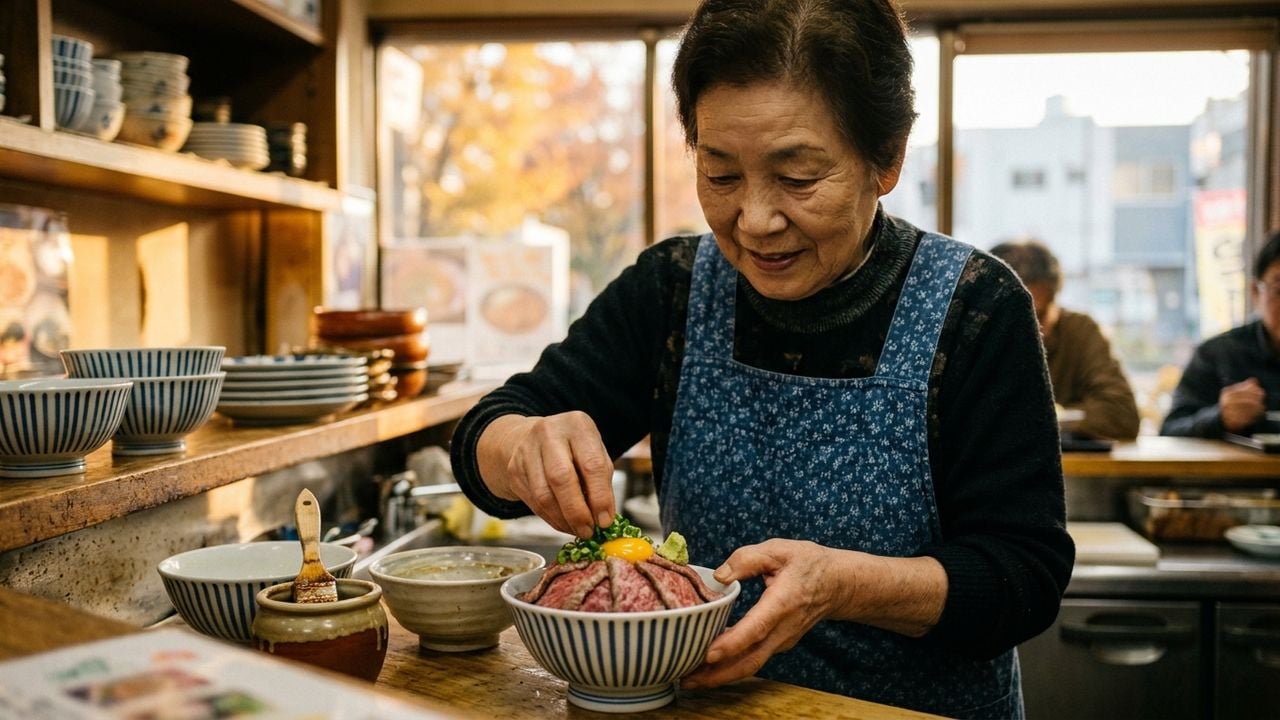
At Itadaki, we serve Horai Wagyu in what we call Shinkoccho — our standard-size Rare Wagyu Gyudon, featuring 100g of beef over 200g of Aichi-grown "Aichi no Kaori" rice, accompanied by miso soup made with Hatcho miso from Okazaki, traditional Atsumi Ichō-zuke pickles, Toyohashi-grown shiso leaves, and a raw Nagoya Cochin egg from Yamada Poultry Farm. Every ingredient on that tray comes from Aichi Prefecture. Not a marketing line — a genuine commitment.
We limit Horai Wagyu to 10 bowls per day. During Asian Games week, those bowls are going quickly. If you're planning to visit, reserving in advance via Tabelog is the most reliable way to secure one.
One guest — a wagyu enthusiast who had already eaten Kobe beef and Matsusaka beef before visiting us — described it simply: "The rare wagyu was unlike anything I've ever tasted — a life-changing culinary experience." I don't say that to impress you. I say it because that reaction is what happens when someone finally understands that the story behind the bowl is as carefully constructed as the technique itself.
"The rare wagyu was unlike anything I've ever tasted — a life-changing culinary experience."
Guest testimonial, wagyu enthusiast visiting Nagoya
A Personal Note: IG Arena and What This Week Means to Me
I'll admit something that has nothing to do with the restaurant, and everything to do with why this week feels special to me personally.
I've been a basketball fan for as long as I can remember. When IG Arena — the Aichi International Arena designed by Kengo Kuma, which opened in July 2025 — was confirmed as a venue for basketball at the 2026 Asian Games, I felt something I can only describe as civic pride. The Nagoya Diamond Dolphins play there. Grand Sumo tournaments happen there. And now, the Asian Games. This city is finally on the world stage in a way that matches what I've always believed Nagoya deserves.
That's part of why I want every visitor who comes through our door during Asian Games week to leave not just full, but genuinely impressed by what Aichi has to offer. The arena and the bowl are, in my mind, expressions of the same thing: craft, precision, and a regional identity that doesn't need to shout to be noticed.
If you're in Nagoya for the Games and looking to understand the food scene beyond the obvious tourist trail, I'd also recommend reading our Aichi beef food guide for Asian Games visitors — it covers the broader landscape of what makes this prefecture's ingredients worth seeking out. And if you're weighing your lunch options near the venues, our guide to the best lunch spot near Yabacho Station during Asian Games walks through the logistics practically.
How to Visit During Asian Games Week
Itadaki is a 4-minute walk from Yabacho Station Exit 4 on the Meijo Subway Line, and also within walking distance from Sakae Station, Kamimaezu Station, and Osu Kannon Station. From Nagoya Station, it's roughly 10 minutes by subway — Higashiyama Line to Sakae, then transfer to the Meijo Line to Yabacho.
We're open Tuesday this week (September 15), and our regular schedule runs Saturday through Tuesday, 11:00 to 15:00. Public holidays shift our opening to 9:00. Last order is 30 minutes before closing. Because our schedule can shift for operational reasons, I'd recommend checking our monthly calendar on Instagram before you make your way over — especially during a high-traffic week like this one.
We have printed menus in English, Simplified Chinese, and Korean, and a photographic five-step guide explaining exactly how to enjoy the dish. You don't need Japanese to have a complete experience here. That has always been important to me — genuinely welcoming international guests, not just tolerating them.
For our complete menu, access details, and store information, visit our official page at https://itadaki8.com/english/.
The Bowl Is Worth the Planning
Asian Games week in Nagoya is, by any measure, a remarkable moment for this city. But remarkable moments deserve remarkable meals. If you've been hesitating because of questions about rare wagyu safety — now you have your answer, in plain language, from the person who built the cooking method from the ground up.
Ten bowls a day. Three farms in Japan. Three hundred cattle a year. One technique that took years to develop. That's the story behind every Horai Wagyu bowl we serve. We'd be honored to serve one to you this week.
If you'd like to learn more about how other Asian Games visitors have planned their time around a visit to Itadaki, this piece on fitting Itadaki into Asian Games week covers exactly that.
You've read through the technique, the sourcing, and the story — and if any part of that resonated, the next step is straightforward. Secure your seat before the 10 daily bowls are gone. Reservations are handled through Tabelog, and the process takes just a few minutes.