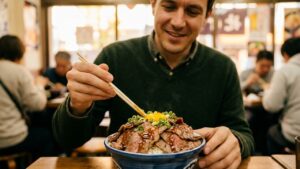
Where to Eat Near Aichi-Nagoya 2026 Asian Games Venues: Rare Wagyu Beef Bowl in Nagoya
 gotowp
The 2026 Asian Games are officially underway here in Nagoya, and the city is buzzing. Flags at Yabacho Station, unfamiliar languages echoing through Osu Shopping Street, visitors in team colors grabbing lunch between events — it's one of those moments where Nagoya suddenly feels like it belongs to the whole world.
And every year — not just during major sporting events — I hear the same thing from first-time visitors to Itadaki: "I almost didn't come in because I was worried I wouldn't be able to order."
That one sentence stays with me. Because what it really means is: I almost missed something I would have remembered for the rest of my trip. And that, more than anything, is what I want to change.
If you're visiting Nagoya for the Asian Games and searching for a meaningful lunch near the venues — one that doesn't require a Japanese phrase book or a local friend to translate — this article is for you.
Who This Is For
- ✅ Visitors attending the 2026 Asian Games in Nagoya who want to explore authentic local food beyond hotel restaurants
- ✅ Travelers who feel nervous about ordering at specialty Japanese restaurants without speaking Japanese
- ✅ Wagyu enthusiasts curious about Aichi's rare beef brands beyond Kobe and Matsusaka
- ✅ Anyone who wants a genuinely memorable lunch experience — with a clear, English-language menu to guide them through it
- ✅ Solo diners and families alike looking for a welcoming, relaxed setting with comfortable seating
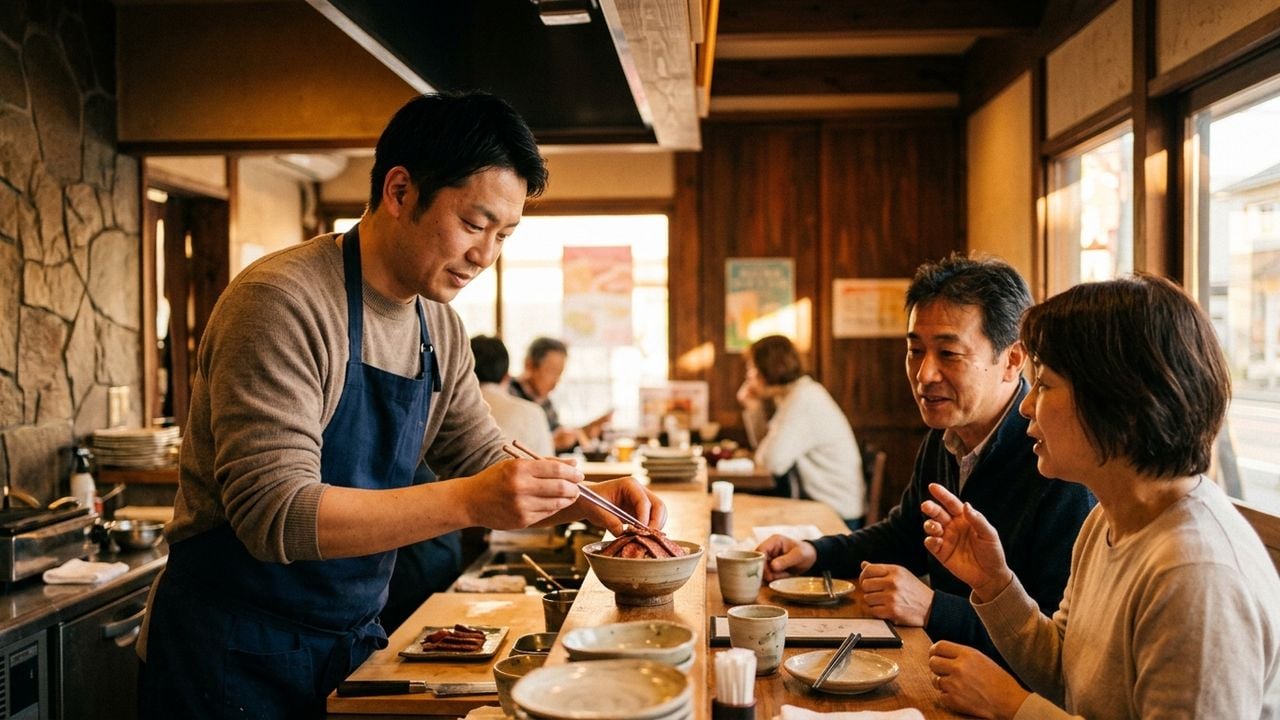
The Language Barrier That Stops You From the Best Meal of Your Trip
Here's something I've noticed in my 18 years working in food and hospitality: the anxiety around ordering in Japanese is rarely about the food itself. It's about the fear of getting it wrong — of not knowing what you're eating, of accidentally ordering something you're allergic to, or of holding up the line while staff try to explain a dish you've never encountered before.
That anxiety is completely understandable. And it's exactly why so many visitors to Japan end up eating at international chains during trips that were supposed to be about discovery.
Rare Wagyu Gyudon — the dish we invented and specialize in at Itadaki — is unlike anything most visitors have encountered before. The "rare" preparation, the five-step eating ritual, the raw Nagoya Cochin egg that arrives alongside the bowl: without context, it can feel confusing. Even for Japanese visitors, we often explain the process. For international guests, we've made sure that explanation is built directly into the experience itself.
The five-step eating guide sounds clear on paper — but knowing whether we're actually open on the day you're planning to visit is a different question. Our schedule follows a monthly calendar, and the Asian Games period is busier than usual. Our Instagram shows the confirmed business calendar each month, updated in advance.
How Itadaki Makes It Easy — In Your Language
When you sit down at Itadaki, you'll receive a fully printed menu in English, Simplified Chinese, and Korean. This isn't a rough translation or a QR code that leads to an app — it's a proper, purpose-designed multilingual menu with photos of every dish, clearly listed prices, and descriptions of every key ingredient.
More importantly, the menu includes a five-step visual guide titled "How to Enjoy Rare Gyudon." It walks you through the entire experience:
- Separate the raw Nagoya Cochin egg — the white goes into the miso soup, the golden yolk sits atop the beef
- Taste the wagyu first, in its purest form, before mixing anything
- Blend the yolk into the beef for a richer, silkier bite
- Add the complimentary condiments — pickled ginger, dried nori, chirimen jako (tiny dried whitebait), and our original 8-spice blend — to discover new flavor dimensions
- Finish with a touch of wasabi for a clean, refreshing final note
You don't need to ask a single question to follow this ritual correctly. The guide does the talking. But if you do want to ask something — about allergens, about portion sizes, about which wagyu to choose — our staff is genuinely welcoming of international guests, and translation apps work perfectly well in the restaurant. Point-and-order is always an option too.
One note on allergens: soy (in our sauce and miso), wheat (in the soy sauce), and egg (the Nagoya Cochin egg, which can be removed at -¥150) are present in the main dish. The complimentary chirimen topping contains sesame — if you have a sesame allergy, simply leave that condiment aside. If you have a severe allergy, please let us know at the time of reservation.
✓ Key Takeaways
- Itadaki's printed menu is fully available in English, Simplified Chinese, and Korean — no Japanese required to order
- A five-step visual guide walks you through the rare gyudon experience from the moment the bowl arrives
- The staff is welcoming of international guests, and translation apps are easy to use inside the restaurant
You now know the multilingual menu handles the ordering, and the five-step guide handles the eating — but the one thing neither can guarantee is that the 10 daily Horai Wagyu bowls will still be available when you arrive. During the Asian Games, they've been going well before the lunch rush ends. Securing your bowl in advance is the one step that makes the difference.
What You're Actually Eating — and Why It's Worth the Trip
Once the language question is answered, the next thing visitors often ask is: "But is the food actually special?"
The honest answer is that Horai Wagyu — the ultra-rare beef we source directly from Okumikawa in Aichi Prefecture — is genuinely unlike most wagyu available in Japan. Only 300 heads are raised annually across just 3 farms, fed on sake lees from "Horaisen Sora," a premium local sake from the mountains of Aichi. That distinctive feeding method creates a flavor profile that sits somewhere between the rich marbling of classic wagyu and the clean, lean depth of high-quality grass-fed beef.
A guest who visited us earlier this year, and who had already experienced wagyu at some of Japan's most respected tables, put it simply:
"I've had Kobe beef and Matsusaka beef, but Horai Wagyu at Itadaki was on another level."
That kind of reaction isn't something we engineered through marketing. It comes from the fact that Horai Wagyu is genuinely rare — not rare in the way that word gets overused in food culture, but rare in the sense that 300 heads out of approximately 500,000 wagyu in Japan is a number that tells its own story.
The rare-style preparation is achieved through our proprietary two-stage cooking technique, which heats the beef to over 70°C at the core — fully meeting Japan's Ministry of Health, Labour and Welfare food safety standards — while preserving that distinctive texture. "Rare" here is not a shortcut. It's a technical achievement that took years to develop.
If you're visiting Nagoya during the Asian Games and want to understand more about why Horai Wagyu is in a category of its own, our article on Nagoya's exclusive Horai Wagyu experience — limited to 10 bowls a day goes deeper into the story behind this ingredient.
Getting Here from Asian Games Venues
Itadaki is located on the 2nd floor at 4-1-20 Osu, Naka-ku, Nagoya — a 4-minute walk from Yabacho Station Exit 4 on the Meijo Subway Line. From most central Nagoya venues and hotels, that puts us within 10 to 15 minutes by subway.
We're open for lunch only: 11:00–15:00 on Saturdays, Sundays, Mondays, and Tuesdays, with last order at 14:30. On public holidays, we open earlier at 9:00. We are closed Wednesday through Friday. Because our schedule follows a monthly calendar and irregular closures can occur, please check our official Instagram before you visit to confirm the day's availability.
For the Horai Wagyu gyudon specifically — our signature Shinkoccho, priced at ¥2,700 for 100g of beef with rice and all accompaniments — we limit service to 10 bowls per day. During peak periods like the Asian Games, those bowls go early. A reservation via Tabelog is strongly recommended if Horai Wagyu is on your list.
The Mikawa Beef Rare Gyudon (starting from ¥1,800 for the Fumoto size) is available every service without limit, and is equally made with the same two-stage cooking technique and the same all-Aichi ingredients. It's an excellent choice if you arrive without a reservation and the Horai Wagyu has already sold out.
For a broader look at where to eat lunch near Asian Games venues in Nagoya, this guide on lunch options during the 2026 Asian Games may also be useful for your planning.
One Lunch, One Story Worth Telling
When I opened Itadaki in April 2022, one of the things I was most deliberate about was making sure international visitors could walk in without anxiety and walk out with a story worth sharing. That meant a real multilingual menu, not an afterthought. It meant a step-by-step guide for a dish that genuinely needs one. And it meant a staff culture where every guest — regardless of language — is made to feel at home.
The 2026 Asian Games have brought visitors to Nagoya from across Asia and beyond, and many of them are discovering Osu for the first time. That's a meaningful thing. Osu has been welcoming travelers for over 400 years — from the days of Osu Kannon Temple's pilgrims to today's cosplay enthusiasts and sports fans — and that spirit of openness is something I think about every time we open the doors.
You don't need to speak Japanese to have a lunch you'll remember. You just need to find the right place.
For our complete menu, access details, and store information, visit our official page at https://itadaki8.com/english/
If this is the lunch you want to have during your Nagoya stay — the one where the language barrier isn't a concern, where the wagyu is genuinely rare, and where the experience is built to be remembered — the reservation is the only thing left to sort. Tabelog online reservations are available in English, and the process takes just a few minutes.