Why Kimono Rental Customers Love Osu's Rare Wagyu Restaurant
 gotowp
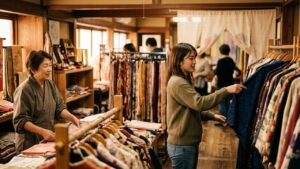
You've just slipped into a beautiful kimono at a rental shop in Osu, stepped out onto the shopping street, and spent the last hour walking past temple lanterns and centuries-old storefronts. Now you're hungry — and somewhere in the back of your mind, a thought forms: this moment deserves a meal that matches it.
That feeling — of wanting the food to live up to the experience around it — is something many kimono rental visitors describe when they arrive at Itadaki for the first time. Not just a good lunch. A lunch that becomes part of the memory.
Who This Is For
- ✅ Kimono rental guests exploring Osu who want a lunch experience that feels as special as the outfit they're wearing
- ✅ Travelers determined to have at least one meal in Japan that becomes a story worth telling for years
- ✅ Visitors curious about rare wagyu beyond Kobe and Matsusaka beef
- ✅ First-time diners wondering whether a rare-style wagyu bowl is safe, comfortable, and easy to navigate without Japanese
- ✅ Anyone who wants to understand what makes Osu the right neighborhood for this kind of discovery
Why Does Osu Feel Like the Perfect Place for a Once-in-a-Lifetime Lunch?
Osu is one of those rare neighborhoods that holds contradictions gracefully. A 400-year-old Buddhist temple sits at the entrance to a shopping street full of vintage clothing and anime goods. Traditional festival banners hang above storefronts selling Taiwanese snacks. Kimono-clad visitors stroll past cosplayers without anyone missing a beat.
It's a neighborhood where doing something unexpected feels completely natural — which is exactly the atmosphere that makes Itadaki fit so well here. Because Itadaki itself is an unexpected thing: a beef bowl restaurant that reimagines Japan's most humble everyday dish as a culinary experience you genuinely cannot have anywhere else in the world.
Founder Masayuki Goto opened Itadaki in Osu in April 2022 with a clear question driving him: every other Japanese donburi — katsudon, oyakodon, kaisendon — already had a premium, high-craft version. Why had nobody created a premium gyudon? Not a chain. Not a "limited-time special." A restaurant built entirely around that single idea, executed with complete seriousness.
That question became The Original Rare Wagyu Gyudon. And Osu — layered, surprising, and welcoming to anyone who walks through — turned out to be exactly the right home for it.
You're already thinking about how to plan your Osu day — and whether the Horai Wagyu will still be available by the time you arrive. Itadaki's monthly business calendar, including any irregular closures in September, is updated on our official Instagram. A quick check takes under a minute.
Is a Rare-Style Wagyu Bowl Actually Safe to Eat?
This is the first question many visitors ask, and it deserves a direct answer: yes, fully.
Itadaki's signature preparation uses a proprietary two-stage cooking technique developed under Goto's direction. The beef reaches over 70°C at the core — fully meeting Japan's Ministry of Health, Labour and Welfare food safety standards — while preserving what we call a "rare" mouthfeel. It is not raw. It is not sashimi-style beef. It is a technically demanding method that delivers the silky texture of rare wagyu without any compromise on safety.
Goto holds a Certified Food Sanitation Supervisor qualification and operates under a Licensed Restaurant permit from the Aichi Prefecture Public Health Center. The technique is difficult to replicate precisely, which is one reason Itadaki remains the originator of this culinary concept — featured on eight major Japanese TV programs, including NHK, since opening.
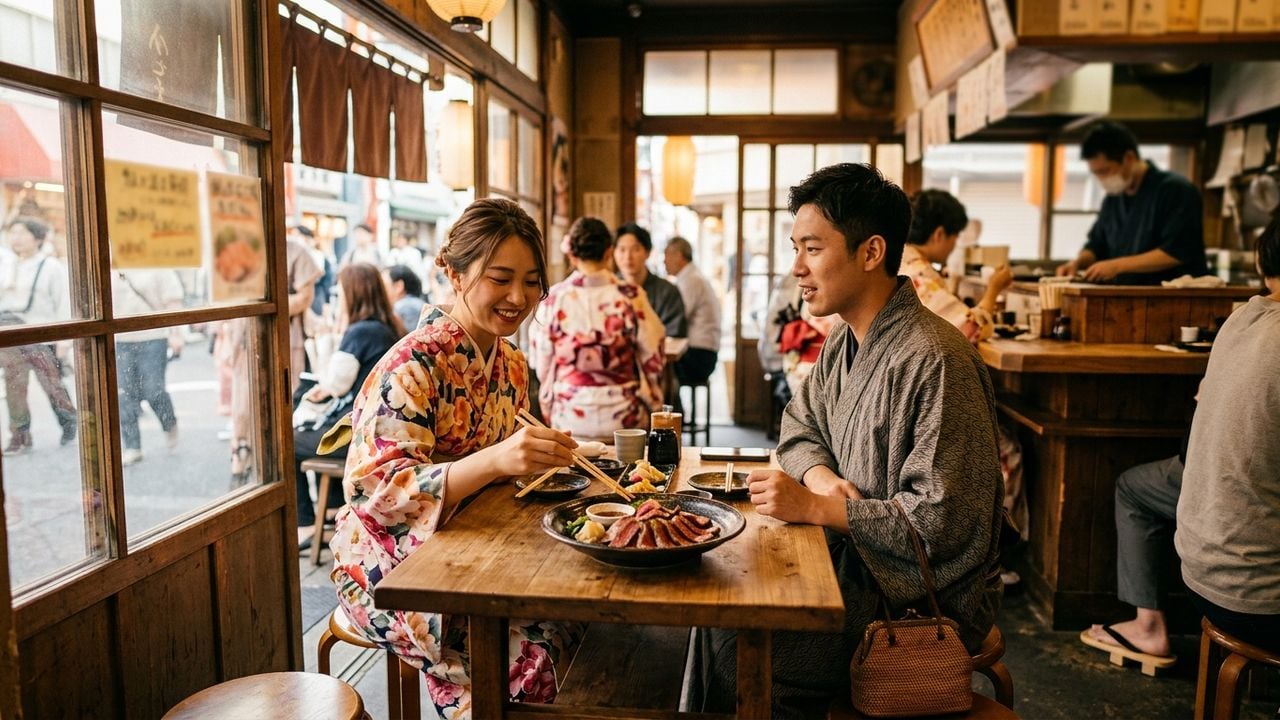
For kimono visitors who sometimes worry about spills: the dish is served in a bowl, the movements are calm and unhurried, and the sofa-style seating gives you space to sit comfortably whatever you're wearing. Past guests have visited in full kimono with no issues — the restaurant's relaxed pace is designed for exactly this kind of extended, enjoyable lunch.
✓ Key Takeaways
- Itadaki's two-stage cooking technique heats beef to over 70°C at the core — meeting Japanese food safety standards while delivering a rare mouthfeel.
- The restaurant is located a 4-minute walk from Yabacho Station Exit 4, directly in the heart of Osu's kimono-friendly district.
- All 18 seats feature sofa-style seating — comfortable for extended lunches, whatever you're wearing.
The bowl is limited to 10 per day, and September Sundays in Osu tend to fill quickly — especially with kimono rental guests who share the same idea of making lunch the highlight of their day. Securing your seat in advance means you arrive knowing your Horai Wagyu is waiting. Reservation is handled through Tabelog, no Japanese required.
What Makes This Experience Impossible to Replicate Anywhere Else?
The wagyu itself is where the story becomes genuinely rare.
The signature bowl — Shinkoccho, ¥2,700 — is built around Horai Wagyu: a Japanese black wagyu raised in Okumikawa, deep in Aichi Prefecture, by only three farms in Japan. Annual production: 300 heads. Out of an estimated 500,000 wagyu raised in Japan each year, 300 of them are Horai Wagyu. These cattle are fed on sake lees from Horaisen Sora, a renowned premium sake brewed locally, which contributes to a flavor profile unlike any other wagyu — clean, nuanced, with a balance of delicate marbling and genuine lean-meat depth.
Itadaki is one of the very few restaurants in Nagoya that sources this beef directly from the farms. The bowl is limited to 10 each day, and on busy days it sells out before the lunch rush ends. Reservation via Tabelog is genuinely recommended — not as a formality, but because this is one of those cases where the limitation is real.
Every other ingredient comes from Aichi Prefecture as well: the rice is Aichi no Kaori, the miso soup uses Hatcho miso from Okazaki, the egg is a Nagoya Cochin from Yamada Poultry Farm, the pickles are traditional Atsumi Ichō-zuke from the Atsumi Peninsula. "Everything from Aichi" isn't a marketing phrase — it's a commitment Goto built into the concept from the beginning, born from his desire to support local Aichi farmers who struggled during the pandemic.
If you want to understand more about why this wagyu is so unusual, what makes Horai Wagyu one of Japan's most rare beef varieties is worth reading before your visit.
"The staff were welcoming and made us feel at home even without perfect Japanese."
A guest who visited Itadaki during their Nagoya stay
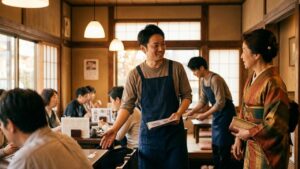
This is something we hear often — and it matters especially for kimono visitors who are already navigating a new cultural experience and don't need the added pressure of a language barrier at the table. Printed menus are available in English, Simplified Chinese, and Korean, and the dining experience unfolds through a five-step guide that makes the dish approachable and genuinely enjoyable, even on your first visit to a wagyu restaurant.
How Does the Five-Step Experience Turn a Meal into a Memory?
Part of what kimono visitors respond to — beyond the taste — is the ritual of the meal itself. There's a sequence to it, and it mirrors the deliberate, layered nature of Japanese culture that many travelers come to Japan specifically to experience.
The bowl arrives with the Nagoya Cochin egg resting on the wagyu. Step one is to separate it: the white goes into the miso soup, the golden yolk stays atop the beef. You taste the wagyu first in its purest form — no additions, just the Horai Wagyu and the signature white soy sauce from Hekinan City. Then the yolk folds in, changing the texture entirely. From there, the complimentary condiments on the table — pickled ginger from Kimura Farm in Inazawa, dried nori from Mikawa Bay, chirimen jako whitebait from Minamichita, Itadaki's own eight-spice blend — let you reshape the bowl into something different with each bite. The final note is wasabi: clean, refreshing, final.
Guests who have tried Kobe beef and Matsusaka beef often arrive expecting to add Horai Wagyu to a mental checklist. What they frequently describe afterward is something more than that — not a checkbox ticked, but a dish with a story that stays with them. The Instagram-worthy presentation helps, but it's the narrative you carry home — 300 heads a year, three farms, sake-lees feeding, a chef with 18 years of experience who invented this entire category — that makes it worth sharing.
If you're planning your Osu visit and wondering how Itadaki compares with other experiences in the area, finding the best kimono-friendly restaurant near Osu Kannon gives a broader look at the neighborhood's lunch options.
What Should You Know Before You Go?
Itadaki is open for lunch only — Tuesday, Saturday, Sunday, and Monday, 11:00 to 15:00, with last order at 14:30. On public holidays the restaurant opens at 9:00. Wednesday, Thursday, and Friday are closed. Irregular closures do apply — the monthly business calendar is posted on the official Instagram account, so checking before you visit is always a good idea.
Access is straightforward: a 4-minute walk from Yabacho Station Exit 4 on the Meijo Subway Line, and also within walking distance from Sakae, Kamimaezu, and Osu Kannon stations. From Nagoya Station, the total journey is around ten minutes by subway. There is no dedicated parking, but coin parking lots are available within a one-to-three minute walk throughout the Osu area.
The restaurant is on the second floor and requires using a staircase — worth knowing if you're navigating a stroller or planning around mobility. All 18 seats are sofa-style table seating, with counter seats for solo visitors and larger tables for groups of four or five.
September in Nagoya still carries the warmth of late summer, and Osu's covered shopping arcade makes it comfortable for kimono strolling regardless of weather. If you're visiting the Osu area this month and looking for a lunch that anchors the experience, this is the window.
For our complete menu, access details, and store information, visit our official page at https://itadaki8.com/english/
You've read about the 300-head annual production, the five-step ritual, the sake-lees feeding, the two-stage cooking technique — and now the question is simply whether you'll be one of the 10 guests who gets to experience it that day. The Tabelog reservation page is where that answer becomes yes.