Osu Kimono Rental vs Kyoto: A Modern Traveler's Choice
 gotowp
A guest stopped by the counter last month and told me something that's been on my mind ever since. She'd spent a full day in Kyoto a week before visiting Nagoya — hired a professional kimono photographer, posed at the usual temples, got the beautifully composed shots everyone expects. "The photos were gorgeous," she said. "But honestly? Everyone has those same photos." She'd come to Osu on a friend's recommendation, half-curious and half-skeptical. By the time she left, she was texting her friends: Forget what I said about Kyoto — this is the story.
That conversation sums up something I've been noticing more and more from visitors who pass through Itadaki: the shift in what travelers are actually looking for. Not just a great photo, but a great photo with a story nobody else has.
So let's talk honestly about Osu versus Kyoto for kimono — not as a ranking, but as a genuine choice between two very different travel experiences. Which one gives you the content, the memory, and the narrative you actually want to bring home?
Who This Is For
- ✅ Travelers who want Japan trip content that stands out from the standard Kyoto temple album
- ✅ Anyone weighing Osu versus Kyoto for kimono and not sure which fits their travel style
- ✅ Visitors to Nagoya who want to maximize a single day for photos, culture, and food
- ✅ Repeat Japan visitors who have already done Kyoto and are ready to go deeper
- ✅ Anyone who believes the story behind a photo matters as much as the photo itself
What Kyoto Gives You — And What It Costs
Let's be fair to Kyoto first, because it genuinely deserves its reputation. The backdrop of centuries-old vermillion torii gates, stone lanterns, and moss-draped temple paths creates the kind of visual perfection that took generations to build. In kimono, against those settings, every shot looks considered and timeless. There's a reason Kyoto remains the benchmark.
But here's what experienced Japan travelers have started to notice: the Kyoto kimono experience has become almost algorithmically predictable. The Fushimi Inari crowd-shot. The Gion cobblestones at golden hour. The matcha café stop between temples. Beautiful, yes — and also, almost identical to what twelve other people from your social feed posted last spring.
The infrastructure in Kyoto is world-class. Kimono rental shops are everywhere, English support is solid, and the logistics are smooth. What's harder to control is the crowds — particularly during autumn foliage season (which begins in November), a period when Kyoto's most photogenic spots require genuine patience, early starts, and some luck to capture without a sea of other visitors in the frame.
For a first-time Japan traveler, Kyoto in kimono remains a deeply worthwhile experience. The question is: what do you want your second — or third — Japan trip to look like?
You're comparing Osu and Kyoto to find the day that actually produces content worth sharing — not just beautiful photos, but a story with layers. Itadaki's business calendar shifts monthly, and since Horai Wagyu is limited to 10 bowls a day, the date you choose for your Osu kimono day matters more than it might seem. Our monthly schedule is posted on Instagram so you can plan around confirmed open days before you finalize your itinerary.
What Makes Osu Different: Contrast as the Story
Osu's appeal works on a completely different logic. Instead of harmony between kimono and setting, Osu offers something harder to find: contrast. A 400-year-old covered shopping arcade where you might walk past a Buddhist statue shop, a vintage synth dealer, a Taiwanese snack stall, and a cosplay café within the same five minutes — all while dressed in a silk kimono you just rented around the corner.
That visual tension is exactly what makes Osu photographs feel alive in a way that polished temple backdrops sometimes don't. Your followers won't just think "beautiful" — they'll think "wait, where is that?" And that question is the beginning of a story worth telling.
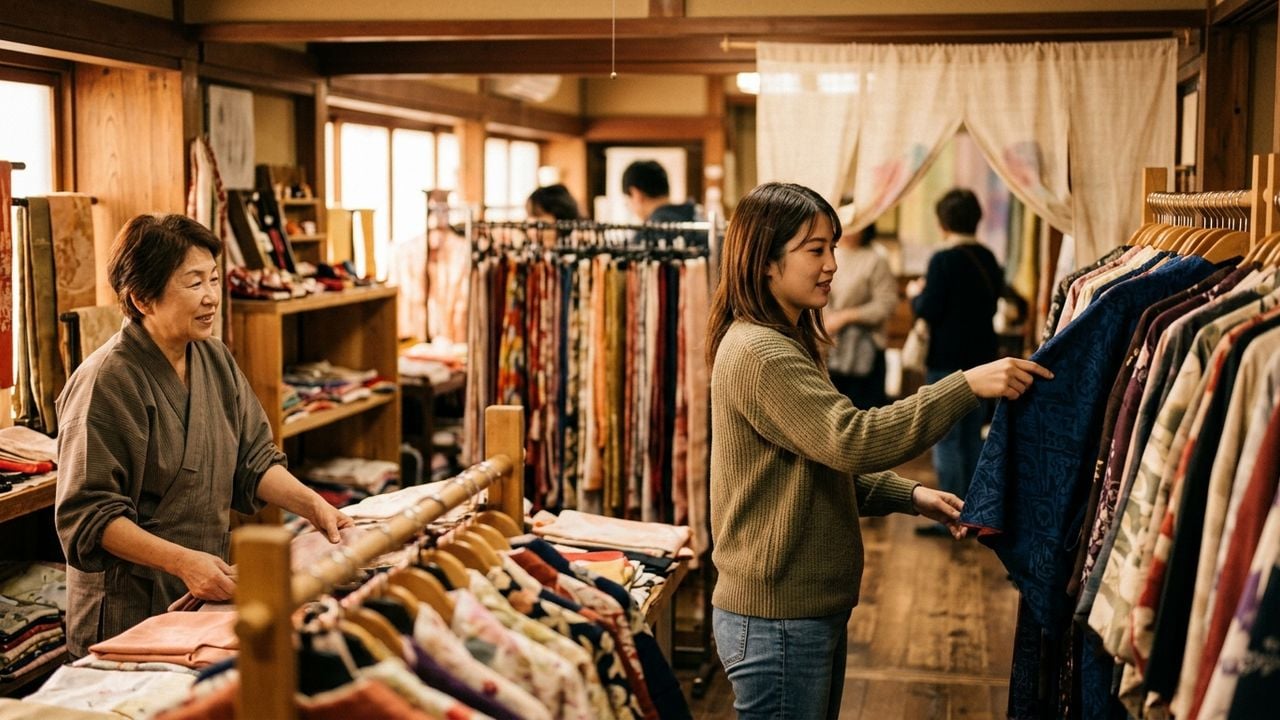
The kimono rental infrastructure in Osu has grown considerably in recent years, with shops offering English support and same-day rentals. The district's walkability means you can move fluidly between Osu Kannon Temple, the covered shopping streets, and quieter back lanes without needing taxis or subway transfers. For photographers — whether you've hired someone or are shooting with a friend — the variety of backdrops within a small area gives you far more flexibility than a single temple visit allows.
If you're weighing specific spots and want a closer look at how Osu's photography locations compare with Kyoto's most famous sites, this side-by-side comparison of Osu and Kyoto kimono photo locations breaks it down in more detail.
✓ Key Takeaways
- Kyoto offers timeless, polished visuals — ideal for first-time visitors wanting the classic Japan aesthetic.
- Osu offers contrast and surprise — a living district where kimono meets subculture, creating content that genuinely stands out.
- The best choice depends less on budget or logistics and more on what kind of story you want to bring home.
The guest quoted above — the one who ranked Horai Wagyu above Kobe and Matsusaka — almost didn't make it because the 10 daily bowls had sold out by the time she arrived on a walk-in visit. If your Osu day is built around creating a story worth telling, the lunch chapter is too important to leave to chance. Securing a reservation in advance means the wagyu story is already written into your day before you even board the subway.
The Story Layer: What You Can Actually Tell People
Here's the part that I think travelers underestimate when choosing between destinations: what happens after you post the photo.
When your followers ask "Where was that taken?", a Kyoto answer is instantly understood — beautiful, expected, contextualized. An Osu answer opens a conversation: It's this incredible district in Nagoya that mixes Buddhist temples with anime shops. I had no idea it existed until I went. And if your day in Osu also included something like lunch at Itadaki — where the wagyu gyudon comes with a story about 300 cattle raised annually on sake lees from a single renowned brewery — the narrative keeps building in ways a Kyoto temple visit rarely produces.
One guest put it this way after trying our Horai Wagyu:
"I've had Kobe beef and Matsusaka beef, but Horai Wagyu at Itadaki was on another level."
Guest, international visitor to Nagoya
That's not just a food review — it's a line worth repeating at dinner parties for years. And it came from a lunch that almost didn't happen, because the guest had originally planned to skip Nagoya entirely. The combination of Osu's visual energy, kimono photographs in an unexpected setting, and a genuinely rare culinary discovery created a single day that became the unexpected highlight of an entire Japan trip.
If you're curious about how other visitors have built that kind of layered Osu day, this account of one traveler's kimono day in Osu, including a lunch at Itadaki, gives a real sense of how the pieces fit together.
Practical Comparison: Planning Your Day
Beyond the aesthetic and narrative differences, there are real logistical considerations worth comparing honestly.
Travel time and cost: Getting to central Kyoto from Nagoya by Shinkansen takes about 35 minutes and is convenient, but adds meaningful cost to a single-day outing. Osu is within 10 minutes of Nagoya Station by subway, making it an easy half-day or full-day addition to a Nagoya stay without the transit overhead.
Crowds and timing: In September, Kyoto is moving into its shoulder season before the autumn color rush — manageable, but popular spots fill quickly on weekends. Osu, being less on the standard international tourist circuit, tends to offer more breathing room, which matters when you're trying to get clean shots in kimono without crowds photobombing every frame.
Same-day flexibility: Kyoto rewards early starts and advance planning. Osu rewards spontaneity. Kimono rentals, lunch, and photography can all be arranged on the day without the logistical anxiety that comes with peak Kyoto timing.
For whom each works best:
- If this is your first trip to Japan and you haven't experienced Kyoto yet — go to Kyoto. It earns its place on every list for good reason.
- If you've already done Kyoto and want content that tells a different story — Osu is the sharper choice.
- If you're staying in Nagoya and have one free afternoon — Osu is an easy yes, and Kyoto doesn't need to factor in at all.
- If maximizing content variety in a single trip matters to you — doing both, in that order, gives you genuine contrast worth showing.
For a closer look at what specifically makes Osu work for photographers choosing it over Kyoto, this piece on why kimono photographers are choosing Osu goes deeper into the visual and logistical reasons.
Building the Day That Becomes the Story
The travelers who leave Osu with the richest content tend to approach the day with a loose structure rather than a rigid itinerary. Start at Osu Kannon Temple in the morning before the shopping streets fill up. Move through the covered arcade in kimono — the covered roof means weather rarely disrupts plans, which is a genuine advantage over outdoor temple visits. Let the shooting happen organically. Then, when hunger arrives, treat lunch not as a break from the experience but as the next chapter of it.
That's the mindset shift that separates a good day from an unforgettable one. A visually stunning photo and an ingredient story that nobody back home has heard of — those two things together are what make people stop scrolling.
Itadaki is open for lunch on Saturdays, Sundays, Mondays, and Tuesdays (11:00–15:00), and is a four-minute walk from Yabacho Station Exit 4. Our Horai Wagyu gyudon is limited to 10 bowls per day, so if you're planning your Osu day around it, a reservation via Tabelog is the reliable way to secure your bowl before the day begins.
For our complete menu, access details, and store information, visit our official page at https://itadaki8.com/english/
You've weighed Osu against Kyoto and you know which kind of story you want to come home with — now the question is whether that story includes a bowl of Horai Wagyu that only 300 cattle a year make possible. Reservations for Itadaki are handled through Tabelog, and with only 10 Horai Wagyu bowls available each service, booking ahead is the one step that makes the rest of the day feel easy.