Comparing Kimono Photo Spots in Osu With Traditional Kyoto Sites
 gotowp
You've probably stood in front of a Kyoto shrine in a rented kimono, waited for the crowd to part just long enough to take one clean photo, and wondered if there was a better way. Or maybe Kyoto is already on your itinerary for a different day, and you're trying to figure out what Nagoya actually offers for a kimono experience. You're not alone. This is one of the most common questions I hear from travelers who find their way to Osu.
I'm Masayuki Goto, founder of Itadaki in Osu, Nagoya. I spend a lot of time thinking about what makes a travel experience genuinely unforgettable rather than just visually satisfying. That obsession — partly professional, partly just who I am — is something I carry into my own days off, too. When I'm not at the restaurant, I'm usually exploring other neighborhoods, eating somewhere new, or watching basketball at IG Arena. But some of my most grounding off-days start with a quiet walk through Osu's older streets, and that's honestly where this comparison begins.
Who This Is For
- ✅ Travelers who want a kimono photo experience that feels authentic rather than staged or overcrowded
- ✅ Repeat Japan visitors who have already explored Kyoto and are looking for something genuinely different in Nagoya
- ✅ Visitors combining Osu sightseeing with a memorable lunch as part of their Nagoya itinerary
- ✅ Anyone planning a full-day Osu experience and wondering how to make it truly once-in-a-lifetime
- ✅ Travelers who want to understand what makes Osu distinct — not just as a backup to Kyoto, but as a destination worth choosing on its own terms
What Kyoto Gives You — and What It Can't
Let's be honest about Kyoto first. Fushimi Inari, Gion, Arashiyama — these are genuinely beautiful places to wear a kimono. The architecture, the history, and the visual coherence of the cityscape make Kyoto one of the most photographed places on earth for good reason. If your priority is a postcard-perfect image in front of a torii gate, Kyoto delivers.
But there are trade-offs that repeat visitors know well. Popular kimono photo spots in Kyoto — particularly in Gion and around Kiyomizudera — have become genuinely crowded at peak hours. Some of Gion's most famous alleys now have signage asking visitors in kimono to refrain from entering residential streets entirely, a reflection of the real friction that mass tourism creates in historic neighborhoods. Waiting for a crowd-free shot can mean waking at dawn or accepting that your photo will include dozens of other tourists in the frame.
None of this makes Kyoto less beautiful. But it does raise a question: what if the most memorable photo — and the most memorable day — isn't in the most famous location?
You're weighing Osu against Kyoto for the day, which means you're already thinking about more than just photos — you're thinking about how the whole day fits together. Our monthly business calendar tells you exactly which dates we're open so you can build your Osu day around a confirmed lunch slot. One quick check saves you the frustration of planning around a closed day.
Osu's Quiet Advantage: Contrast as Character
What Osu offers for kimono photos isn't the same as what Kyoto offers. And that difference is precisely the point.
Osu's appeal as a kimono backdrop comes from its layered, contradictory character. You can photograph in front of Osu Kannon Temple — one of Central Japan's most important Buddhist sites, with centuries of history — and then turn a corner into a street lined with vintage clothing stores, anime shops, and Taiwanese street food stalls. The juxtaposition is genuinely Osu. A kimono against that backdrop tells a completely different visual story from a kimono against a Kyoto lantern-lit alley.
I walk through Shikemichi (四間道) on some of my days off — a preserved Edo-period merchant district near Nagoya Station, with 300-year-old warehouses and rooftop shrines called "Yanegami-sama" that you'll find nowhere else in Japan. It's the kind of place that foreign visitors almost never discover on a first trip, but that repeat travelers remember for years. The cobblestone streets there are genuinely quiet. A kimono photo in Shikemichi tells a story that even most Japanese people from outside Nagoya wouldn't recognize — and that rarity has its own value.
For visitors who enjoy the reasons kimono photographers are increasingly choosing Osu over Kyoto, the district's approachability is a significant part of the draw. Osu doesn't require you to navigate around crowds to find an authentic moment.
✓ Key Takeaways
- Kyoto's iconic kimono spots are stunning but increasingly managed around crowd control — the experience is less spontaneous than it once was.
- Osu offers visual contrast (temple + subculture street) and quieter alternatives like Shikemichi that reward visitors willing to look slightly off the main path.
- For repeat Japan travelers, Osu's distinctiveness is a feature, not a compromise.
The Horai Wagyu you just read about — 300 heads per year, fed on sake lees, available only at lunch — is limited to 10 bowls each day we're open. If your Osu kimono day is already taking shape in your mind, locking in the Horai Wagyu bowl now is the one step that makes the whole experience certain rather than hopeful. Reservation is through Tabelog Online, fully available in English.
The Afternoon After the Photos: Why Lunch Matters More Than You Think
Here's something I've thought about a lot — both as someone who explores restaurants constantly on days off and as someone who runs one. A travel day has a rhythm, and the meal you choose for lunch often defines how you remember the whole day. A forgettable lunch in a beautiful location still leaves you feeling like something was missing.
Kyoto has extraordinary restaurants, but the challenge is the same as the kimono spots: the most well-known places require advance planning, and the ones near the most popular photo locations are often priced for tourists and designed for volume. You know the type.
Osu has a different dynamic. Its food scene is genuinely local — dense, opinionated, and full of specialty shops that exist because Nagoya residents love them, not because tour buses stop nearby. That environment is exactly what I wanted when I opened Itadaki: a restaurant where the dish itself tells a story worth sharing, in a neighborhood where discovery still feels real.
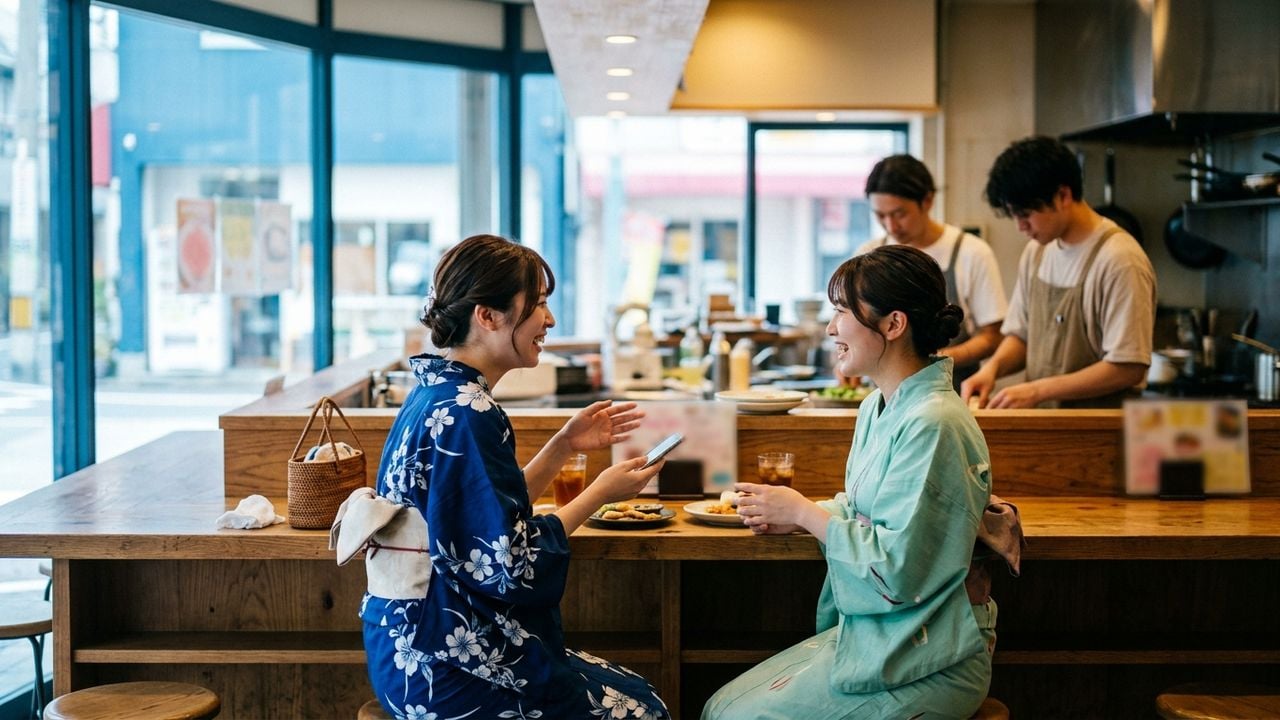
Pairing a kimono walk through Osu with the most photogenic Osu spots and their nearby lunch options is one way to plan a genuinely full day in Nagoya — one that holds together from the first photo to the last bite.
"The staff were welcoming and made us feel at home even without perfect Japanese."
— Guest review
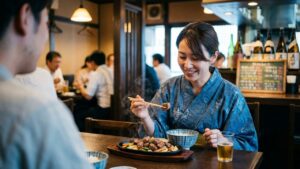
That comment stays with me. It reflects something I care about deeply: genuine hospitality doesn't require a common language. When someone arrives at Itadaki in a kimono after a morning exploring Osu Kannon and the surrounding streets, they're already in a particular kind of mood — open, curious, looking for something that matches the spirit of the day. That's the visitor I most want to cook for.
What Makes an Experience Truly Once-in-a-Lifetime
I travel internationally whenever I can. One thing I've learned from eating in many different countries is that the most memorable meals aren't always in the most famous restaurants. They're the ones where the concept, the ingredient, and the setting all come together into something you can't find anywhere else — and where you leave with a story, not just a full stomach.
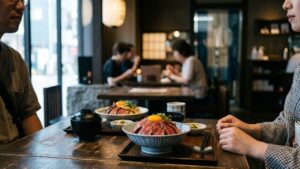
That principle is what Itadaki is built on. The Rare Wagyu Gyudon we serve here — particularly the version featuring Horai Wagyu from Okumikawa, Aichi — exists because no one had done it before. Among roughly 500,000 wagyu cattle raised in Japan each year, Horai Wagyu accounts for just 300 heads annually, produced by three farms using a feeding method that incorporates sake lees from Horaisen Sora, a renowned local premium sake. We created a proprietary two-stage cooking technique that delivers a rare texture while meeting Japan's strict food safety standards — something that took genuine development to achieve.
The result is a bowl that carries a story you'll actually want to tell. Not "I had wagyu in Japan" — but something specific: the name of the beef, the region it came from, the technique behind how it was prepared, and the moment you understood why it was different from anything else you'd eaten. That narrative is what turns a lunch into something once-in-a-lifetime.
For anyone building a Japan trip around authentic, singular discoveries — whether that's a kimono photo in a neighborhood that Kyoto tourists have never heard of, or a beef bowl concept invented in Osu in 2022 — the logic is the same: the story you carry home matters as much as the experience itself.
If you're comparing notes on how a Nagoya day trip stacks up against more familiar destinations, this look at Nagoya's samurai history versus Kyoto's might give you more context for planning your full itinerary.
Planning Your Osu Day: A Few Practical Notes
Kimono rental shops are available within the Osu district, and the shopping street is fully walkable in traditional dress — the area is cosplay-friendly by local culture, and kimono visitors fit right in. Osu Kannon Temple is a natural starting point; the surrounding shotengai (shopping arcade) offers plenty of texture for photos.
Itadaki is located at 4-1-20 Osu, 2nd floor, a 4-minute walk from Yabacho Station Exit 4 on the Meijo Subway Line. We're open for lunch on Saturdays, Sundays, Mondays, and Tuesdays (11:00–15:00), with public holiday hours beginning at 9:00. Our Horai Wagyu Rare Gyudon is strictly limited to 10 bowls daily, and we recommend reserving in advance via Tabelog — when you do, paste 鳳来牛希望 into the notes field to request Horai Wagyu specifically. For walk-in guests, the Mikawa Beef Rare Gyudon is always available and prepared with the same technique.
Our menu is available in English, Simplified Chinese, and Korean, with a visual five-step guide that walks you through how to enjoy the dish — so no Japanese is required to have the full experience.
For our complete menu, access details, and store information, visit our official page at https://itadaki8.com/english/
Osu and Kyoto aren't in competition. They're simply different kinds of days. But if you've already seen Kyoto — or if you want your Nagoya afternoon to be something no one else in your travel group has done — Osu offers a version of Japan that rewards the decision to look a little further.
A kimono walk through Osu and a bowl of the Original Rare Wagyu Gyudon — that's a Nagoya afternoon with a story attached to every part of it. The Horai Wagyu sells out on busy days, and your travel window in Japan is fixed. Securing your reservation now means you arrive knowing exactly what's waiting for you.